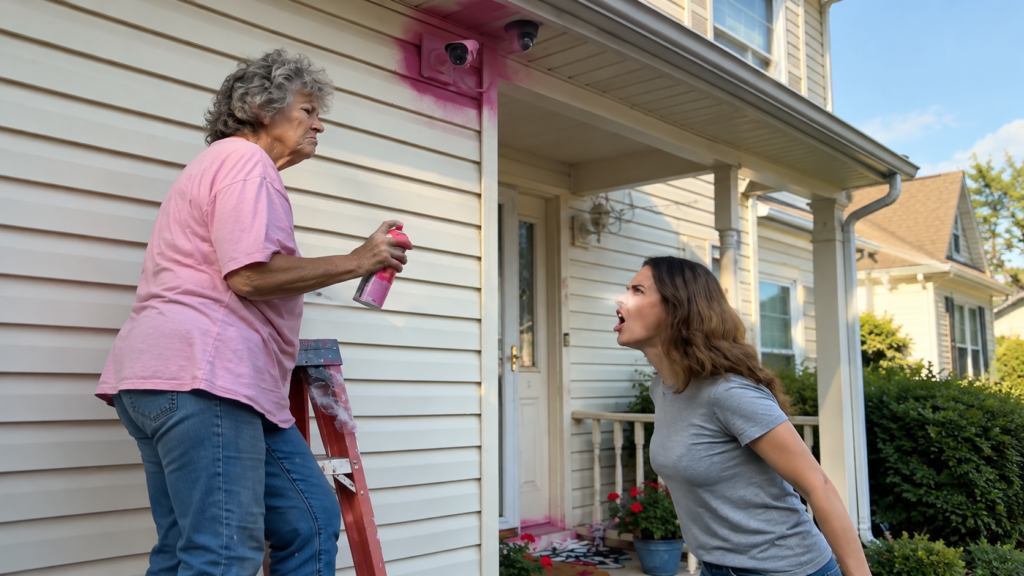
The first pink streak struck the camera housing just above the front porch.
From the top of her red aluminum ladder, Evelyn Rusk leaned toward the eave and pressed the nozzle again. Paint scattered across the white siding in a wet fan. She had chosen the color deliberately. It was impossible to mistake for dirt, a shadow, or a malfunction. By the time anyone noticed, the camera would be useless for the evening.
The front door opened beneath her.
Mara Bellamy stepped onto the porch carrying a travel mug and stopped so abruptly that coffee splashed across her wrist. She was thirty-two, still wearing the blue work shirt of the neighborhood fabrication studio where she’d spent the previous night repairing a display. For a moment she only stared.
“What are you doing?”
Evelyn kept the can in her hand. “It’s none of your business.”
“You’re spraying my security camera.”
“I can see where I’m spraying.”
“Then please explain why.”
Evelyn looked down without moving a foot off the ladder. Her pale hair had escaped its clip; pink dots decorated her gardening gloves. She was sixty-eight and had lived three doors away since before Mara was born. She had taught dozens of children to ride bicycles and had once rescued a runaway grocery cart before it rolled into traffic. Now she looked ready to argue with the entire street.
“Take that thing down,” Evelyn said.
“The ladder?”
“The camera.”
“Not until you tell me why you’re destroying it.”
Evelyn’s jaw hardened. “Some people put eyes everywhere and think that makes them the owner of whatever those eyes can see.”
Mara glanced at the driveway. Her father’s battered tool case sat behind the hedge where she’d left it the night before. She remembered the small object she’d found while looking for a hex key. Reaching into her pocket, she drew out a ring of keys with a bright blue plastic fob.
Evelyn stopped breathing for a beat.
The can tilted in her hand. Pink paint dripped from the nozzle onto the step below.
“Where did you get that?” Evelyn asked.
“In a box I was given yesterday.”
“Who gave you the box?”
“My dad. He thought it belonged to the old theater.”
Evelyn descended two rungs too quickly. Mara grabbed the ladder to steady it.
“Don’t touch me,” Evelyn snapped, although Mara hadn’t.
“Fine. But don’t fall on my porch.”
Evelyn climbed down more carefully. Up close, her expression was no longer defiant. It was frightened, but also searching, as if a familiar tune had begun playing in the wrong room.
“Blue fob,” she murmured. “With the bite out of the corner.”
Mara turned it in her palm. A crescent-shaped notch marked the plastic. “You recognize it.”
Evelyn glanced past her, through the open doorway, where strips of painted cardboard and aluminum framework leaned against the hallway wall.
“Did it come with a little silver drive?” she asked.
“Maybe.”
“Do not plug it into a computer.”
That warning, delivered with such precise terror, made Mara forget her coffee-stained wrist.
“Why?”
Evelyn looked toward the end of Juniper Lane. Parked beneath the distant maple trees was a long white delivery van with no lettering. It had been there for three days, waiting for the neighborhood’s annual Lantern Walk. That alone wasn’t strange. The company operating this year’s attraction had been unloading supplies since Monday.
But Evelyn watched the van as if she expected it to move.
“Because,” she said, “somebody has spent twenty years waiting for that little drive to show up.”
Before Mara could reply, a side door on the van slid open. A man in a mustard-yellow jacket stepped out and raised a phone to his ear.
Evelyn thrust the paint can into Mara’s hands.
“Put the ladder away,” she whispered. “And whatever you do, don’t tell anyone you found the blue key.”
Then she walked down the path so quickly that she left her red ladder standing against Mara’s house.
***
There were two versions of the Lantern Walk in Alderbrook.
The public one involved paper lanterns, warm cider, children carrying homemade stars, and a loop through six residential streets. The private one had existed in Evelyn Rusk’s garage for twenty-three years: a sprawling, extraordinary collection of moving shadow figures, mirror wheels, collapsible arches, and handmade mechanisms that could transform an ordinary cul-de-sac into an enchanted city for exactly eighteen minutes.
When Mara was nine, Evelyn had been the undisputed master of that city. She’d built clockwork fish that appeared to swim through windows. She’d made a cardboard moon split into four silver petals. Every fall, children crowded around her workbench to watch her make something impossible from springs, hinges, and scrap wood.
Then, fourteen years earlier, the mechanical parade stopped. Nobody knew why. Evelyn closed the garage. The Lantern Walk continued with ordinary decorations, and people eventually forgot what they’d lost.
Now a regional entertainment company, Brightline Experiences, had offered to revive the old parade for Alderbrook’s centennial celebration. The council accepted before anyone could object. Brightline’s creative director, Julian Pike, circulated glossy pictures of illuminated puppets, moving arches, and an enormous walking swan. The concept looked uncannily like Evelyn’s old work.
Mara had been hired for a modest fee to help with structural checks and to train the volunteer operators. It was her first paid community project after returning to town. Her father, Gabriel, had quietly slipped her the old theater tool case, insisting it contained useful spare fasteners. Mara suspected he was mostly trying to get her to spend time out of her apartment.
Inside the case she found the blue key fob, a tiny silver USB drive, and a label written in faded block capitals: FINAL NIGHT / NOT FOR SHOW.
At first she thought the drive contained obsolete music cues. She’d left it untouched because she had a hundred more immediate problems, including a broken pivot on a paper dragon.
Now the label had become difficult to ignore.
She called her father from the kitchen. He answered over the noise of a lawn mower.
“Did you know Evelyn Rusk owned that blue fob?”
Silence.
“Dad?”
“Where are you?”
“Home.”
“Stay there. I’ll come by.”
“Why is everyone acting like I found a live grenade?”
“Because I thought that box had been emptied years ago.”
He hung up.
Mara looked through the living room window. Evelyn’s red ladder still leaned against the house, its top splattered pink. Children riding past slowed to look at the ruined camera. Across the street, Mrs. Keene lifted her phone and took a photograph.
By noon the photograph would be on the neighborhood message board. By evening everyone would have a theory. Mara needed a better one.
She carried the tool case to her workshop in the detached garage and examined the USB drive. It was no larger than her thumbnail, with scratches on the metal sheath. Someone had attached a thin cord of blue thread through its loop. The fob had a printed number beneath the notch: 04.
A knock interrupted her.
On the step stood Leon Price, seventeen, holding two cartons of donated fabric. He was one of the student volunteers building the centennial parade, a patient, soft-spoken young man with exceptional mechanical instincts and a tendency to apologize to objects when he dropped them.
“Brightline wants the rear wheels by four,” he said. “Also, somebody painted your camera.”
“News travels.”
“Mrs. Keene made a poll. Thirty-nine people think it’s a protest against surveillance.”
“What’s the other option?”
“That she’s just mad.”
Mara put down the drive. “Leon, have you seen the white Brightline van on the corner?”
“Sure. They keep some of the parade parts in it.”
“Who has access?”
“Julian, his assistant, and a contractor named Ellis. Why?”
“Do you know what they’re loading tonight?”
Leon’s cheerful expression slipped. “I thought you did.”
“Loading what?”
“They brought in the old moving floor.”
Mara stared at him. “What moving floor?”
“The one with all the little trap panels. Julian says it’s from the original show.”
She had inspected every item on Brightline’s official safety list. No moving floor appeared anywhere in it.
“Where did they put it?”
“Inside the school gym. It’s covered with a green tarp.”
Mara reached for her car keys. Outside, a boy pointed toward the pink camera and shouted something about a crime scene.
She’d expected the worst part of her day to be repainting white siding. That now seemed laughably optimistic.
***
The school gym smelled of floor polish and orange-peel cleaner. Plastic lanterns hung from the basketball hoops. Volunteers worked along the bleachers while Julian Pike stood beside a green tarp, charming two council members with a demonstration on his tablet.
Julian was forty-five, impeccably groomed, and wore mustard-yellow jackets in all weather. He had a stage presenter’s gift for making every question seem like the exciting prelude to his own answer.
“Mara!” he called. “Our structural guardian arrives.”
“What is under the tarp?” she asked.
“A surprise.”
“Surprises don’t belong under a volunteer safety plan.”











