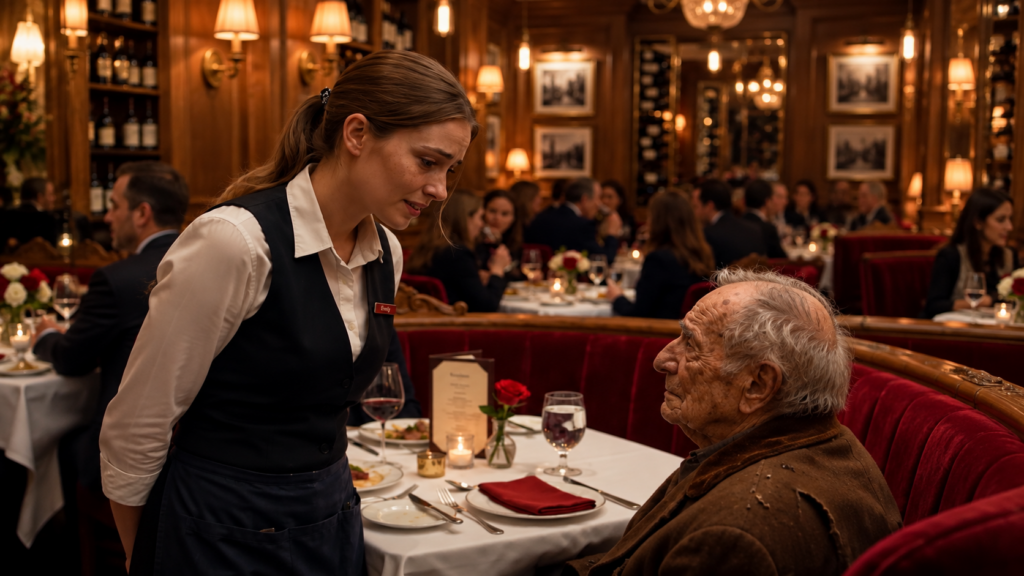
Emily Carter knew that a restaurant could tell a lie without speaking a word.
The tall windows of the Halcyon Room reflected the city like a promise that nothing ugly could happen behind the glass.
There were white roses on every table and linen napkins folded into the shape of small sailing boats.
A pianist played softly beneath a painted ceiling, while the dining room captain moved between tables as if he were conducting an orchestra.
Outside, on the other side of the revolving door, a delivery cyclist was arguing with a taxi driver in the rain.
Inside, a woman complained because the candle beside her plate was one shade darker than the other candles.
Emily had been working at the Halcyon Room for fourteen months, long enough to know which complaints required an apology and which required a manager to invent an apology grand enough to impress the complaining customer.
She was twenty-four, recently promoted from breakfast service, and still trying to earn enough money to pay for the dental work her mother had postponed for years.
The promotion had come with longer hours, shorter breaks, and a uniform made of fabric that showed every drop of water.
At six forty-five, her supervisor, Conrad Pike, caught her checking the time beside the service station.
“Your section is not a clock-watching section,” he said.
“I was checking when table eighteen’s soufflé should come out,” Emily replied.
“Then keep your eyes on the kitchen door and your opinions to yourself.”
Conrad had a narrow face and an ability to smile without appearing pleased.
He had spent the afternoon preparing for a private event that would begin after the public dinner service.
A discreet notice at the entrance said the restaurant would close early for a special presentation called The Thirteenth Course.
Nobody on the service team knew what the presentation involved, although the kitchen had received crates of theatrical equipment and a pair of strangers had been measuring the distance between the tables.
The staff had been told to work as usual and avoid asking questions.
At seven ten, a man in a brown coat entered through the revolving door.
He was thin and tall, with a soft gray scarf wrapped twice around his neck.
Rainwater darkened the shoulders of his coat, and his right hand trembled when he took off his hat.
The hostess looked from the man to the reservations screen.
“Do you have a booking?” she asked.
“No,” he replied. “I was hoping for a quiet corner and something warm.”
“Our dinner service begins at ninety dollars per person before beverages.”
“I see.”
The man looked down at his polished but worn shoes.
“Could I sit for a moment while I decide?”
The hostess glanced at Conrad.
Conrad lifted two fingers, an impatient gesture that meant she could seat him where he would not be seen from the entrance.
She led him to table twenty-two, a small table beside a decorative screen.
Emily noticed him because he thanked the hostess as if she had done him an extraordinary favor.
She brought water and a menu.
“Would you prefer still or sparkling?” she asked.
“Whichever doesn’t cost extra,” he said with a little smile.
Emily filled his glass from the carafe in her hand.
The man opened the menu, looked at the prices, and closed it again.
His hand trembled when he set it down.
“Is everything all right?” Emily asked.
“Everything except my timing,” he said. “I seem to have arrived at the wrong place with the wrong wallet.”
“Would you like me to see whether the kitchen has soup?”
“I can’t afford anything here.”
The words were quiet,
but he said them plainly.
Emily thought of her mother, who sometimes claimed she had eaten lunch so that Emily would take the last bowl of rice.
She knew the difference between a diner fishing for a free meal and a person trying to disappear before anyone noticed his hunger.
“I have an employee meal I haven’t touched,” she said.
“That belongs to you.”
“And it’s mine to share.”
She brought him a bowl of lentil soup, a piece of bread, and the roast vegetables the kitchen staff had eaten during their break.
The food was simple but hot.
The man looked at the bowl for a long moment before lifting his spoon.
“You have no idea what that means,” he said.
“It means you should eat while it’s warm,” Emily replied.
Across the room, Victoria Langford was watching.
Victoria was seated at table four beneath a crystal chandelier, accompanied by a young man whose expression suggested he had learned to agree before understanding what he was agreeing to.
She had purchased the restaurant’s entire private salon for a charity supper the previous month, and Conrad treated her as though she owned the sidewalk outside.
Tonight, she wore a green silk jacket and a necklace of dark stones that looked almost black under the lamps.
She had been waiting ten minutes for her second course.
When she saw Emily place the soup in front of the old man, she raised her glass and tapped it with a spoon.
The tiny sound cut cleanly through the music.
“Miss,” Victoria called.
Emily approached.
“Why is that man being served before me?”
“Your course is being finished now, ma’am.”
“I saw you bring him food from the kitchen.”
“He was hungry.”
“We are all hungry in a restaurant,” Victoria said, glancing around for approval.
No one laughed.
“I apologize for the delay,” Emily said. “Your order is next.
”
“Do you understand the difference between him and me?”
Emily hesitated.
“You both came here to eat.”
Victoria’s eyes widened.
“You made me wait for him?”
“He needed something warm, and his food was already prepared.”
“You will apologize for that answer.”
“I’m sorry your course has taken longer than expected.”
“That is not what I asked.”
Victoria stood so abruptly that her chair scraped across the marble floor.
She picked up the water glass and threw its contents into Emily’s face.
The water struck her left eye and ran down her collar.
Several diners gasped.
Someone at the nearest table pushed back a chair,
but nobody stood.
Emily remained motionless, too stunned to move her hands.
Conrad arrived as though summoned by the sound of expensive glass hitting wood.
He took in Victoria’s empty glass, Emily’s soaked uniform, and the eyes turning toward them.
“Miss Langford, I am deeply sorry,” he said.
Emily looked at him.
“She threw water at me.”
“Emily, step away from the table.”
“I didn’t touch her.”
“You have created a disturbance in the dining room,” Conrad said.
Victoria folded her arms.
“At least someone understands hospitality.”
Conrad faced Emily, speaking loudly enough for the nearby tables to hear.
“Remove your apron and leave the premises.”
“You’re firing me for feeding someone?”
“You’re being dismissed for insubordination.”
Emily could feel water dripping from her hair onto the carpet.
She untied her apron, folded it once, and laid it on the service station.
Her fingers were shaking, but she refused to wipe her face until she was out of Victoria’s sight.
At table twenty-two, the elderly man stood.
He had finished only half his soup.
“Conrad,” he said.
The manager turned, annoyed that the man knew his name.
“Sir, please remain seated.”
“You have made an extraordinary mistake.”
“I will attend to you in a moment.”
“You don’t have a moment,” the man said.
He reached into his coat and took out a slim black phone.
He dialed a number without looking at the screen.
When a woman answered, his voice became crisp and assured.
“Mara, I’m in the Halcyon Room,” he said. “Bring the company upstairs. No entrance cue. Come through the front door.”
He listened to the response.
“Yes,” he added. “All of them. Right now.”
Conrad stopped walking.
Victoria lowered her glass.
Emily looked from one face to the other, suddenly aware that the name Mara meant something to the manager.
The elderly man put away the phone and turned toward her.
“My name is Walter Finch,” he said. “Please don’t leave yet.”
CHAPTER TWO — THE COMPANY
Emily had never heard Walter Finch’s name before, but Conrad looked as if someone had removed the floor beneath his shoes.
“Mr. Finch,” he said in a voice nothing like the one he had used with Emily, “this is an unfortunate misunderstanding.”
“What part did you misunderstand?” Walter asked.
“The situation became emotional.”
“It became wet,” Walter replied. “The emotion came afterward.”
Victoria straightened her jacket.
“Who is this man?”
Conrad hesitated, and the pause interested everyone at her table.
“Mr. Finch is involved in this evening’s special program.”
“Involved how?” Victoria demanded.
Walter did not answer her.
He looked toward Emily, who was standing with her hands hanging uselessly at her sides.
“Will you take a seat?” he asked.
“I’ve just been told to leave.”
“Then consider it an invitation from another guest.”
Emily sat at the nearest unoccupied table because her knees had started to feel unreliable.
A young busser named Luis brought her a dry towel without being asked.
She pressed it to her face and whispered thanks.











