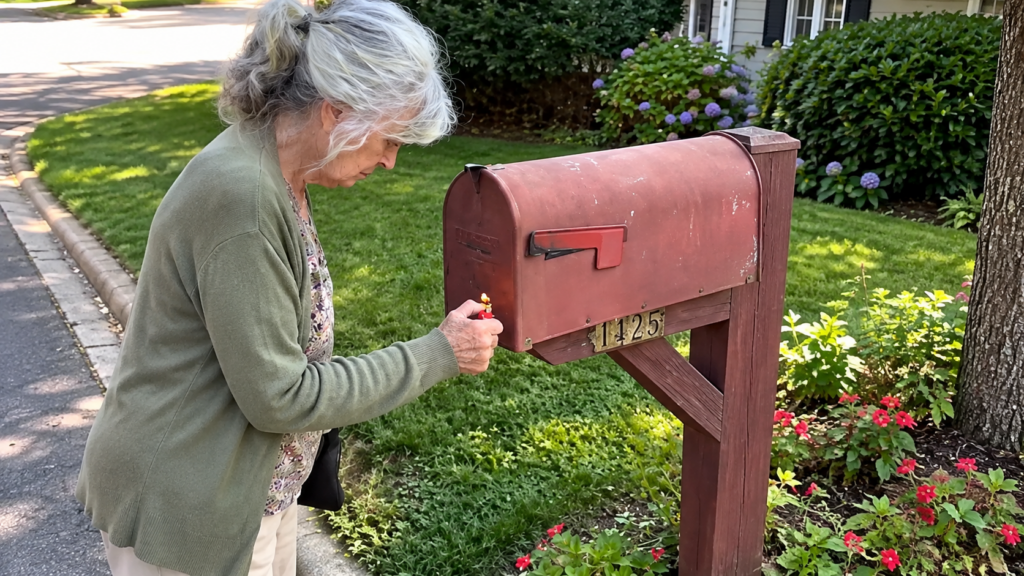
The first thing Owen Mercer noticed was the smell. He had been carrying a basket of laundry through his front hall when a bitter ribbon of smoke slipped beneath the weather stripping. At first he blamed someone burning leaves, although that was prohibited in Briar Glen. Then orange light jumped against the frosted glass beside his front door.
He put down the basket and looked out. His red mailbox was burning.
Five minutes earlier, Mrs. Etta Voss had walked along the edge of his lawn wearing her dark green raincoat despite the warm afternoon. She had paused at the roadside, bent toward the mailbox, and gone away with the deliberate pace of somebody refusing to hurry. Owen had seen only the last few seconds through his kitchen window. He had thought she was leaving another complaint about his garden. Etta had opinions about everything on Juniper Lane, from the height of hedges to which color of bunting belonged at neighborhood celebrations.
Now flame boiled through the mailbox door. Owen stepped onto the porch and felt the heat even from the path. He started toward the curb before a sharp metallic pop stopped him. The mailbox lurched sideways on its post. He backed away and shouted for his neighbor to call the fire department. A passing cyclist had already stopped and pulled out a phone.
The grass around the post smoked. A piece of something pale rested just beyond the scorched patch, and Owen nearly stepped on it as he retreated. It was a rectangle of heavy card, curled at one corner but untouched by flame. A thin brushstroke of cobalt blue crossed it, followed by a narrow line of yellow.
Owen knew those colors. He had spent the last month mixing them for a restoration project at Briar Glen’s old public bathhouse, which had been converted into a community arts hall. The project was supposed to culminate on Saturday, only three days away, in a celebration called the Wall of First Hands. Dozens of artists were repainting a twenty-foot mural that had disappeared behind generations of advertising boards. The colors on the card were the colors of the mural’s original sky.
He crouched without touching the card. Someone had written two words across the visible corner: FOR OWEN.
A voice behind him said, “Don’t go closer.”
It was Mara Solis, his neighbor from two doors down. She had arrived carrying a garden hose, but she kept the nozzle pointed away from the fire, waiting for firefighters who knew what had started it. Owen told her what he had seen of Etta. Mara looked toward the neat white house at the bend, where every curtain was closed.
“That woman chairs the arts committee,” Mara said. “Why would she burn your mail?”
Owen had no answer. He stood watching firefighters arrive, set down equipment, and extinguish the blaze. Black water ran into the gutter. The captain asked everyone to stay back while her crew checked the post and the surrounding ground. Owen gave a statement without guessing about motives. The cyclist said he had seen an older woman leaving the curb. A delivery driver remembered a green coat.
When the firefighters finally lifted the damaged box away, Owen saw another object at its base: a tiny ceramic tile shaped like a moth, its wings painted blue and yellow. It had been tucked between the post and the soil, not burned with the mail. Its surface carried a fingerprint pressed into wet clay, exaggerated enough to remain visible after firing.
He knew the tile too. Twenty-seven years ago he had helped his father unload crates at the bathhouse for an exhibition that never opened. The artist had made ceramic moths to mark where visitors could touch the mural and feel its design. The exhibition had been canceled after a bitter public argument, and Owen had not seen one of those tiles since.
The artist’s name was Leona Bell.
On Saturday, Etta Voss planned to unveil a restored mural credited entirely to herself. The program had been printed. The mayor had been invited. Every volunteer, including Owen, had been told the name Leona Bell was a rumor best left undisturbed.
Owen looked from the rescued tile to the burned mailbox. For the first time since the flames appeared, he felt something other than anger. Someone had intended him to receive a message. Someone else had been willing to burn his property rather than let him read it.
He asked the captain whether the pale card could be collected safely. She said the crew would document the scene and tell him when it could be handled. Owen thanked her and waited. He did not call Etta. He wanted to know what the card had been doing beneath a burning mailbox before he asked the woman who had stopped beside it.
Across Juniper Lane, the blinds in Etta’s house moved once, then became still.
CHAPTER TWO: A WALL THAT REMEMBERED
The bathhouse smelled of plaster dust and oranges. Volunteers had brought citrus peels in paper bags because Mara claimed the smell made long painting sessions easier. Owen arrived shortly before sunset, still wearing the jeans that smelled of smoke. He found thirteen people working beneath tall windows while a radio played softly on a shelf.
At the far end, an enormous painted sky spread across the north wall. A woman in a yellow dress stood at its center, arms open, her body assembled from hundreds of small shapes: paintbrushes, bread loaves, gears, fish, leaves, sewing needles, bricks, and open palms. It was a portrait of work rather than a portrait of any one person. Owen had loved it since childhood.
“Your mailbox?” asked Niko Price, the restoration coordinator, when he saw Owen’s face.
“Destroyed. Somebody wanted to stop a letter arriving.”
Niko lowered his brush. “What letter?”
“I don’t know yet. But there’s a moth tile beside the post. Leona Bell made those, didn’t she?”
Niko looked toward the scaffolding, where Etta’s daughter-in-law Iris was arranging photographs for the opening display. His discomfort was small but unmistakable. “We agreed to keep discussions about attribution off the work floor until after Saturday.”
“Who agreed?”
“The committee. It doesn’t help the painters to argue about what happened before any of us were here.”
Owen glanced around at the volunteers. Two teenagers were repainting fish scales. A retired bricklayer was mixing plaster. Mara stood on a short ladder, using a narrow brush to repair the edge of a blue wing. Their labor deserved a truthful account of whose design they were bringing back.
“It was before some of us were here,” Owen said. “Not all.”
Niko rubbed his eyes. “Etta says she drafted the mural with temporary assistants. She says Leona helped with the tiles but quit before installation.”
“My father told me Leona drew the woman in the middle.”
“Your father wasn’t on the arts committee.”
“No. He drove the truck that carried the panels.”
Iris approached, her clipboard pressed to her chest. “Owen, everyone’s upset about the fire. But we cannot let a private dispute hijack opening week.”
Owen looked at the board beside her. A heading announced ETTA VOSS: THE VISION BEHIND THE WALL. Under it were photographs of Etta at an easel and quotations about generosity and collaboration. The story had been repeated so often that nobody seemed to notice the absence of the hands that had painted the original wall.
“Did you ever meet Leona?” he asked.
Iris hesitated. “No. She moved away long ago.”
“Then how do you know what she made?”
“Because Etta has been telling that story for decades.”
Owen picked up his jacket. The words were not malicious. They were worse in a quieter way: proof of how comfortably a story could harden without anyone testing it.
He left the hall and called his father, whose hearing had become unreliable but whose memory for places remained precise. Thomas Mercer answered after six rings. Owen told him about the red mailbox, the moth tile, and the blue-and-yellow card.
For a long time, Thomas said nothing. Then he asked, “Was the moth looking left or right?”
“Left. Why?”
“Because the ones looking left marked the places where Leona wanted children to put their hands. The other ones were just decorations.”
“Who would put one outside my house?”
“I don’t know. But if somebody wants you to look with your hands, there may be a reason.”
His father gave him an address near the rail station. “Try the old framing shop. Mrs. Renner kept Leona’s unused display pieces after the exhibition fell apart. If anyone knows whether she’s alive, it’ll be Alma.”
Owen thanked him and hung up. He stood beneath the mural for another minute. At the painted woman’s feet was a broad golden path that the committee had labeled THE ROAD TOGETHER. Owen recalled his father insisting it was not a road. Leona had painted a ribbon cut from a garment, a reminder that a city was made through mending as much as through construction.











