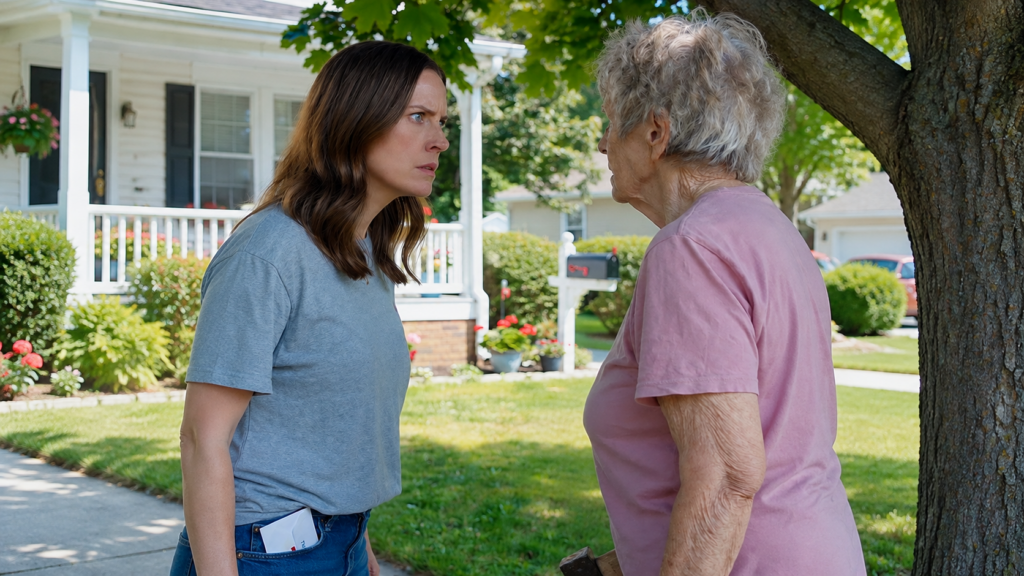
The first strike sounded like somebody hitting a wooden door with a shovel.
Megan Cole looked up from the dish she was drying and saw her maple tree jerk beside the walkway.
She was thirty-two years old, and she had owned the small yellow house on Alder Street for exactly eleven months.
The tree was the first thing she had loved about the place.
An older woman stood beneath its branches with a short-handled axe lifted over her shoulder.
Helen Brooks had lived two doors down for almost thirty years, and Megan knew her mostly from curt nods and an argument about where delivery drivers parked.
Helen swung again.
A pale splinter flew across the walkway.
Megan dropped the towel and ran through the front door.
“Stop!” she shouted.
Helen hit the trunk a third time before turning.
“That tree is on my property,” Megan said, stepping between the woman and the wound in the bark.
“It should never have been planted there,” Helen replied.
The axe hung at her side, but her grip remained tight.
Megan could see that Helen was shaking.
It would have been easier to understand if the older woman had looked angry.
Instead she kept glancing at the patch of ground between the trunk and the walkway.
“You don’t get to decide that,” Megan said.
Helen opened her mouth, then closed it.
Megan suddenly remembered the white envelope that had been pushed through her own mail slot yesterday afternoon.
It was addressed to Helen Brooks, but the courier had apparently mistaken the house number.
Megan had meant to walk it over after work.
Now the return address on the envelope came back to her with peculiar force.
THE HOLLOW STAGE CONSERVATION WORKSHOP, MERIDIAN, OHIO.
She reached into the back pocket of her jeans.
“This came for you yesterday,” she said.
Helen’s eyes fell on the envelope.
The change in her face was startling.
She let the axe touch the grass, took the letter, and stared at the printed address.
“Where did you get this?” she asked.
“I just told you.”
Helen tore the flap carefully, as if the paper might burn her fingers.
She read the first page.
A gust of wind pushed a red leaf across the driveway.
“They found the display?” she whispered.
Megan waited.
Helen read the next line, then put a hand against the tree to steady herself.
“They think I can lead them to it.”
“Lead who to what?”
Helen looked up at the house.
For the first time,
Megan noticed that the older woman’s canvas bag contained a small folding spade and a flashlight.
“There is something buried under your maple,” Helen said.
Megan looked at the fresh axe cuts.
“You could have knocked on my door.”
“I did not come here to ask for a favor.”
“Then why did you come?”
Helen folded the letter, avoiding Megan’s eyes.
“Because somebody is going to arrive for it before sunset, and I cannot let him have it.”
A white delivery van turned into Alder Street and slowed in front of the house.
Helen moved so quickly that Megan almost stepped backward.
“Please,” Helen said, “whatever you think of me, don’t tell that driver anything.”
The van continued past the driveway.
Neither woman spoke until it disappeared around the corner.
Then Megan took out her phone and photographed the damage to the trunk.
“Put the axe down,” she said.
Helen obeyed.
“Now tell me the truth.”
Helen looked at the cut tree, the envelope, and the narrow patch of soil she had been trying to reach.
“It starts with a theater that was small enough to carry in two suitcases,” she said.
CHAPTER TWO: A THEATER IN A SUITCASE
Megan had no intention of bringing Helen into the house.
She pulled two patio chairs into the front yard and kept the axe on the porch out of reach.
Helen sat as though she was waiting for a sentence to be passed.
“When I was nineteen,” she began, “I built little worlds for a company called Morrow & Finch.”
Megan frowned.
“Dollhouses?”
“Not exactly.”
Helen held her hands about a foot apart.
“They were miniature theaters with sliding scenery, tiny lamps, moving floors, and figures that performed without anyone touching them in front of the audience.”
Megan pictured a toy shop display.
Helen saw the mistake.
“Imagine a storm crossing a whole fishing village while you sit close enough to see every window light up.
”
“A model.”
“A performance,” Helen corrected.
“We spent months making one show last nine minutes.”
The company traveled between libraries, children’s hospitals, and community halls before miniature spectacles became fashionable again.
Its founder, Solomon Morrow, designed the mechanisms, but most of the painting and carving came from three young women.
Helen was one of them.
She spoke about her colleagues with an ease she had not shown in any previous conversation.
Iris Finch painted scenery so delicate that the windows in her houses appeared to hold real curtains.
Nadia Vale cut costumes from scraps of silk and made figures that could bend at the waist.
Helen built the miniature streets, staircases, and roofs.
“We made a show called The Last Lantern,” Helen said.
“What was it about?”
“A little town that keeps a lighthouse lit after the keeper leaves.”
Helen smiled faintly.
“The lighthouse was no taller than a coffee mug.”
“And it’s buried under my tree?”
“A part of it was.”
The smile disappeared.
Megan leaned forward.
“Why?”
Helen picked a loose thread from her sleeve.
“Because when the company broke apart, Solomon claimed everything we had made was his work.”
Megan had heard versions of that story from artists and designers she knew.
“So you took it back?”
“I took the only piece that could not be copied from a photograph.”
Helen described a narrow wooden platform containing a curved track and a rotating miniature harbor.
The ingenious part was a set of hand-carved cams shaped differently from ordinary machine components.
Once the mechanism turned, buildings moved at uneven intervals, making the whole town appear alive.
“He knew how to sketch it,” Helen said.
“He didn’t know how to make it work without Iris’s timing marks and Nadia’s balance weights.”
“What happened to the others?”
“We lost touch.”
There was something clipped about that answer.
Megan noticed, but she did not interrupt.
Helen explained that she had wrapped the components separately and placed them in a sealed tin beneath a young maple in the yard of the house where she lived in 1992.
The house had since been replaced, the lot subdivided, and the tree left standing near the new front walkway.
“It was a foolish hiding place,” Helen said.
“You knew the land might change hands.”
“At twenty-five, I thought I would return the next weekend.”
Megan looked at her.
“And you waited thirty-four years?”
“It became harder to explain with every year.”
Helen handed her the letter.
The workshop wrote that a privately owned version of The Last Lantern was being prepared for a public sale that evening.
Its owners had requested authentication of a supposedly complete mechanical original.
The conservators believed an essential component was missing and had reached Helen through an old membership directory.
They invited her to inspect the object before anyone made a public claim about its authorship.
A photograph on the second page showed a miniature harbor suspended inside a glass case.
The rooftops were blue, the windows amber, and a red lighthouse stood on the far edge.
Megan understood why Helen had started trembling.
“You think the missing part is still down there.”
“I know what I buried.”
“You don’t know if it survived.”
“No,” Helen admitted.
“And you don’t know who’s coming for it.”
Helen’s eyes flicked toward the road.
“I know enough.”
A car door slammed two houses away.
Megan looked up and saw a tall man emerge from a silver SUV carrying a rectangular padded case.
He glanced toward the maple before pretending to check his phone.
Helen stood abruptly.
“That is Everett Sloan,” she said.
“Who is he?”
“Solomon Morrow’s last apprentice.”
The man began walking toward Megan’s driveway.
“And he knows what I buried,” Helen said.
CHAPTER THREE: THE MAN WITH THE CASE
Everett Sloan smiled before he reached the porch.
He was in his late forties and wore a pale linen jacket that looked too expensive for a neighborhood errand.
“Mrs. Brooks,” he said, as though delighted to meet her by chance.
“You haven’t returned my calls.”
Helen folded her arms.
“I blocked your number.”
Everett glanced at Megan.
“You must be the homeowner.”
“Megan Cole.”
“Everett Sloan, restoration specialist.”
He held out a card embossed with a small gold lighthouse.
Megan did not take it.
“What are you restoring?”
Everett looked at the damaged maple.
“Apparently, our friend is doing some excavation.”
“She was attacking my tree,” Megan said.
“That’s unfortunate.”
He set the padded case on the porch rail.
“But I might be able to make the afternoon much more pleasant.”
Helen stared at the case.
“You have the harbor.”
“I have a representative section.”
Everett released two clasps and lifted the lid.
Inside rested a row of tiny painted buildings on dark velvet.
They were so detailed that Megan could see individual bricks along a miniature bakery wall.
Helen stepped closer despite herself.
“That window is wrong,” she said.
Everett’s expression tightened.
“It’s been restored.”
“Iris painted green glass, not yellow.”
“Restoration involves choices.”
“You made the choice because you never saw the original under proper light.”
Everett snapped the case shut.
“Nostalgia can be very persuasive,” he replied.
Megan moved between them.
“Explain why you’re here.”
Everett said the miniature was part of a collection being exhibited at the Meridian Arts Exchange tonight.
A buyer wanted assurance that all surviving elements belonged together.
If a particular drive assembly could be found, the buyer would increase his offer substantially.
“I understand Mrs. Brooks may know where some old hardware was stored,” he said.
“Hardware?” Helen repeated.
“An assembly,” Everett amended.
“A rusty piece of machinery with limited value on its own.”
Megan looked from one face to the other.
“If it has limited value, why did you drive here?”
Everett laughed once.
“Because completeness matters to collectors.”
“And whose collection is it?”
“That is confidential.”
“Then this conversation is over.”
Everett’s smile faded.
“Miss Cole, I could offer you a generous amount for a small, supervised excavation.”
“You cannot excavate my yard.”
“I could also pay for a replacement tree.”
“You didn’t hear me.”
He looked past her at the axe marks.
“I hope you understand that a damaged tree can be costly to maintain.”
The threat was quiet but unmistakable.
Helen stepped in front of him.
“Leave her alone.”
“You are the reason she’s involved,” Everett answered.
“You could have called me three weeks ago.”
“You told me the harbor had been destroyed.”
“At the time, that was my understanding.”
“You tried to buy Iris’s drawings from her niece.”
Everett stopped smiling entirely.
Megan could see that Helen had finally said something useful.
“Iris has a niece?” she asked.
Helen hesitated.
Everett closed the case and picked it up.
“Mrs. Brooks has had a difficult week,” he said.
“Please don’t allow old misunderstandings to become your problem.”
He walked toward his SUV.
Before reaching the sidewalk, he turned.
“The exhibition begins at six.”
He pointed at the tree.
“After that, the value of whatever is in your ground may change considerably.”
Megan watched him drive away.
Then she turned to Helen.
“You told me you lost touch with Iris.”
Helen stared at the empty road.
“I did.”
“He knows her niece.”
“I didn’t know that part.”
“You left something out.”
“Several things,” Helen admitted.
Megan pointed to the axe.
“Start with the one that made you think you could chop down my tree.”
Helen sank onto the chair.
“I was trying to reach the tin before Everett arrived,” she said.
“But I wasn’t trying to save the mechanism for myself.”
“For whom, then?”
Helen pressed a hand to her mouth.
“For Nadia.”
“The third woman?”
Helen nodded.
“She is alive, and she thinks I betrayed her.”











