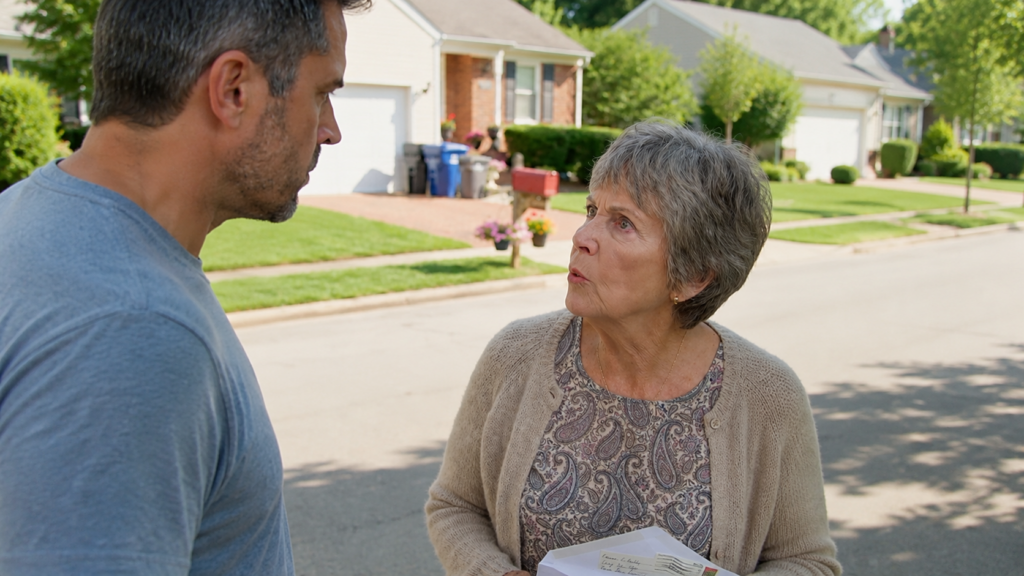
The first thing that disappeared was a white envelope with a blue corner.
I knew that because the orchestra administrator in Cleveland had photographed it before sending it.
She had written my street address in thick black ink and drawn a tiny eighth note beside my name.
Her name was Dr. Lila Soren, and she had promised that the letter would change how I thought about the next year of my life.
I waited nine days, then twelve, then fourteen.
On the fifteenth afternoon, my neighbor June Bell knocked on my door carrying two tomatoes and an expression of practiced concern.
“You seem distracted, Mara,” she said.
I told her I was waiting for something important.
June looked past me toward the upright piano in my living room.
“Important enough to leave us?” she asked.
I laughed because I thought she was joking.
June did not laugh with me.
I was thirty-four, a piano technician who also taught six teenagers in a borrowed rehearsal room above the Bellwether Community Center.
Three years earlier, I had come to the lakeside town of Arlen to care for my father during his final illness.
After his death, I stayed because the students had nobody else to accompany them.
They were unusually talented and endlessly inconvenient, which made them difficult to abandon.
June’s daughter, sixteen-year-old Wren Bell, played clarinet better than anyone I had ever taught.
Wren also had the habit of apologizing whenever she performed well, as though excellence were something she had taken from another child.
June served as the unpaid coordinator of our regional youth ensemble.
She booked rooms, ordered music stands, collected permission slips, and had a key to almost every cupboard in the community center.
For two years, that arrangement had seemed like a blessing.
Now I understood how much access one ordinary key could buy.
The letter from Cleveland was an invitation to interview for a yearlong residency restoring instruments for the Great Lakes Orchestra.
The job paid enough to let me repair the roof of my father’s house, and it offered work I had wanted since college.
I had not told my students about it because nothing had been settled.
June somehow knew.
“If it comes,” I said, “I’ll tell everyone what I decide.”
Her eyes shifted to my mailbox by the porch steps.
“Mail is unreliable around here,” she said.
“You shouldn’t plan your future around it.”
She left the tomatoes on my railing,
although I had told her I did not need them.
The next morning, I received a final reminder from the orchestra by email.
My response deadline was at noon.
The email referred to a packet that contained a timed restoration exercise and a short musical score.
Applicants had to prepare both parts without assistance and present the results in person.
The packet was sent only by post to protect the blind evaluation.
I called Cleveland and explained that nothing had arrived.
The administrator sounded surprised.
“The tracking shows delivery to your address last Tuesday,” she said.
I looked through my front window.
June was standing at the curb with a watering can, staring at my mailbox.
CHAPTER TWO — A SECOND ABSENCE
I went to the post office that afternoon with the tracking number written on my hand.
Clerk Ramon Price searched the delivery record while a queue formed behind me.
“Carrier scanned it as delivered at ten forty-two,” he said.
“Could somebody else in your household have taken it?”
“I live alone.”
Ramon turned the screen toward me.
The photograph showed my envelope resting halfway inside my mailbox, with the blue corner clearly visible.
A second photograph, taken for a different parcel that afternoon,
showed the box empty.
“Is that normal?” I asked.
“Photographs aren’t proof of who collected the mail,” Ramon answered.
“But you should file a report if you’re certain it is missing.”
I filled out the form at a counter beside the window.
A woman carrying a toddler waited behind me and complained about the slowness of the line.
I nearly abandoned the report because I felt foolish accusing an unknown person of taking one envelope.
Then Ramon mentioned two other items marked delivered to my address during the same week.
One was a notice from a regional arts foundation.
The other was a replacement reed order I had paid for on Wren’s behalf.
Neither had reached me.
I checked the dates and realized both had disappeared while I was teaching afternoon classes.
I walked home through cold November light, turning the facts over without wanting to arrange them.
At four, June called me across the fence.
She wanted to know whether I had resolved the problem with the orchestra.
“How did you know which orchestra?” I asked.
She went still.
“You mentioned it,” she said.
“I didn’t.”
“Maybe Wren mentioned it.”
Wren appeared in their kitchen window and stared at her mother.
June looked up sharply, and the girl vanished.
I asked June whether she had seen anyone near my mailbox.
“Children are always walking around,” she replied.
“I wouldn’t know.”
“Did you see the delivery on Tuesday?”
“I wasn’t watching your house.”
She returned indoors before I could ask anything else.
That night, I searched my paperwork and discovered that the missing envelope was not the first problem.
A receipt for a metronome had never arrived.
Two invoices from a local repair shop were missing.
The parents of three students had written checks for accompaniment fees, but the envelopes had vanished between their homes and mine.
I phoned the parents and explained that I had not received their payments.
Each assured me they had sent them correctly.
One mother, Asha Patel, said something that made my stomach tighten.
“June told me you were donating your time this season,” she said.
“She said the checks were unnecessary.”
I sat on the kitchen floor and stared at the piano bench.
For weeks, June had been managing more than rehearsal schedules.
She had been deciding which facts other people were allowed to give me.
CHAPTER THREE A — THE POSTCARD IN THE RAIN
The morning after my visit to the post office, I remembered a postcard from a piano parts supplier in Toledo.
The supplier normally sent me a handwritten reminder when a shipment was ready for collection.
My next shipment contained replacement hammers for the community center piano, which had begun sounding dull in its middle register.
I called the supplier and asked whether the card had been posted.
The owner, Mr. Brennan, answered with the kind of certainty that comes from doing one job for forty years.
“My wife stamped it herself,” he said.
“We put it into the outgoing tray on the third.”
“Did the shipment go elsewhere?”
“No, it’s waiting for you here.”
I explained that the reminder never arrived.
He offered to send another, then stopped when he heard how tired I sounded.
“Have you missed other things?” he asked.
I said yes.
“Then don’t wait for the post to tell you what you already know about the shipment,” he said.
His ordinary kindness nearly made me cry.
I drove to Toledo that afternoon through a light rain and collected the parts myself.
At the shop, Mr. Brennan showed me how he sorted every order into numbered drawers.
He offered a paper invoice and a second copy for my records.
“I don’t want somebody else’s mistake to leave you without a piano,” he said.
The drive home took two hours longer because a crash had closed the main road.
By the time I reached Arlen, Wren had called six times.
She was at the rehearsal room with three classmates, waiting for me to arrive.
June had told them I had canceled the session.
I had done no such thing.
I phoned Wren from the parking lot and asked her to stay inside with the other students.
When I entered, Felix was sitting at the piano trying to improvise a marching tune.
He stopped immediately and apologized for touching the instrument.
“You should always play a piano if it needs playing,” I told him.
Then I asked where they had heard rehearsal was canceled.
Dev pointed to a note taped beside the entrance.
It had June’s name printed beneath a short announcement about a scheduling conflict.
I photographed the notice for the board and removed it from the door.
The children watched me with the peculiar seriousness young musicians reserve for adults who might break a promise.
“Did we do something wrong?” Wren asked.
“No,” I said.
“I went to collect the parts for the piano because the reminder never reached me.”
Felix looked at the box in my hands.
“Does that mean we can fix the ugly notes?” he asked.
“Some of them,” I said.
“The rest belong to us.”
We worked on the instrument until the custodian turned off the corridor lights.
Dev held a flashlight while I checked the worn action.
Wren sorted the replacement pieces into the order I requested.
Felix tried to keep the other students quiet, with limited success.
It was one of our happiest rehearsals, and we had barely played a note.
On the way out, I saw June standing beneath the awning across the parking lot.
She did not wave.
I lifted the box of parts so she could see why I had gone away.
She turned and walked toward her car.
At home, I placed Mr. Brennan’s duplicate invoice into a folder.
I added the canceled rehearsal notice beside it.
The stack of missing correspondence had become a stack of things I could still prove.
I began to understand that proving a fact and restoring what it cost were different kinds of work.











