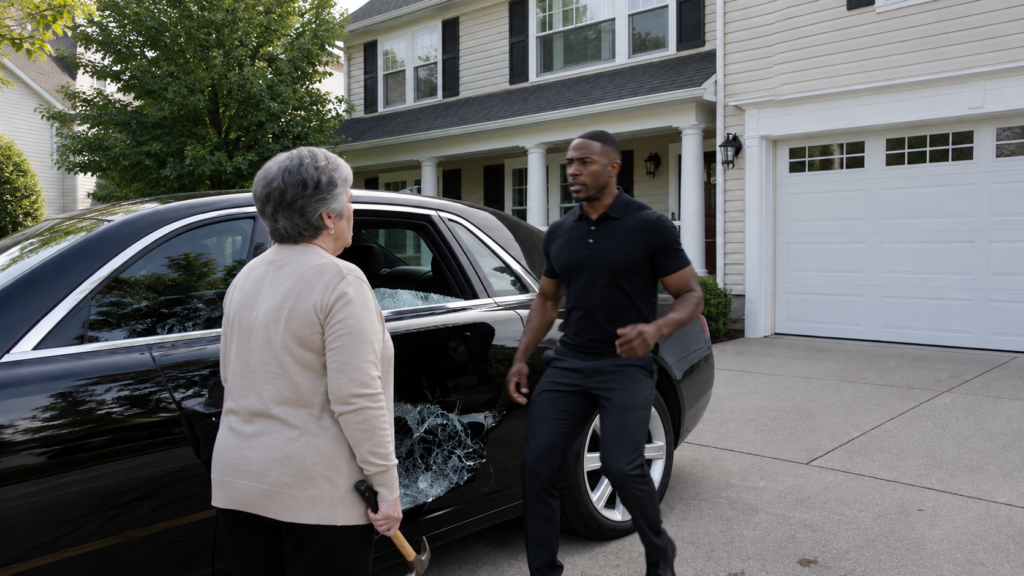
The sound came from Daniel Mercer’s driveway at eleven minutes past seven on a Thursday morning.
It was sharp enough to make the kitchen window tremble.
Daniel set down his coffee and ran toward the front door.
Another blow landed before he reached the porch.
His black Rolls-Royce stood beneath the maple tree with its passenger window in glittering pieces.
Fresh dents ran across the door like marks left by an angry animal.
Carol Haines stood beside the car with a hammer clenched in both hands.
She was sixty-five, short, broad-shouldered, and breathing hard beneath her green raincoat.
She looked more offended than frightened when Daniel stepped outside.
“What are you doing?” Daniel demanded.
Carol pointed at the car with the hammer.
“You cannot park something like this in our neighborhood.”
“It is parked on my property.”
“I warned you yesterday.”
“Yesterday you told me the vehicle made the street look like a showroom.”
“That should have been enough.”
Daniel looked at the torn leather visible through the broken glass.
“You have damaged a car because you dislike its appearance.”
Carol raised the hammer again.
“People like you do not get special treatment here.”
“Put that down before someone gets hurt.”
A white delivery truck slowed at the corner.
Two children waiting for the school bus stopped talking.
Carol seemed to notice the audience only when the truck driver lifted his phone.
Then two government vehicles approached from opposite ends of the street.
A man in a dark suit hurried out of the first vehicle.
Carol smiled with exhausted triumph.
“Good, maybe someone will finally deal with you.”
The man passed her without a glance.
“Governor Mercer, we have been looking for you.”
Daniel closed his eyes for a moment.
“The security detail is supposed to arrive at eight.”
“Your office received a threat assessment overnight, sir.”
Carol slowly lowered the hammer.
The man looked at the damaged car and reached for his radio.
“Do we have an immediate threat to the governor?”
“No,” Daniel said.
He met Carol’s eyes across the roof of the car.
“We have a woman who has committed an act of vandalism, and we have two children who should not have to witness an armed response.”
The man stopped speaking into his radio.
Daniel pointed toward the school bus stop.
“Please keep this calm.”
Carol’s voice emerged thin and unfamiliar.
“You are the governor?”
“Daniel Mercer.”
“The new federal governor?”
“Yes.”
“The papers said you were living at the district residence.”
“The papers were wrong.”
Carol stared at the fragments of glass beneath her shoes.
The security officer asked her to place the hammer on the ground.
She obeyed after a long pause.
“I did not know,” she whispered.
Daniel answered without raising his voice.
“That is not what makes it wrong.”
CHAPTER TWO — AN ORDINARY STREET
Cedar Row had been built around a factory that closed before Daniel was born.
The homes were narrow, the front gardens uneven, and the sidewalks repaired in patches by three different administrations.
People had spent decades keeping the houses alive without expecting anybody important to notice.
Carol had lived at number twenty-six since her first marriage.
She had survived a husband’s illness, a daughter’s departure, and the slow disappearance of neighbors who once borrowed sugar from one another without knocking.
She regarded the street as a place that belonged to its residents collectively.
Daniel had moved into number twenty-eight three days earlier.
He had chosen the house partly because he could walk to a neighborhood bakery without a guard standing between him and the customers.
He had also chosen it because the district residence felt like a government office with beds.
His appointment as governor of the Lake Arden Federal District had followed the creation of a temporary federally administered region comprising several formerly separate municipal services.
The title sounded grander than his actual authority.
He oversaw district agencies and could direct administrative reviews, but he could not erase local laws, decide criminal cases, or dismiss an employee without process.
He could not restore a neighbor’s dignity by signing an order.
He had already learned that lesson in another city.
His press staff had kept his address private because of threats directed at public officials.
Carol knew none of this when he arrived.
She saw the car first and decided that its owner represented everything that frightened her about the street’s future.
The day before the attack,
she had confronted him beside the front steps.
“We do not need rich people turning this into a place we cannot afford,” she had said.
Daniel had explained that he intended to live there, not redevelop it.
Carol had called him a liar.
Now a uniformed district officer photographed the damaged car while another took Carol’s name.
Daniel asked that the officer handle the incident exactly as he would for any other resident.
The officer looked relieved to receive a sensible instruction.
Carol sat on her porch with both hands folded around an empty mug.
Her next-door neighbor, Mrs. Ortez,
approached her through the connecting garden gate.
“Carol, what have you done?”
“I thought he was buying the block.”
“With a car?”
Carol did not answer.
Mrs. Ortez was a retired school secretary who had seen plenty of bad decisions disguised as community protection.
“Did somebody tell you he was buying the block?” she asked.
“People were talking.”
“Which people?”
Carol glanced toward the far end of Cedar Row.
A blue sedan had been parked there on three mornings that week.
Its driver had visited Carol twice.
She turned her mug between her palms.
“I need to make a telephone call,”
she said.
CHAPTER THREE — THE GOVERNOR’S FIRST MORNING
Daniel reached his temporary office an hour late in a district-issued sedan.
His chief of staff, Lena Ortiz, was waiting beside a table covered with briefing papers.
She looked at the scratches on his hand before she looked at his face.
“Did you get cut?”
“Only when I moved a piece of glass away from the tire.”
“Security says the neighbor struck the car repeatedly.”
“She did.”
“And you asked them not to arrest her at the scene.”
“I asked them to assess the facts instead of treating property damage as an attempted assassination.”
Lena handed him a folder marked PUBLIC SERVICE ACCESS.
“The community hearing is tomorrow,” she said.
“Has everyone received the agenda?”
“Everyone who requested it in English.”
Daniel looked up.
“That is not what I asked.”
Lena sighed.
“The district’s language access contractor has missed another translation deadline.”
“Which contractor?”
“CivicBridge Solutions.”
Daniel recognized the name from earlier transition reports.
CivicBridge operated interpretation scheduling, multilingual appointment notifications, and the public telephone line used by residents seeking assistance with district services.
The company’s contract had been renewed twice without a competitive review because administrators feared an interruption in service.
“Are they sending interpreters to the hearing?” Daniel asked.
“They say they are.”
“That does not answer whether anyone will arrive.”
Lena hesitated.
“We received twelve complaints last week.”
“From residents?”
“From people trying to help residents.”
Daniel opened the folder.
A printed complaint described a woman turned away from a licensing appointment because the interpreter assigned to her never appeared.
Another described an elderly man who signed an English-language form he could not read because he was told the appointment would be canceled otherwise.
A third came from a community clinic whose staff had spent forty minutes waiting for a telephone interpreter to connect.
None of the complaints had received a substantive response.
“How many more are waiting?” Daniel asked.
“Legal is reviewing that.”
“Ask legal for an answer by noon.”
Lena nodded.
Then she placed a photograph on the desk.
It showed Carol Haines standing beside a smiling man at a ribbon-cutting ceremony.
The man wore a blue tie and held a pair of oversized scissors.
Daniel recognized him as Nolan Price, president of CivicBridge Solutions.
“Your neighbor is on their community advisory committee,” Lena said.
Daniel stared at the photograph.
“Does that matter to the car?”
“I do not know.”
“Then keep the investigations separate until we do.”
CHAPTER FOUR — THE MAN IN THE BLUE SEDAN
Carol called Nolan Price at nine forty-two.
He answered on the fourth ring.
“I need to speak with you,” she said.
“I am between meetings.”
“I damaged the new man’s car.”
Silence followed.
“Which new man?”
“The one beside me.”
“Carol, please tell me you did not do something foolish.”
“I broke his window.”
“Good God.”
“He is Governor Mercer.”
Nolan said nothing for so long that Carol thought the call had ended.
“Did you know?” she asked.
“I knew a government employee had moved into the neighborhood.”
“That is not what I asked.”
“We should discuss this in person.”
Carol gripped the telephone.
“You told me the car belonged to an investor trying to buy the old library building.”
“I told you people were interested in the neighborhood.”
“You said he was part of that interest.”
“I said the situation deserved attention.”
Carol remembered his smile as he sat at her kitchen table on Tuesday.
He had arrived carrying pastries and the printed program for the district’s community hearing.
He had talked about outsiders moving in and deciding how longtime residents should live.
He had asked Carol to speak about why established organizations should control public access programs.
He had never mentioned Daniel’s name.
“Why did you come here twice?” Carol demanded.
“You are an influential voice in the community.”
“You stopped me from calling the governor’s office when I complained about the library.”
“Because formal complaints can become complicated.”
“And you told me to keep my concerns local.”
“Carol, do not discuss our private conversations with anyone until I arrive.”
The instruction sounded suddenly different from his earlier praise.
Carol watched a technician sweep broken glass from Daniel’s driveway.
“Do not come,” she said.
She ended the call before Nolan could answer.
Then she opened the drawer containing her CivicBridge advisory badge.
The blue plastic card still bore her photograph and the words COMMUNITY REPRESENTATIVE.
She put it on the table and stared at the smiling face printed beneath the title.











