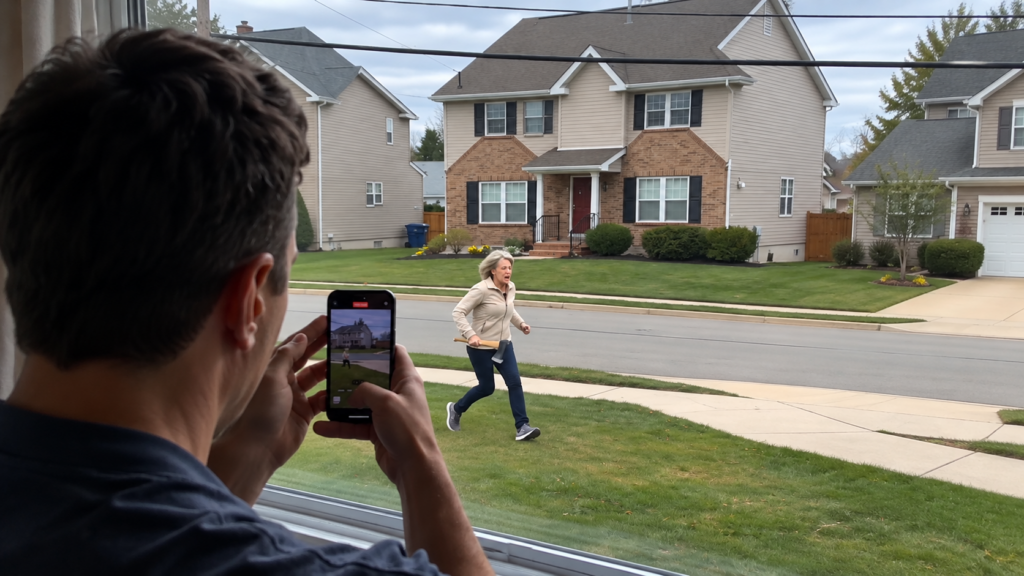
The first blow sounded like a car striking a concrete barrier.
I was standing in my kitchen with a bowl of cereal when the second blow shook the window above the sink.
Outside, my neighbor Vivian Kessler had planted her feet beside my mailbox and raised a long-handled sledgehammer over her shoulder.
She wore a blue gardening apron over a perfectly pressed white blouse.
That detail frightened me more than the hammer.
Vivian had dressed for an ordinary Tuesday, as though destroying another person’s property belonged on her morning schedule.
She struck the metal box a third time.
The door flew into the street.
I dropped my spoon and hurried toward the porch.
Vivian noticed me before I reached the steps.
Her face changed, but she did not lower the hammer.
“Where did you put it?” she shouted.
I stopped behind the porch railing.
“Put what?”
She pointed the hammer toward the crushed box.
“Don’t insult me, Adrian.”
My name is Adrian Bell, and I had lived on Marigold Court for six weeks.
Until that morning, I believed Vivian’s greatest offense was reporting neighbors for leaving trash cans outside after collection.
Now she was standing in my yard with a weapon and asking a question she expected me to understand.
“Get away from my house,” I said.
She looked past me toward the upstairs windows.
“You had no right to move it.”
A school bus turned onto our street.
Vivian lowered the hammer just enough to let it pass.
Three children pressed their faces against the windows and stared.
When the bus disappeared, she stepped closer.
“Tell me where it is, and this can stop.”
I took my phone from my pocket.
“You need to leave.”
For a moment, she seemed ready to climb the porch steps.
Then a garage door opened across the street.
Our neighbor, Malik Freeman, emerged carrying a thermos and stared at the wreckage.
Vivian put the hammer in the back of her car.
She drove away without another word.
Malik crossed the street slowly.
“Did she really do that?” he asked.
“You saw the end of it.”
He studied the scattered pieces of my mailbox.
“Whatever she wants,” he said, “don’t tell her where it went.”
I turned toward him.
“You know what she’s looking for?”
Malik’s expression closed.
“I know enough to be scared.”
CHAPTER TWO — WHAT HAD BEEN MOVED
The object Vivian wanted had not been inside my mailbox that morning.
It had never belonged to me in the first place.
Three days earlier, a woman named Ruth Calder had come to my door carrying a cardboard grocery box.
Ruth was sixty-eight, walked with a cane, and lived in a narrow yellow house two streets away.
She had mistaken me for the previous owner of my home.
When I explained that the owner had moved out, she nearly collapsed on the porch.
“Then I came too late,” she whispered.
I offered her a chair and a glass of water.
She refused the water but accepted the chair.
For several minutes, she watched a delivery van move down the street.
Then she opened the box.
Inside sat a miniature wooden carousel, no larger than a dinner plate.
Its painted horses were chipped, and one had lost an ear.
“This belongs at the children’s theater,” Ruth said.
I knew the building she meant.
The Crescent Children’s Theater had stood beside the public library until a private demolition crew fenced it off last winter.
“Why bring it here?” I asked.
Ruth touched the carousel without turning it.
“Because the man who lived here promised he would keep it safe until the hearing.”
“What hearing?”
She looked down at the floorboards.
“The hearing that never happened.”
I wanted to tell her that I could not take responsibility for a stranger’s belongings.
Instead, I asked why the carousel mattered.
Ruth lifted the roof of the tiny wooden structure.
Beneath it was a round brass mechanism fitted with a row of narrow teeth.
“This is the original control model,” she said.
“Control for what?”
“The rotating stage that injured my granddaughter.”
Her granddaughter, Nora, had been thirteen when a mechanical platform at the theater moved during a rehearsal.
Nora survived, but her injured leg never fully recovered.
The theater’s operators blamed a young stagehand for engaging the machinery at the wrong moment.
Ruth believed the equipment had been altered during a renovation.
“That model shows how the emergency release was supposed to work,
” she said.
“Why didn’t anyone examine it?”
“Because everyone who asked was told it had been destroyed.”
She closed the lid.
“My husband built it before he died.”
I looked at the carousel again.
It was an ordinary-looking toy with a terrible history attached.
“Why would Vivian Kessler want this?” I asked.
Ruth’s fingers tightened around her cane.
“You know Vivian?”
“She lives next door.”
Ruth stood so quickly that the chair scraped the porch.
“Then don’t leave it here.”
That evening, I carried the carousel to the workshop of my friend Soren Vale.
Soren repaired musical instruments and theatrical mechanisms in a brick building downtown.
He had once helped me restore a broken antique clock.
When I told him the story, he examined the miniature carousel without taking it apart.
“I can store it,” he said.
“Can you tell whether it proves anything?”
“Not without the full machine and someone who understands its original design.”
He placed the model inside a locked storage cabinet.
“And don’t tell anyone I have it.”
I went home believing the object was safe.
By Tuesday morning, Vivian had destroyed my mailbox searching for it.











