CHAPTER SEVENTEEN: THE BOOK THEY HAD PROMISED
Denise did not want the neighborhood memory collection to vanish because Victor had misused it.
She argued that families who had spent hours sharing stories deserved the chance to preserve them properly.
Others disagreed.
Beatrice feared that anything connected to the restaurant would carry the same betrayal.
Raymond suggested making a new collection under the public library’s supervision.
Claire Mercer offered to arrange a room and explain ordinary archival practices.
The library could accept donated photographs and oral histories only with the contributors’ permission.
It could not claim ownership of family memories simply because someone had attended an event.
At the first planning session, Denise placed an empty notebook in the center of the table.
“Before anybody writes a word, we decide who gets to say yes,” she said.
Beatrice brought her brother’s band photograph.
She wanted it displayed with his name and the year of the parade, but not with a statement about the Eastbank project.
Raymond brought a photograph of his father’s hardware store.
He wanted the collection to include the day the shop closed because that was part of the neighborhood’s history too.
Levi volunteered to help catalog the photographs.
Marta offered recipes from former community kitchen volunteers.
Ethan agreed to type transcripts as long as he was not expected to invent polished quotations.
“Some people tell stories in circles,” Denise said.
“Let them.”
An older man named Walter Finch described the first time the Eastbank hall opened during a power outage.
His account wandered from folding chairs to his father’s radio to a lost pair of gloves.
Ethan typed every detail until Walter stopped him.
“I don’t need the gloves in there,” Walter said.
“They were green,” Ethan replied.
“You remembered them forty years later.”
Walter laughed.
“Maybe they belong.”
The work was slow, and the room became noisy whenever two families recognized the same face in different photographs.
Nobody tried to turn that noise into agreement about offices or zoning.
Some days, the book seemed impossible to organize.
One volunteer missed an appointment because of a sick child.
Another discovered that her photograph had already been donated to a different historical archive.
Claire explained the permissions they would need.
The group adjusted its plan rather than forcing a deadline.
Denise kept the empty notebook on the table even after other pages filled.
“That one stays blank,” she said.
“It reminds us that nobody’s story belongs here until they put it here.”
Ethan looked at the growing stacks of photographs.
The project was not a grand rescue.
It was people doing awkward, patient work in a room that smelled of coffee and old paper.
He found that he liked it.
CHAPTER EIGHTEEN: THE LAST NIGHT AT THE BISTRO
When the bistro finally reopened for limited lunch service, Victor was not managing it.
The receiver had approved a temporary staff arrangement pending resolution of the wider business dispute.
Customers were given clear information about old deposits and how to request refunds.
The memorial promotional material was no longer displayed.
Marta asked Ethan to visit after his shift at The Orchard Room.
He arrived just before closing.
The candles were gone, and the northern wall held ordinary prints of market stalls and city streets.
Levi carried plates from the dining room without balancing three jobs at once.
Marta stood at the pass, arguing cheerfully with the pastry cook about the right amount of lemon in a tart.
“You look different,” she told Ethan.
“My new boss lets me eat on break.”
“An outrageous innovation.”
She placed a bowl of soup in front of him.
“This one’s on me.”
Ethan reached for his wallet.
“I can pay.”
“I know,” Marta said.
“I’m offering.
”
He accepted.
Halfway through the soup, Gideon entered with Claire on his arm.
He wore the same frayed jacket he had worn the night Ethan was fired.
Marta came out from the kitchen to greet him.
“We have one table by the window,” she said.
Gideon glanced toward the register.
“I brought enough cash this time.”
Ethan laughed.
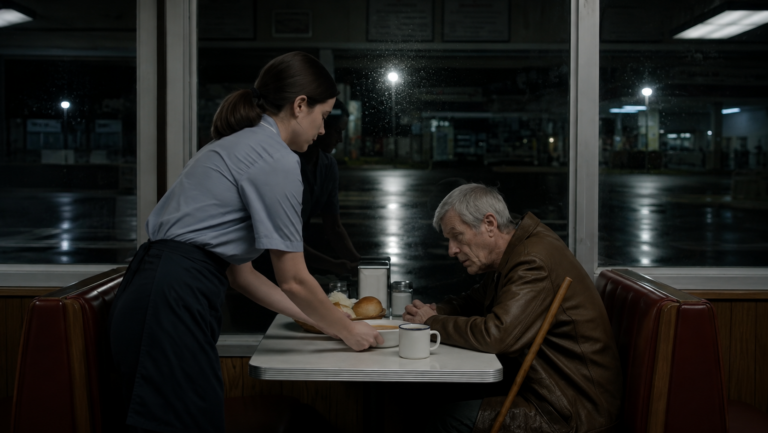
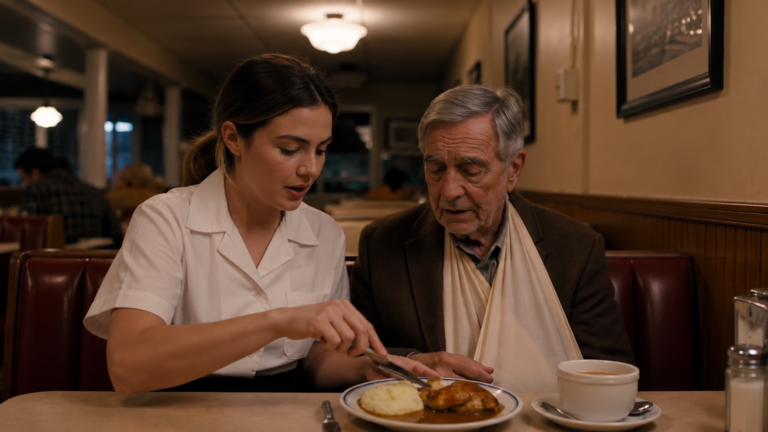
The old man sat beside him instead of taking the empty table.
For a moment the dining room felt painfully familiar.
Gideon unfolded a small receipt from his pocket.
“Seven dollars and forty cents,” he said.
He placed the money beside Ethan’s plate.
Ethan shook his head.
“I didn’t expect it back.”
“I know.”
Gideon pushed it closer.
“That’s why I wanted to give it back.”
Ethan considered refusing again.
Then he took the money and folded it into his wallet.
“Thank you,” he said.
Claire asked about his new job.
He told her that Janelle had offered him regular shifts and that the anniversary couple had returned the following week.
Gideon listened with visible relief.
“Good,” he said.
“I had hoped that much.”
They ate while Marta finished the kitchen’s final orders.
Outside, the streetlights came on one by one.
Near the door,
a customer struggled to find her bus pass while balancing a bag of leftovers.
Levi held the door without being asked.
The woman smiled and stepped into the evening.
Gideon watched her go.
“I spent a lot of years believing institutions could solve every problem if the paperwork was correct,” he said.
Ethan looked at him.
“And now?”
“Now I think paperwork should make room for people to solve what only people can see.”
He stood carefully.
Claire took his arm.
The old man paused beside the window where their story had begun.
“You asked me that night why I had the authority to close this place,
” he said.
“I did.”
“I had a specific legal duty, and I was fortunate it gave me a way to stop one bad decision from becoming a bigger one.”
He glanced around the modest room.
“But I didn’t have the authority to decide what kind of place it would become.”
Marta appeared behind the counter.
“We do,” she said.
Gideon smiled.
Ethan finished his soup, carried the bowl to the service station, and walked out into the cold with the last light of the bistro behind him.
CHAPTER NINETEEN: THE PEOPLE WHO PAID
One problem remained after the bistro reopened.
Several families had paid deposits for memorial books that nobody had received.
The restaurant could return the money, but money alone could not return the hours people had spent remembering their relatives.
Talia organized a meeting with the affected customers to explain the available refunds.
She brought a representative who could answer questions about the court-supervised account without promising outcomes beyond its authority.
Victor did not attend.
His attorney sent a written response disputing parts of the review, and Talia made that position available to the parties rather than pretending it did not exist.
Denise sat near the front with a copy of her old receipt.
A man named Paul Mercer asked whether the restaurant could keep the photographs his wife had submitted.
Talia explained that the review would require materials obtained from customers to be handled according to their permissions and applicable agreements.
“We will not assume a refund purchases your story,” she said.
Paul looked relieved, but the woman beside him raised a different question.
“What if I want the book they promised?” she asked.
Her name was Imogen Wells, and her father had written restaurant reviews for a neighborhood newspaper.
She wanted his life remembered beyond a photograph on a wall.
Denise described the library collection,
but she did not pressure Imogen to join.
“That project belongs to whoever chooses to contribute,” she said.
“You can keep your story at home, or bring it later.”
The discussion became difficult when a couple argued that all event customers deserved extra compensation.
Another guest objected to sharing a limited pool of funds with people who had attended dinner for free.
Talia let each person finish.
She distinguished documented deposits from possible additional claims that would require separate review.
Ethan, seated at the side of the room, watched the frustration spread.
The people had not come because they loved legal procedures.
They had come because someone had given them a reason to feel foolish for trusting a restaurant.
A woman who had remained silent finally lifted her hand.
“My father died before I could ask him how he met my mother,” she said.
“At that dinner, I heard somebody else’s story and remembered the answer he once gave me.”
Her voice cracked.
“I don’t regret coming.”
“I regret that they took what was good about it and made it into something else.”
No one interrupted her.
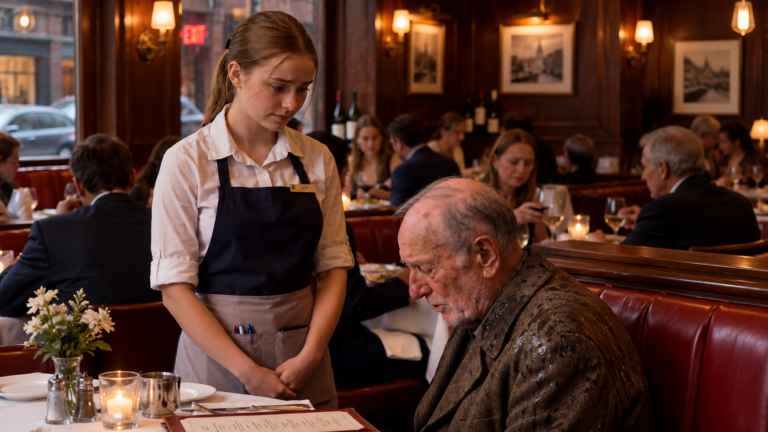
Ethan thought back to the old man’s dinner check and the shame he had tried to spare him.
He understood that the worst injury often came after the money changed hands.
It came when somebody with authority decided that another person’s embarrassment was convenient.
At the end, Talia handed out written instructions for requesting refunds and correcting the use of personal material.
The customers took the papers home to consider their choices.
There was no applause.
There was no dramatic confession.
But the questions had been answered in front of the people who paid, and nobody was asked to pretend the past evening had been something it was not.
EPILOGUE: A NAME ON THE PAGE
The neighborhood memory collection opened to the public in a small library room in early spring.
It did not include endorsements for either side of the Eastbank redevelopment dispute.
That dispute continued through public meetings, revised plans, and negotiations about access to shared space.
The library displayed photographs with names, dates, and permissions provided by the families.
Denise stood beside a picture of her mother stirring an enormous pot of stew.
Below it was a short account she had written in her own words.
Lucille Price had fed generations of children at Eastbank, and she had expected people to make room for anyone who arrived hungry.
Levi read the card twice.
“She would have liked that,” he said.
Denise squeezed his shoulder.
Ethan arrived late because The Orchard Room had been busy with lunch.
He brought Janelle, who wanted to see the recipes the families had preserved.
Marta greeted them with a plate of cookies made from one of Lucille’s handwritten recipes.
Gideon sat near the back with Claire, listening as Walter Finch argued gently with Beatrice about the date of a neighborhood parade.
Nobody was recording their disagreement for a campaign.
A child pointed at an old photograph and asked who the woman holding the wooden spoon was.
Denise knelt beside him.
“That was my mother,” she said.
“Her name was Lucille.”
She began telling him a story that was hers to tell.
The End.