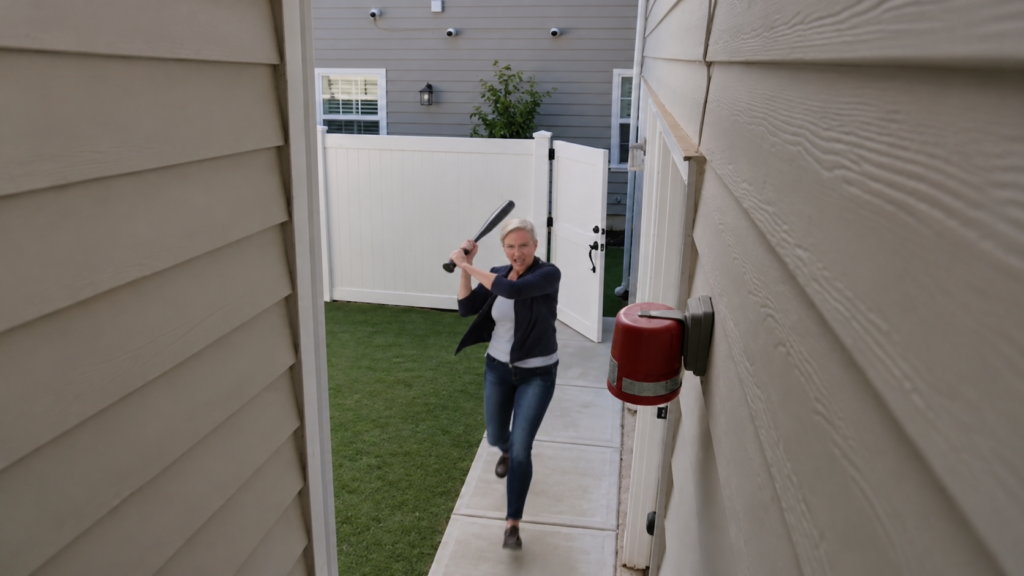
The first blow sounded like a dinner plate breaking against a brick wall.
Rachel Cole dropped the basket of clean towels she was carrying through her kitchen.
The second blow came before she reached the back door.
She ran outside and found her neighbor, sixty-five-year-old Miriam Vale, standing beside the side gate with a black baseball bat.
Red plastic covered the concrete near her shoes.
The little alarm that Rachel had installed beside the converted rehearsal room hung from its cable like a broken lantern.
Miriam had not bothered to cover her face.
She raised the bat again when she saw Rachel approaching.
Rachel stopped three steps away.
“Put that down.”
Miriam lowered the bat without surrendering it.
Her gray hair had escaped its usual neat braid, and a narrow red mark crossed one cheek.
“That thing needed to go,” she said.
“It was on my house.”
“I know where it was.”
“You came through a locked gate to destroy it.”
Miriam looked past Rachel toward the small building at the rear of the property.
The rehearsal-room windows were dark.
Rachel had rented the room to a local youth theater collective six weeks earlier.
She had installed the red alarm after discovering that the former workshop had only one obvious exit from the rear corridor.
The device sounded whenever the emergency door was forced open or held open beyond its safety interval.
It did not lock anybody inside, and it was not connected to a police dispatcher.
It existed to make sure that an unexpected opening could not pass unnoticed during rehearsals.
The alarm had never sounded during a scheduled session.
“Why were you desperate to stop it working?” Rachel asked.
Miriam gripped the bat with both hands.
“You should ask the people you let into that room.”
“I have their contract and their insurance.”
“You have their signatures.”
Rachel felt anger give way to a colder sensation.
“What does that mean?”
A car passed at the end of the alley.
Miriam watched its headlights disappear before answering.
“I thought there would be time to tell you.”
“Tell me what?”
“I thought I could do one thing without anybody getting hurt.”
Rachel pulled out her phone and photographed the broken casing.
Miriam did not object.
“I’m calling the police,” Rachel said.
“You should.”
The response startled Rachel more than another threat would have.
“Then stay right there.”
“I wasn’t going anywhere.”
Rachel called the nonemergency number and reported the damage and unlawful entry.
When the dispatcher asked whether the neighbor still held the weapon,
Rachel looked at Miriam.
Miriam placed the bat carefully on the concrete and stepped away.
“She’s put it down,” Rachel said.
The dispatcher told her to keep her distance until an officer arrived.
Rachel moved toward her kitchen door, then heard a faint tapping from the rehearsal room.
It came three times and stopped.
She turned back.
Miriam’s face had become so pale that Rachel could see the little freckles under her eyes.
“Don’t go in alone,” Miriam said.
“Who is in there?”
“I don’t know who’s left.”
Rachel did not wait for an explanation.
She called the emergency number again and told the dispatcher that someone might be inside the outbuilding.
Then she shouted toward the windows.
“This is Rachel Cole. If anyone is inside, call out.”
For several seconds nobody answered.
A young man’s voice finally came from behind the locked rear door.
“Please don’t let them come back.”
CHAPTER TWO — THE REHEARSAL ROOM
The dispatcher instructed Rachel not to force entry while the situation remained uncertain.
Rachel stood where she could see the main entrance and the narrow emergency door.
“What’s your name?” she called.
“Leo.”
“Are you hurt?”
“No. I don’t think so.”
“Can you open the main door?”
“Someone put a padlock on the outside.”
Rachel stared at the front hasp,
which had never been part of her rental arrangement.
A blue steel lock now secured the door.
She had walked past the entrance an hour earlier and had not noticed it in the fading light.
“What about the emergency door?”
“It opens, but the alarm keeps screaming.”
Rachel looked at the red fragments on the ground.
“The alarm is broken now.”
“I know.”
“How do you know?”
The young man hesitated.
“Mrs. Vale said she’d come back.”
Miriam closed her eyes.
Rachel turned toward her.
“You knew a person was locked inside my building?”
“I knew the front door was locked.
”
“Then why didn’t you call me?”
“Because I didn’t think he would trust you.”
Rachel felt as if the concrete had shifted under her feet.
A siren sounded in the distance.
A police cruiser arrived first, followed by a fire department utility truck.
Officer Denise Armand asked Rachel to identify herself and describe what she knew.
Rachel showed her the rental agreement, the broken alarm, and the padlocked entrance.
A firefighter cut the new padlock with bolt cutters.
The door swung inward, revealing a boy of perhaps seventeen seated beside a stack of folding chairs.
He wore an oversized black sweatshirt and carried a canvas bag clutched against his chest.
There were no injuries visible on his face, but his hands shook as he stood.
“My name is Leo Marin,” he said before anyone could ask.
“I came here for an audition.”
A paramedic guided Leo to the ambulance so he could be examined and speak with officers away from the crowd.
Rachel told Officer Armand that the room was licensed for rehearsals, not overnight confinement.
“Who’s responsible for the rental?” the officer asked.
“Northstar Youth Performance, according to the paperwork.”
“Who signed for the key?”
“A woman named Celia Hart.”
Miriam made a choking sound.
“That’s not her name.
”
Rachel and the officer turned together.
“Then what is it?” Armand asked.
Miriam rubbed her hands down the front of her cardigan.
“She’s called Celia because she wants people to think she still works with the theater.”
“What theater?”
“The Wilton Playhouse.”
Rachel recognized the name immediately.
The Wilton Playhouse had closed three years earlier after a funding dispute.
Miriam had worked there as a costume supervisor for most of her adult life.
“Her real name is Dana Rusk,” Miriam said.
“She’s my niece.”
The revelation traveled faster than the police report.
Three neighbors gathered by the alley fence as the fire crew checked the room.
Rachel heard someone whisper that Miriam had saved a child.
She heard another person say that Miriam had arranged the whole thing.
Neither version matched what she had seen.
The firefighter emerged carrying a clipboard.
“There’s no secondary obstruction on the emergency door,” he told Rachel.
“The panic bar works.”
“Then why didn’t he leave?” Rachel asked.
“We can ask him when he’s ready.”
Rachel already knew part of the answer.
The red alarm was loud enough to wake half the block.
Someone had persuaded the boy that making a sound would be worse than remaining inside.
She glanced toward Miriam, who stood under the porch light with both shoulders hunched.
“You broke the alarm so he could get out quietly,” Rachel said.
Miriam nodded.
“Why quietly?”
Miriam looked toward the ambulance.
“Because Dana told him his sister would pay if anyone knew he was here.”
CHAPTER THREE — THE CASTING LIST
The next morning Rachel met Officer Armand at the station and gave a full statement.
Her first impulse had been to end the rental immediately and change every lock on the property.
Armand agreed about the locks but warned Rachel not to discard any materials left inside the rehearsal room.
A detective had been assigned to determine whether other applicants had been held or threatened.
Leo’s mother had collected him from the hospital before dawn.
He had refused to speak to Rachel, although the officer said that he was physically safe.
Miriam had been cited for criminal property damage,
and further decisions would depend on the investigation.
Rachel did not ask the police to excuse Miriam’s actions.
She wanted an explanation for why the older woman had stayed silent while children were put at risk.
When Rachel returned home, a woman stood at her fence in a bright orange coat.
She introduced herself as Helena Marin, Leo’s mother.
“I know my son was in your building,” Helena said.
“I didn’t know he was supposed to be there until I got the hospital call.”
Rachel opened the gate but did not invite Helena into the house.
“I rented the room to a youth theater group,
” Rachel said.
“They told me the auditions would finish before eight.”
“Leo told me the audition was at noon.”
“Then something else happened after that.”
Helena pulled a folded flyer from her coat.
Its photograph showed a group of teenagers under theater lights.
A headline promised a paid summer repertory residency with housing and professional coaching.
Rachel read the promises twice.
The Wilton Playhouse logo had been printed at the bottom.
“That place has been closed for years,” she said.
“I know that now,” Helena answered.
“Leo thought the program was reopening.”
“Why would your son be afraid for his sister?”
Helena folded the flyer with shaking fingers.
“She’s twelve, and she’s been sick of people telling her brother he’ll never get anywhere.”
“That doesn’t explain the threat.”
“Dana Rusk told Leo that she could arrange a scholarship audition for his sister if he signed the performance agreement.”
“What agreement?”
“He says he wasn’t allowed to read it outside the room.”
Rachel remembered the clipboard that the firefighter had carried out.
“I’ll tell the detective about that.”
Helena took a step toward her.
“My son believes he’s responsible for whatever happens to his sister.”
“He isn’t.”
“I know. He doesn’t.”
Helena’s voice cracked on the last word.
Rachel offered her a chair on the porch and waited while she regained control.
A delivery truck pulled up at the opposite curb.
The driver left a cardboard box at Miriam’s house and drove away without looking at them.
Helena stared at the porch across the street.
“She knew about the auditions,” she said.
“Miriam?”
“She came to our community center two weeks ago and warned the children that the residency was suspicious.”
“Did anybody listen?”
“The coordinator told her she was spreading rumors about her own family.”
Rachel looked again at Miriam’s closed curtains.
An older woman had warned people, apparently failed to persuade them, and then destroyed a piece of safety equipment.
Rachel still could not make those actions fit into a single sensible account.











