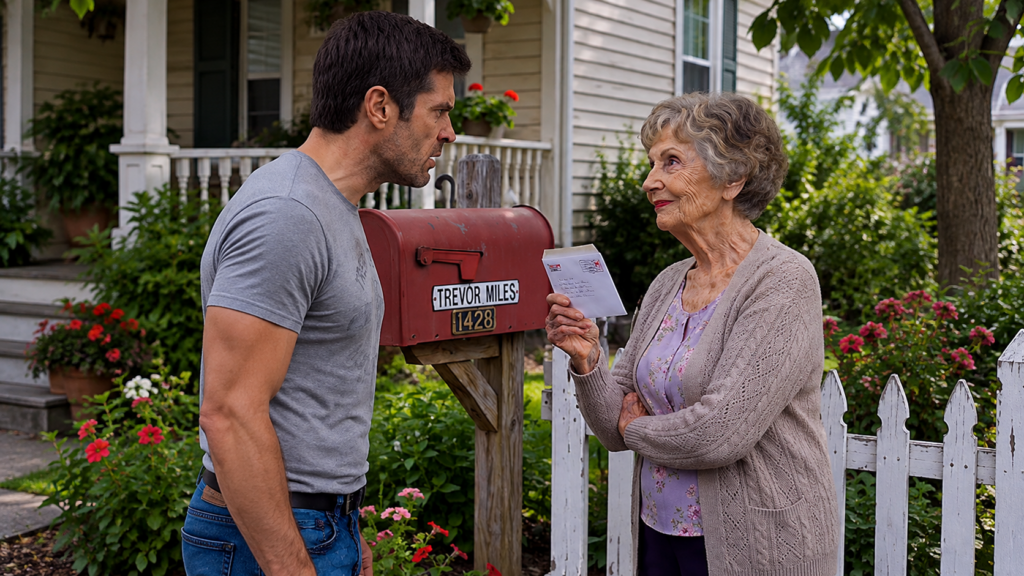
Trevor Miles was carrying two bags of groceries when he saw Evelyn Price standing at his mailbox with an envelope in her hand.
The envelope was open.
One corner had been torn carefully, as though somebody had tried to preserve the appearance of an accident.
Evelyn wore gardening gloves despite the heat, and a yellow pencil protruded from the pocket of her linen jacket.
Trevor set the groceries on the sidewalk.
“What are you doing with my mail?”
Evelyn barely looked embarrassed.
“I was checking whether you were hiding another violation.”
Trevor held out his hand.
“That letter has my name on it.”
She folded the envelope against her palm.
“If you followed the rules, you wouldn’t have anything to worry about.”
Trevor felt the familiar tightening behind his ribs that came whenever Evelyn mentioned rules.
For eleven months, he had been trying to finish renovating his late aunt’s house without turning every conversation into an argument over the neighborhood association.
He had fixed the porch, replaced the rotten gutters, and painted the shutters the same dark blue they had been for thirty years.
Evelyn had objected to all three projects.
First she claimed the gutter brackets were visible from the sidewalk.
Then she insisted blue shutters made the street look inconsistent.
Finally she photographed a delivery van unloading lumber and reported that Trevor was operating a commercial warehouse.
He had almost laughed at that one, until a warning arrived charging him for a special inspection.
Now she was opening his private mail.
“Give it back,” Trevor said.
Evelyn glanced down at the folded page.
“You’ve been invited to something at the community center.”
“That isn’t your business.”
“It becomes my business when residents organize activities without permission.”
Trevor took one step forward and stopped.
He was not going to reach for an envelope and give Evelyn a chance to describe the encounter as an assault.
“Place it on the mailbox,” he said.
She hesitated, then laid the envelope on the metal lid.
Trevor retrieved it and turned it over.
A narrow blue stripe ran along the outside, with the return address of the Riverbend Civic Partnership.
Inside was an invitation to a neighborhood meeting about a new public gathering room in a vacant storefront.
Trevor had applied to help build wheelchair-accessible shelving there, using his carpentry skills.
He had never mentioned the application to Evelyn.
She looked at the shopping bags.
“Your aunt understood this street had standards.”
“My aunt understood the difference between a community and a private kingdom.”
Evelyn’s face hardened.
“Be careful, Trevor.”
He carried his groceries inside before his temper convinced him to say something worse.
He placed the envelope on the kitchen table, beside the tomatoes and a carton of eggs.
The invitation was not confidential, but the act of opening it felt invasive in a way he struggled to explain.
Somebody had examined his correspondence because she believed his participation in neighborhood life required her approval.
His phone buzzed.
It was a message from Nia Foster, the teenager across the street who helped his aunt carry groceries before she died.
Did she get yours too?
Trevor called her immediately.
Nia answered on the second ring.
“Mrs. Price took my acceptance letter out of our mailbox this morning,” she said.
“What acceptance letter?”
“The Saturday workshop at the community center.”
Nia spoke quickly, swallowing the ends of her words.
“She said the workshop might violate neighborhood noise rules, and she needed to verify my participation.”
“Did she return it?”
“She pushed it through our door after lunch.”
“Was it open?”
“Yes.”
Trevor looked toward Evelyn’s house.
Its front curtains were partly drawn, although her lights were on.
“Keep the envelope,” he told Nia.
“Don’t throw anything away.”
Nia went quiet.
“Do you think she’ll make them cancel the workshop?”
Trevor thought of the half-built ramp waiting in his garage and the shelves he had promised to install.
“Not if the rest of us have something to say about it.”
After the call, he photographed the envelope and reported the interference to the Postal Inspection Service.
He expected a form letter or a request for additional information.
He did not expect anyone to visit the following afternoon.
CHAPTER TWO — THE FOURTH COMPLAINT
The two inspectors arrived in an ordinary sedan without flashing lights.
Trevor was repairing a loose porch rail when he noticed them walking toward his gate.
The woman introduced herself as Inspector Lena Ortiz.
Her partner, Inspector Malcolm Shaw, carried a narrow document case.
Ortiz showed her credentials before asking whether he was Trevor Miles.
“We’re following up on your report concerning interference with delivered mail,” she said.
Trevor led them onto the porch.
He explained what happened and handed over the opened envelope in a clear sleeve.
Ortiz examined the flap without removing anything.
“Has Mrs. Price ever told you she has authority to inspect mail?”
“She has told me she has authority to inspect practically everything.”
Shaw did not smile.
“Has anyone else mentioned similar experiences?”
Trevor told them about Nia.
“Four complaints have already identified Mrs. Price,” Ortiz said.
Trevor stared at her.
“Four?”
“That’s why we’re speaking with residents directly.”
Evelyn watched from across the street.
She stepped onto her porch when Shaw crossed the lawn toward her.
Trevor stayed beside Ortiz and could hear most of the exchange.
“This is ridiculous,” Evelyn said.
“I was protecting the neighborhood.”
Shaw’s voice remained steady.
“Mrs. Price, how many residents’ mailboxes have you opened?”
Her face changed.
“I don’t keep a count.”
“Then you acknowledge opening more than one?”
“I said I don’t keep a count.”
Trevor felt his stomach drop.
Her casual answer suggested that the behavior had become an ordinary part of her mornings.
Shaw asked whether she had retained any pieces of mail.
Evelyn denied taking anything, but said she had copied details when she believed a resident planned an unapproved activity.
Ortiz approached before the conversation turned into a public argument.
“Mrs. Price, we’re not discussing association rules right now,” she said.
“We’re discussing mail addressed to other people.”
Evelyn drew herself up.
“The association expects me to protect property values.”
“An association position does not grant you permission to open another person’s mail.”
Evelyn glanced toward Trevor.
“He’s organizing a workshop with power tools.”
“It’s a woodworking class,” Trevor said.
“At a licensed community center.”
Evelyn pointed her pencil at him.
“You see how he gets?”
Ortiz asked them both to stop speaking.
She told Evelyn to preserve any records concerning correspondence she had handled and explained that the inspectors would continue collecting statements.
Evelyn refused to admit wrongdoing beyond what she called brief compliance checks.
When the inspectors departed, Trevor realized the hardest part might be proving the actual consequences.
He could establish that Evelyn had opened his letter.
He could not yet explain why she was so interested in invitations,
workshop applications, and schedules.
Nia arrived on her bicycle an hour later with her mother, Denise.
Denise worked evenings at a nursing home and rarely attended neighborhood meetings because she was usually asleep when they started.
She placed three envelopes on Trevor’s kitchen table.
All had been opened and resealed with transparent tape.
“One is Nia’s scholarship interview,” Denise said.
“One is the community center application, and one is an invitation to a public planning session.”
Trevor read the postmarks.
The scholarship invitation had been mailed twelve days earlier.
The interview date was yesterday.
Nia sat very still.
“I was waiting for that letter,”
she said.
“I checked every afternoon.”
Denise pressed her fingers to the table.
“The organization says they couldn’t reach her and offered the seat to somebody else.”
Trevor looked at Evelyn’s house through the kitchen window.
He had known her interference was insulting.
Now he understood that it could permanently alter somebody’s future.
Denise unfolded a printed email.
“The program coordinator said she received a phone call from someone claiming Nia had withdrawn,” she said.
Trevor looked up.
“Did they get a name?”
“Just someone identifying herself as a neighborhood representative.”
A gust of wind pushed leaves against the window.
Nia rubbed her eyes with the heel of her hand.
“Mrs. Price told me scholarships shouldn’t encourage teenagers to skip school.”
Trevor stared at the opened envelope.
This was no longer an argument about an overly intrusive neighbor.
Somebody had begun deciding which opportunities other people were allowed to receive.
CHAPTER THREE — THE EMPTY STOREFRONT
Riverbend’s old hardware store had been empty since the owner retired.
Its front windows were taped with drawings of the proposed community room.
The drawings showed a small library, a flexible workshop area, and wide doors for residents using mobility aids.
Trevor stood outside on Monday morning with Denise and Nia.
Inside, the project coordinator, Priya Sen, sorted folding chairs into neat rows.
Priya had once worked in municipal recreation and knew how easily an ambitious neighborhood project could fail before construction started.
She welcomed them with a tired smile.
“Please tell me you’re not here to withdraw,” she said.
“Quite the opposite,” Trevor answered.
Priya took Nia’s scholarship envelope and inspected the opening along the top.
“The program sent invitations to six young people in Riverbend,” she said.
“Only two confirmed.”
“How many withdrew?” Denise asked.
“Three were reported unavailable by an individual who said she coordinated association compliance.”
Nia gripped the back of a chair.
“Did that person give names?”
“She knew each applicant’s name and the exact session they’d been offered.”
Trevor glanced at the enrollment sheet.
The workshop was scheduled to begin in nine days.
Without enough confirmed students, the nonprofit could lose its small equipment grant.
The grant was restricted to a class open to all eligible residents, not an invitation-only club.
“Who can reverse the withdrawals?” Trevor asked.
“The students can,” Priya said.
“But they need to contact us by Thursday, because the grant review meets Friday.”
Denise checked her phone.
Nia had already missed her scholarship interview for a different program.
The woodworking workshop was her remaining chance to build a portfolio before community college applications.
Priya explained that Evelyn had attended three organizing meetings earlier in the summer.
She had volunteered to handle resident notifications and had initially seemed helpful.
Then she began insisting that the center screen participants for homeowner association violations.
Priya had refused.
“Her proposal was to rank applicants by whether their households had complied with landscaping, parking, and visitor rules,” she said.
“She called it the Neighborhood Readiness Index.”
Trevor blinked.
“She has an actual name for this?”
Priya unlocked a filing cabinet and produced a single sheet left behind at the last meeting.
The page contained boxes for mail delivery frequency, home-based employment, guest traffic, and outside appointments.
At the bottom was a column marked Community Trust Level.
Denise read it twice.
“Outside appointments?”
Priya nodded.
“Evelyn said repeated service appointments indicated disorder.”
Denise laughed once, without humor.
“I have medical appointments for my mother and work shifts at a nursing home.”
Nia tapped a box labeled Youth Supervision.
“She’s treating every family like a suspect.”
Trevor asked whether the nonprofit had adopted the index.
“Absolutely not,” Priya said.
“But Evelyn still sits on the neighborhood association board, and that board owns a narrow access strip next to this building.”
The proposed center needed permission to use the strip as a loading and accessible drop-off area.
The association was voting on that permission Thursday night.
“If they refuse, can you open anyway?” Trevor asked.
“We can operate limited classes,” Priya said.
“But the accessible entry won’t be ready, and the grant conditions could be affected.”
Trevor looked at the drawings on the glass.
He had promised his aunt he would contribute something permanent to this neighborhood.
He had imagined shelves and a ramp, not a fight over whether his neighbors deserved entry.
Priya checked her calendar.
“Evelyn is presenting a compliance report at that meeting.”
Denise drew a slow breath.
“Do you know what she’s using to make it?”
Priya shook her head.
“No, but she keeps saying she knows which households are responsible and which are not.”
Trevor pictured Evelyn reading his invitation on the sidewalk.
The report had not appeared from nowhere.
It was being assembled one opened envelope at a time.











