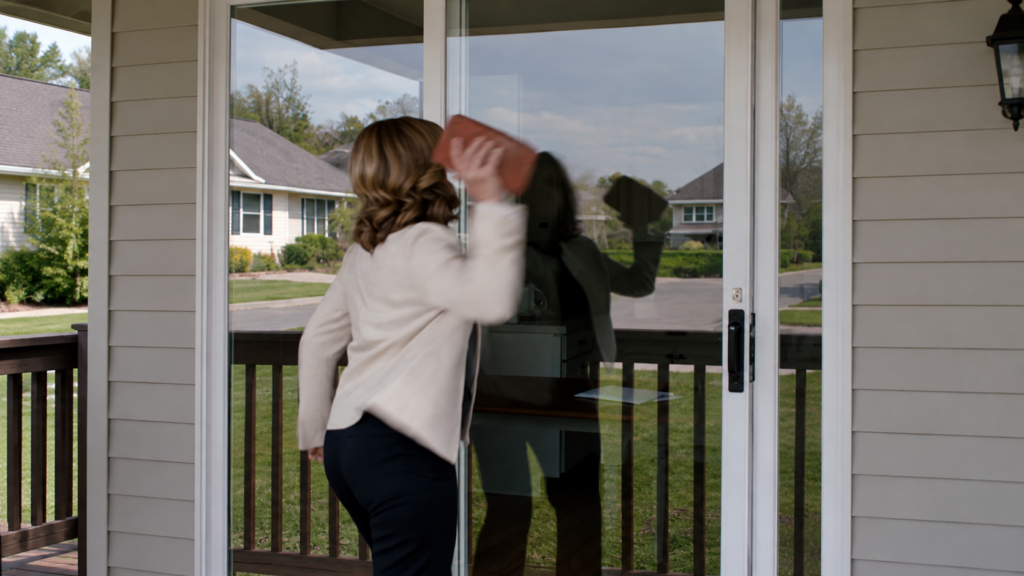
The first crack appeared in Daniel Mercer’s glass front door at 7:14 on a rainy Thursday morning.
A second blow drove a spiderweb of white fractures across the pane.
Daniel stood barefoot in his kitchen, holding a coffee mug while the woman outside raised a landscaping brick for the third time.
Her name was Celia Voss, and she had spent the previous eighteen months telling everyone on Alder Lane that Daniel was the most dangerous man in the neighborhood.
“Open it, Daniel,” she shouted through the rain.
“Give me the envelope, and I’ll pay for the door.”
Daniel had never seen her so frightened.
Celia usually delivered threats in a calm voice while wearing expensive shoes and smiling as though she were offering a favor.
Now her gray cardigan was soaked, one sleeve was torn, and her eyes kept returning to the narrow mail slot beside his front steps.
Daniel looked at the small blue envelope lying on the entry table.
It had arrived sometime before dawn, without a stamp or return address.
His name was printed neatly on the front, followed by four words that made no sense to him.
HOLD FOR VERIFIED RECIPIENT ONLY.
He had not opened it because he was waiting for his eight-year-old daughter,
Nora, to finish breakfast.
Nora loved sorting the mail, especially since her mother had died two years earlier.
Celia swung the brick again.
Glass exploded inward and scattered across the welcome mat.
Daniel put down the coffee, crossed the room, and blocked the entrance before Celia could reach through the broken pane.
“Get away from my house,” he said.
“Do you understand what that is?” Celia demanded.
“I know it has my name on it.”
“You have no idea what you’re holding.”
From upstairs, Nora called for him.
Daniel glanced toward the staircase, and Celia used that instant to push her arm through the broken glass.
Her fingers missed the envelope by less than a foot.
Daniel caught her wrist through the opening and held it away from the table.
She stared at him with an expression that looked less like anger than terror.
“If they see your fingerprints on it, they’ll bury you,” she whispered.
A black sedan stopped at the curb.
A man in a dark raincoat stepped out, followed by a woman carrying a hard-sided equipment case.
The man held up a credential wallet before either neighbor could speak.
“My name is Adrian Bell,” he said.
“I’m an inspector with the United States Postal Inspection Service.”
Celia pulled her arm back so violently that she cut her palm on the remaining glass.
Bell took one look at the blue envelope, then at Daniel, then at the brick in the flower bed.
“Mr. Mercer, do not let that woman touch the envelope,” he said.
Celia’s face lost its color.
Bell added a sentence that Daniel would remember for the rest of his life.
“She is not here to steal your mail.”
He shut the credential wallet and watched Celia as though he expected her to run.
“She is here to erase the reason it was delivered.”
PART TWO — THE HOUSE EVERYONE WATCHED
Three months earlier, Daniel would have found the idea of a federal inspector on Alder Lane absurd.
The neighborhood was a quiet rectangle of brick houses outside Dayton, Ohio, with maples along the sidewalks and school buses that arrived at nearly the same minute each day.
People argued about leaves, fences, barking dogs, and how long a trash bin could remain near the curb.
Daniel worked as an elevator service technician, which meant most neighbors knew him as the man who left before sunrise and came home with grease on his work boots.
His wife, Maren, had taught science at the local middle school before a sudden illness took her life.
Their daughter had inherited Maren’s sharp questions and Daniel’s habit of noticing details other people ignored.
For two years, Daniel measured time through the small routines that kept Nora feeling safe.
He packed her lunch in a blue insulated bag, checked her spelling homework at the kitchen counter, and pretended not to see when she slipped extra chocolate chips into pancake batter.
He could fix a stalled elevator in a twelve-story building, but he still struggled to braid her hair evenly.
Celia Voss lived across the street in the largest house on the block.
She chaired the Alder Lane Neighborhood Improvement Committee,
a private association that had no legal authority beyond collecting voluntary dues and organizing seasonal projects.
Celia rarely mentioned that limitation.
Her flyers looked official, her emails carried numbered violations, and she spoke at city meetings as though she represented every homeowner within five miles.
She had once persuaded six neighbors to replace perfectly functional porch lights because she disliked their color.
After Daniel refused to remove Maren’s handmade garden bench from his front yard, Celia began keeping a file on him.
She photographed his truck, recorded the dates he returned late, and complained about a small patch of brown grass near his driveway.
She accused his brother of parking illegally during Thanksgiving dinner, although the car had been fully inside Daniel’s property line.
Daniel answered her notices politely and then stopped answering them at all.
That silence seemed to offend her more than any argument could have.
At the monthly neighborhood gathering in September, Celia displayed a photograph of Daniel carrying a locked steel toolbox into his garage.
She claimed that strangers visited him after dark and that he might be running an unlicensed business from his home.
The strangers were coworkers who had helped repair the ramp on Nora’s backyard playhouse.
Daniel explained this in front of twenty people,
but Celia had already turned the ordinary photograph into something suspicious.
The following week, a typed note appeared beneath his windshield wiper.
SOME PEOPLE ARE WATCHING YOUR HOUSE FOR GOOD REASON.
Daniel saved the note in a drawer rather than show it to Nora.
He considered filing a harassment complaint, but he disliked the idea of teaching his daughter that every cruel word required a courtroom.
His older neighbor, Luis Ortega, gave him different advice.
Luis was a retired letter carrier with bad knees, a careful mustache, and an extraordinary memory for names and dates.
“People like Celia count on being the only person keeping records,”
Luis told him.
“Write everything down, even the little things.”
Daniel started a notebook that evening.
He recorded the date, time, location, witnesses, and exact words of every confrontation.
He also installed a porch camera, although the camera did not cover the narrow side path that ran between his garage and the small utility shed next door.
Celia noticed the camera within a day.
At their next encounter, she smiled toward the lens and asked whether Daniel was planning to sue the entire street.
He told her he only wanted people to leave his family alone.
She leaned close enough that the camera could see her face.
“Families with nothing to hide do not need so many locks,” she said.
Daniel had no reason to know that Celia’s interest in locks, mailboxes, and delivery schedules had begun years before he moved onto Alder Lane.
He also did not know that an employee in a federal evidence facility had disappeared with a packet of documents tied to her husband’s construction company.
Those documents were supposed to remain buried in a locked warehouse hundreds of miles away.
By the end of September, someone had found a way to send them to the one address Celia feared most.
PART THREE — THE WRONG HOUSE
The first odd delivery arrived on a Monday in early October.
Daniel found a padded mailer beneath his porch bench, sealed with clear tape and addressed to a woman named Eleanor Marsh.
He had never heard that name.
The street address was correct, including Daniel’s house number, but the city and ZIP code had been handwritten over older printed labels.
He brought the package to the post office instead of opening it.
A clerk scanned it, examined the overlapping labels, and said it would be routed to the appropriate unit.
On Tuesday evening, Celia appeared beside his recycling bin while he was bringing it back from the road.
“Did you get a package that wasn’t yours?” she asked.
Daniel stopped walking.
“Why would you think that?”
“A delivery driver was confused about addresses.”
“Then the sender should contact the carrier.”
“Was it a brown mailer?”
Daniel had not mentioned the package to anyone except Luis.
He asked Celia who had sent her.
She looked at his porch camera and changed her answer.
“I was trying to be helpful.”
Daniel wrote the conversation in his notebook.
Two days later, someone left a folded photograph on his windshield.
It showed Maren standing beside a woman outside a hospital, smiling under an autumn tree.
Maren looked tired but healthy, and Daniel immediately recognized the photograph as one taken shortly before her diagnosis.
A date was written on the back.
Beneath it were the words ASK WHY SHE MET ELEANOR.
Daniel sat inside his truck for nearly ten minutes before he could start the engine.
He had believed that Maren’s last few months held no important secrets.
She had continued teaching, attended appointments, and spent every spare minute with Nora.
The idea that someone was using her memory to threaten him made Daniel physically sick.
That night he opened an old external drive containing Maren’s family photographs.
He searched hospital visits, birthdays, school events, and the final vacation they had taken at Lake Erie.
In one photograph, the woman from the windshield stood behind Maren at a science fair.
The caption identified her as Dr. Eleanor Marsh, a former laboratory safety consultant who had volunteered as a judge.
Daniel found three emails from Eleanor in Maren’s archived account.
They concerned a school water-testing project and a request to verify a sample collection date.
The messages were unremarkable until the final one.
It had been sent six weeks before Maren entered the hospital.
Eleanor wrote that she had discovered a serious discrepancy in a set of environmental records and was frightened by the people asking her to change them.
She did not explain the discrepancy.
Instead, she asked Maren to keep a small notebook safe until someone trustworthy could collect it.
Maren replied the next morning.
I WILL KEEP THE ORIGINAL, NOT A COPY.
Daniel read that sentence five times.
He searched every shelf in the house and opened boxes he had not touched since Maren died.
He found science worksheets, photographs, Christmas cards, and a collection of pressed leaves that Nora had made in kindergarten.
He found no notebook.
When Nora wandered into his office, he closed the laptop and said he was sorting old family things.
She looked at the photograph on his desk.
“That lady came to Mom’s classroom once,” Nora said.
Daniel felt the room change around him.
“Do you remember her?”
“She smelled like oranges, and she had a silver bird on her bag.”
“Did she say anything?”
“She told Mom that numbers don’t become true just because grown-ups print them.”
Nora said the woman had handed Maren a little red folder after the science fair.
Daniel asked what happened to it.
Nora thought for a moment and shook her head.
“I remember Mom being mad at the printer,” she said.
“She kept saying somebody had changed a number.”
Daniel could not tell whether the memories belonged together.
He knew only that a dead woman’s school project had suddenly become important to people willing to photograph his family and approach his home.
On Friday, he showed the messages to Luis.
Luis examined the photograph and the altered mailing label through his reading glasses.
“You should talk to someone outside this neighborhood,” he said.
Daniel asked whether he meant a lawyer.
Luis tapped the package receipt Daniel had kept from the post office.
“I mean someone who knows why a package can travel through three states and still end up at exactly the wrong address.”











