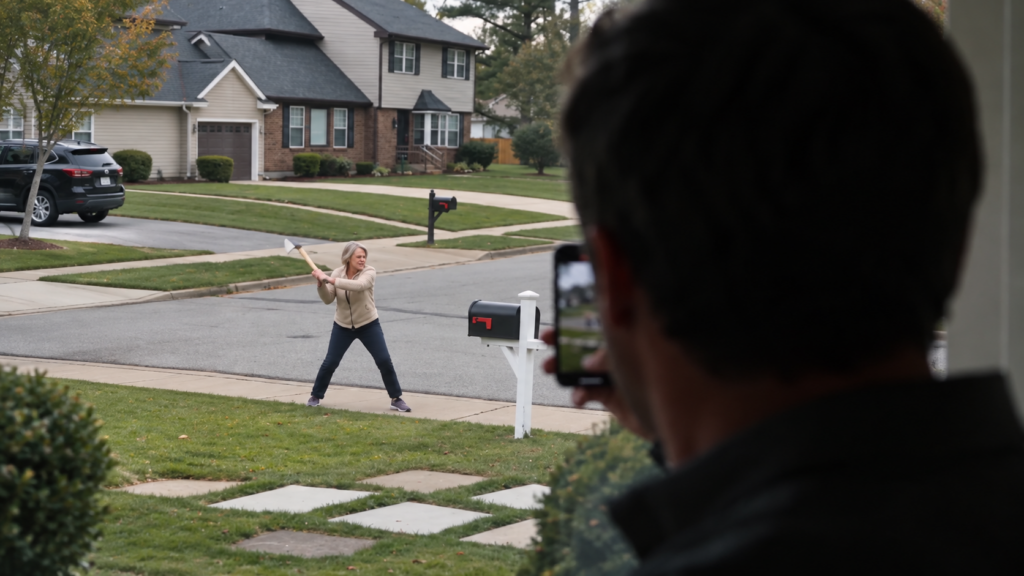
The first blow sounded like somebody dropping a toolbox onto the porch.
Evan Mercer looked up from the kitchen sink and waited for a second noise.
It came almost immediately, sharper and louder, followed by a metallic rattle that rolled across the quiet street.
Through the window, he saw his neighbor standing beside his mailbox with an axe raised over her shoulder.
Marla Voss was sixty-three, wore a yellow raincoat in clear weather, and had spent the last six months accusing Evan of ruining the neighborhood.
She swung again before he reached the front door.
The red metal box folded against its post,
scattering grocery advertisements and a birthday card into the grass.
Evan started down the steps, but Marla pointed the axe toward him.
“Stay right there,” she shouted.
“That thing should never have been put back.”
Evan stopped because he had never seen her holding anything more threatening than a pruning shear.
“You could have asked me to move it,” he said.
Marla looked over his shoulder toward the second floor.
Her expression changed so abruptly that Evan turned to see what had frightened her.
The upstairs curtains were open, but nobody stood in the window.
When he faced the road again,
Marla was dragging the axe toward her house.
She left the ruined mailbox lying in the ditch.
Evan did not chase her.
He had noticed something stranger than the violence.
Marla had attacked the box carefully, turning the blade sideways before the last two strikes as though she wanted to break the metal without cutting through the wooden post.
He bent down and found three shallow notches in the post, all at the same height.
Somebody had marked the wood before Marla arrived.
Chapter Two: The Upstairs Window
“Are you hurt?” a voice called from above him.
Evan looked up and saw fourteen-year-old Iris Chen leaning out of the upstairs guest-room window with her phone in both hands.
Iris was staying with Evan and his wife, Lila, while her mother recovered from surgery in another city.
She had been editing a school documentary about how ordinary people behaved when they believed nobody was watching.
“I filmed it,” Iris said.
“Every swing?” Evan asked.
“Every swing, but that’s not the important part.”
She disappeared from the window and met him at the staircase with the recording already playing.
The footage began before the attack, while Marla was still standing in the street.
A white delivery van had stopped at the corner, and a man in a green cap had stepped out to speak to her.
He pointed at the mailbox, then toward the upstairs window, before handing her the axe.
Evan recognized the man immediately.
His name was Nolan Price, and he ran the company that had been installing decorative street signs for the neighborhood association.
Nolan had told Evan two days earlier that the signs were being delayed because of a supplier problem.
On Iris’s screen, Nolan spoke to Marla for nearly a minute before driving away.
The phone’s microphone had captured only the final exchange.
“You promised nobody would be home,” Marla said.
“Then make sure they stay inside,” Nolan answered.
Evan replayed the sentence twice.
Iris lowered her phone.
“I think she wanted you to come outside,” she said.
Evan looked toward the empty road.
He had spent years teaching Iris to notice what happened around a dramatic event, rather than staring only at the drama itself.
Now she had noticed the part he missed.
Chapter Three: The Other Door
Lila came home from the pharmacy just after noon and found Evan crouched beside the shattered mailbox.
He told her what happened, and Iris showed her the recording.
Lila watched Nolan walk back to the van, then asked to see the beginning again.
“Look at his left hand,”
she said.
Nolan had been holding a narrow cardboard sleeve beneath his arm.
The sleeve was empty when he returned to the van.
Evan checked the roadside grass, the ditch, and the weeds behind the post.
He found nothing except torn paper and a rusty bolt.
Lila walked around the side of the house and stopped near the basement steps.
The outer basement door stood open by two inches.
Evan had locked it that morning.
Inside, a smell of fresh paint hung in the air, though nobody had painted anything for weeks.
A line of pale dust crossed the concrete floor toward a storage closet.
The closet contained Christmas decorations, old camping equipment, and a wooden model of the neighborhood that Iris had built for a school assignment.
The model was still there, but one of its cardboard houses had been crushed.
Evan picked it up and saw that the damage had been made by a heavy boot.
The intruder had stepped directly on Iris’s project while reaching for the shelf above it.
The shelf held nothing valuable.
It did, however, contain six folded canvas banners from the neighborhood’s abandoned street festival.
One banner was missing.
Chapter Four: The Banner
Evan remembered the festival because it had ended in an argument three summers earlier.
The neighborhood association had promised a weekend arts fair, but the event collapsed when dozens of vendors arrived to discover that their reserved spaces had already been sold to other businesses.
The president at the time, Nolan Price, blamed a clerical mistake and resigned from the committee.
Several vendors never received refunds.
Lila had kept the unused banners because she planned to turn the canvas into garden covers.
“Why steal an old banner?” Iris asked.
Evan spread the remaining banners across the basement floor.
Each carried the same painted street scene, with a row of colorful storefronts and a bright blue trolley.
Iris knelt beside the canvas and traced a seam with her finger.
“These were printed in sections,” she said.
“The picture doesn’t line up.”
Evan checked the labels stitched into the corners.
Five banners bore the numbers two through six.
The missing banner was number one.
Lila went still.
“Number one had the sponsor names,” she said.
“And the vendor schedule,” Evan replied.
He remembered standing beside the banner on the morning the fair was canceled, arguing with Nolan about a baker who had paid for the same booth as a furniture dealer.
Nolan had insisted the overlapping reservations were the result of an online error.
But the banners had been printed before the online system went live.
Evan looked at Iris.
“Somebody may have kept a picture of the original plan,” he said.
Iris shook her head.
“Or somebody wants to stop us from seeing who was supposed to be there.”
Chapter Five: Marla’s Kitchen
Evan crossed the street that afternoon without a phone or a camera.
Marla opened her door on the chain and stared at him as though she expected him to be carrying a weapon.
“I don’t want a fight,” Evan said.
“Then go home.”
“Nolan gave you the axe.”
Marla’s hand tightened on the door.
“I don’t know what you’re talking about.”
“Iris filmed him.”
The color drained from Marla’s face.
She glanced behind her toward the kitchen, where a kettle whistled on the stove.
“You shouldn’t have let that girl film anything,” she whispered.
“Why did you destroy my mailbox?”
Marla swallowed.
“Because he said your wife would be at the pharmacy, and you would come running out when you heard the noise.”
“Who went into my basement?”
“I don’t know.”
Evan believed her because she looked genuinely startled.
“He told me you had something that belonged to my husband,” Marla said.
“Your husband died last year.”
“I know when he died.”
Her voice cracked with sudden anger.
“He worked on that festival, and Nolan says people still think he stole their money.”
Evan remembered Marla’s husband, Dennis, hauling folding tables through the rain and refusing payment for his labor.
“I never thought Dennis stole anything,” Evan said.
Marla pulled the chain free and opened the door.
On the kitchen table lay a stack of unopened sympathy cards and a photograph of Dennis standing beside a painted blue trolley.
Someone had circled a face in the background with black marker.
The face belonged to Nolan Price.
Chapter Six: A Different Kind of Witness
Marla told Evan that Nolan had visited her the previous evening with a story about Dennis’s reputation.
He claimed a missing festival banner proved Dennis had accepted cash from vendors without recording the payments.
He also claimed Evan had hidden the banner in his basement to embarrass the Voss family.
“I asked why he hadn’t gone to the police,” Marla said.
“He told me the whole thing would become public if I made a report.”
Evan looked at Dennis’s photograph again.
“Did Dennis ever tell you what happened at the festival?”
Marla nodded slowly.
“He said Nolan was selling the same spaces twice, and he said somebody was going to get hurt if the crowd arrived.”
“Why didn’t he say anything afterward?”
“He did.”
Marla crossed to a cupboard and brought out a cracked red thermos.
“He stood up at a committee meeting and accused Nolan in front of everyone.”
Evan remembered that meeting only vaguely.
It had ended when a fire alarm emptied the community center.
Marla twisted the lid from the thermos and poured out a handful of small brass tags.
Dennis had collected them from the folding tables he rented for the fair.
Each tag carried a booth number, a date, and a vendor’s initials.
“Dennis said these were the only things he trusted,” Marla explained.
Evan arranged the tags on the table.
Several carried identical booth numbers but different initials.
They proved the overlapping assignments had existed before the event began.
They did not prove who collected the money.
Marla watched him sort the tags.
“I thought smashing your mailbox would stop him from talking about Dennis,” she said.
“Now I think he wanted me arrested before I could talk.”











