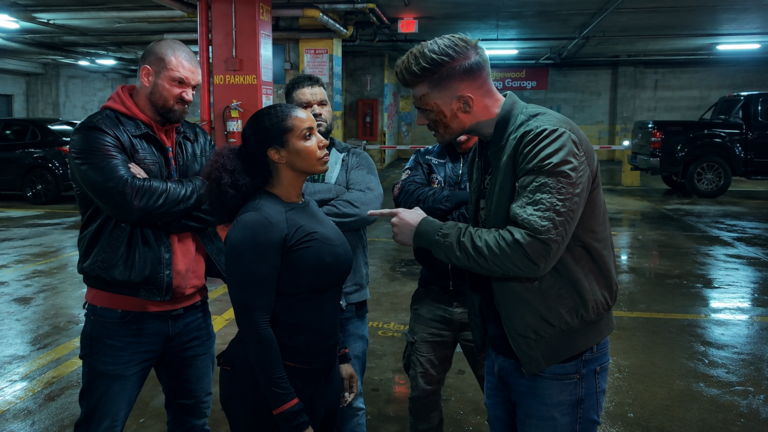
Two days later, Sterling’s disciplinary hearing began in a municipal facility away from the police station.
The hearing officer outlined the allegations and reminded everyone that the proceeding had its own standards and was not the federal trial.
Witnesses described supervision decisions, missing documentation, and the handling of complaints.
Sterling’s counsel challenged inconsistencies and argued that some decisions had been approved by city leadership.
Several disputed matters remained unresolved after the first session.
The hearing officer scheduled additional testimony rather than announcing a verdict for the afternoon news.
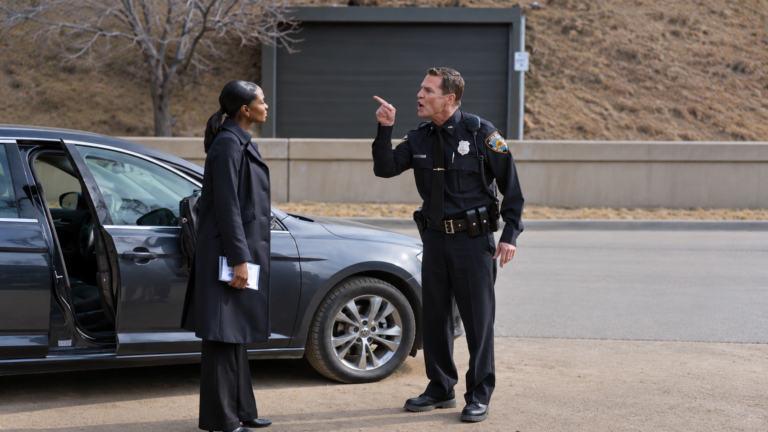
Outside, Sterling walked toward his attorney’s car and stopped when he saw Hayes across the parking lot.
For a moment the two men looked at each other.
Sterling opened his mouth.
His attorney stepped between them.
“Richard, we are leaving.”
Sterling closed his mouth and got into the car.
Hayes watched it pull away.
He had expected to feel satisfaction at seeing his former chief unable to command the scene.
Instead he felt the weight of every conversation he had postponed while wearing the uniform.
He walked back inside to finish the statement he had come to give.
CHAPTER TWENTY-NINE: THE ROOM WITH TWO DOORS
Young returned to Crestwood when the court scheduled a status conference on compliance with the preservation order.
The conference was narrower than the earlier hearing.
The judge wanted to know which records had been produced, which remained disputed, and whether interim safeguards were operating as directed.
Young sat with the government team while David Roth addressed the court.
A city attorney reported that several impounded vehicles had been released after expedited reviews.
The same attorney acknowledged that owners still disputed certain fees and the condition in which their property had been returned.
Judge Whitaker asked for precise figures and a timetable.
She declined to treat a general statement of progress as proof that all outstanding issues had been solved.
The towing contractor’s lawyer objected to several document requests on grounds of privilege and relevance.
The judge heard the arguments before setting a procedure to resolve them.
Young listened without speaking.
It was not her role to convert every disagreement into misconduct.
She had learned that restraint could feel uncomfortable when people were waiting for answers.
It remained necessary.
During a recess, a courthouse employee approached Young near a side corridor.
“Director Jenkins, there’s a resident asking whether she can give you something.”
“Is she represented by counsel?”
“I don’t know.”
“Please direct her to the public intake process or the attorneys handling the case.”
The employee nodded.
Young watched the corridor door close.
On the other side, a woman had apparently traveled a long distance because she believed the director was the one person who would listen.
Young understood the impulse.
She also knew that taking private evidence in a hallway could create problems for the witness and for the investigation.
She found Roth and asked whether public instructions about submitting complaints were clear enough.
“We can make them clearer,” he said.
“Do it before another person spends bus fare trying to find the right door.”
The resident turned out to be the mother of a delivery driver whose car had been released with damage to its rear bumper.
She had brought photographs and a handwritten timeline.
An intake specialist met her in a private room, explained what the office could receive, and offered contact details for the separate administrative claims process.
No one promised that her son’s case would become a federal charge.
The woman left with a receipt showing that her submission had been accepted.
For her, that was not the end of the matter.
It was the first time she had been given a way to follow it without begging someone at a counter.
CHAPTER THIRTY: ANOTHER KIND OF PRESSURE
After the status conference, Nia Palmer called Young through an official line.
She had concerns about the public attention surrounding the case.
“People think every bad experience they have with the city belongs in your investigation,” Nia said.
“Some are frightened when we tell them the issue needs a different office.”
“I don’t want them turned away without an explanation,” Young replied.
“Neither do I.”
“But I also don’t want them promised an outcome we cannot deliver.”
Nia paused.
“Marisol has been asked to speak at three rallies.”
“Does she want to?”
“She says she feels guilty refusing because so many people helped her.”
Young looked across her desk at a stack of pending correspondence.
“Tell her she has already done work that took courage.”
“She may need to hear that from someone outside her family.”
“She shouldn’t owe anyone the use of her story.”
Marisol declined the third rally invitation that evening.
She took her children to a school concert instead.
During the second song her son spotted her in the audience and waved with both hands.
She waved back so enthusiastically that the woman beside her laughed.
Afterward, a local reporter approached her near the exit.
“Could you say a few words about the reform effort?”
Marisol adjusted the scarf around her daughter’s neck.
“Not tonight,” she said.
“People are following your case.”
“Then tell them the bus is still running while the city checks the facts.”
The reporter lowered the microphone.
“Is that all?”
“That’s the news tonight.”
She took her children’s hands and walked toward the parking lot.
For months, strangers had decided what her van meant, what her complaint meant, and what her anger ought to mean.
The small refusal felt like getting one ordinary evening back.
CHAPTER THIRTY-ONE: THE NEXT MORNING’S REPORT
Acting Chief Quinn arrived at the police station before sunrise to review the department’s first independently checked monthly stop report.
The figures were incomplete because several software fields still needed correction.
She published the limitations alongside the totals rather than concealing them in a footnote.
An officer asked whether releasing an imperfect report would make the department look incompetent.
“It will show people what we can verify and what we still need to fix,” Quinn replied.
“That’s better than giving them a confident number we don’t understand.”
She asked Hayes to attend the briefing, not as a symbol of redemption but as an officer assigned to explain how stop narratives were being documented.
Hayes described a new checklist that required officers to distinguish a witnessed traffic violation from information obtained through dispatch.
A sergeant asked whether the process would slow patrol work.
“Sometimes,” Hayes answered.
“It also means the next person reading the report can tell what actually happened.”
The sergeant grunted, but he did not argue.
Quinn’s office received a complaint later that morning alleging that an officer had refused to assist a driver with a flat tire because he feared becoming part of another investigation.
Quinn summoned the officer for an explanation and checked the dispatch record.
The driver had been on the shoulder of a busy road with a child in the car.
The officer had called roadside assistance but had left before ensuring the family was safely visible to oncoming traffic.
Quinn addressed the incident directly.
“Accountability does not mean doing nothing,” she told him.
“It means explaining what you do and why.”
She assigned remedial training and documented the decision.
There would be no dramatic press conference about a single poor judgment.
There would be a record, a supervisor’s review, and a change in practice that could be tested the next time a driver needed help.
That evening Quinn drove past the intersection where the disputed bus stop stood.
She saw an older woman step off the bus with a walking stick and a grocery bag.
The driver waited until the woman had crossed the curb before closing the doors.
Quinn knew the transit committee might still recommend changes after a legitimate safety review.
She hoped its members would watch the street at this hour before deciding anything.
CHAPTER THIRTY-TWO: A PLACE TO STAND
The first winter storm arrived while the federal case was still moving through discovery.
Young was not in Crestwood when the snow began.
She was working late in her office when Theo Barnes brought her the latest preservation update.
Several disputed records had been located, and an independent examiner had begun reconciling contractor payments against vehicle-release dates.
Other questions remained unanswered.
“The mayor’s office wants a statement about whether the investigation is nearly over,” Theo said.
“We should tell them the schedule we know and nothing more.”
“They won’t like that.”
“People deserve timelines that mean something.”
Theo left the folder on her desk.
Young reviewed the summary and signed the transmission to the legal team.
She felt tired, but not because the case had failed to deliver a spectacular ending.
She was tired because a credible process required repeated attention to details that made poor headlines.
Her sister Denise called just before eight.
“Have you eaten?”
“I had soup.”
“Something with vegetables?”
“Denise, I am a federal director.”
“That is not an answer.”
Young laughed and leaned back in her chair.
Denise told her about a neighbor’s new puppy and a broken kitchen faucet.
They talked about ordinary things until Young mentioned the bus route meeting.
“They held off on closing the stops,” she said.
“Because people spoke?”
“Because people brought information the decision makers had ignored.”
“That sounds like progress.”
“It is one decision made with better evidence.”
Denise let the distinction sit between them.
“You know you can be pleased about that,” she said.
Young looked through the dark window at the snow gathering on the pavement.
“I am.”
In Crestwood, Marisol received a message from Thomas Delaney that the morning buses would run on their regular winter schedule unless roads became unsafe.
She set her alarm fifteen minutes earlier, laid out her children’s gloves, and placed the message beside the kitchen clock.
Hayes finished his patrol report and checked each factual statement before submitting it.
Ellen Moss answered another question from the independent reviewer without claiming knowledge she did not possess.
Quinn put the monthly stop report on the department’s public information page.
None of these acts made a clean final chapter for the lawsuits still pending.
They were decisions that could be examined, challenged, and corrected.
Before leaving the office, Young opened the photograph Denise had taken during their breakfast stop on Route 9.
It showed two cups on a table, sunlight on the window, and a stretch of ordinary road beyond the glass.
Young placed the photograph back in the drawer.
She put on her coat, switched off the light, and walked toward the elevator.
The next morning would bring more questions.
People in Crestwood would still need answers from institutions that had failed them.
For that reason, Young did not want the last word to belong to a title, a badge, or a judge’s gavel.
She wanted it to belong to a person who could speak without first asking whether anyone powerful would permit it.
At the Route 9 bus stop, Ruth Delaney stepped beneath the shelter and shook snow from her scarf.
Thomas pulled the bus to the curb and opened the door.
“Still here?” he asked with a smile.
Ruth climbed aboard and tapped her fare card.
“Still here,” she answered.
The doors closed behind her.
The bus moved forward into the falling snow.
The End.