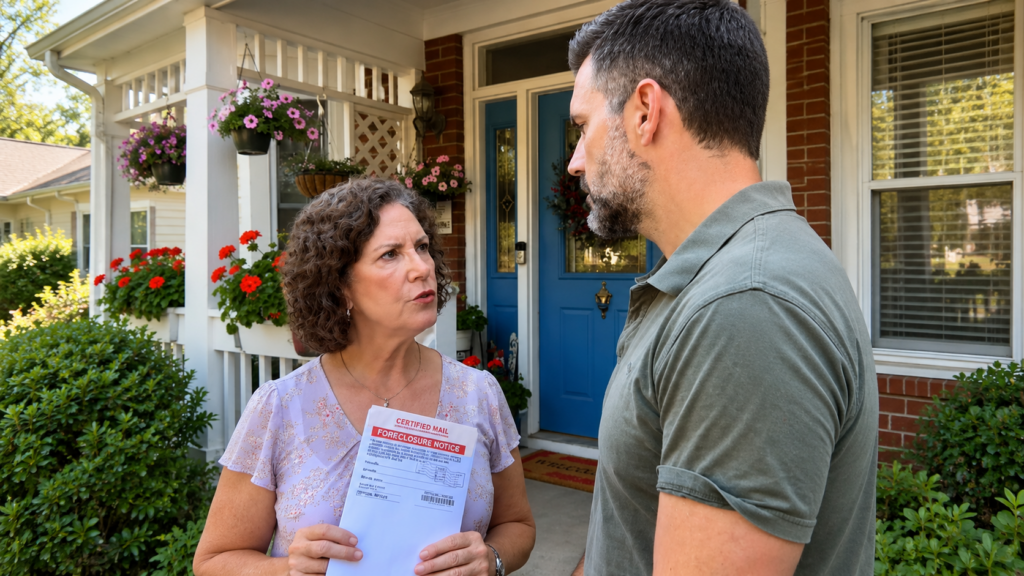
The bees did not stop working when Brenda Higgins announced that Liam Mercer was about to lose his house.
They moved through the purple sage along his front walk as though the woman holding the certified notice were no more important than another passing cloud.
Liam watched one land on a milkweed flower because looking at something ordinary helped him avoid reaching for the paper in Brenda’s hand.
“Forty-two thousand dollars,” she repeated.
“Pay by the first, or your house goes to auction.”
She wore polished riding boots although nobody at Cedar Hollow Estates kept horses.
A measuring stick rested against her leg.
She had brought it on every visit since she decided that Liam’s native garden was an offense against civilization.
“Our restrictions cap fines at fifty dollars a week,” Liam said.
“That has not changed.”
“The board passed an emergency amendment.”
“Five hundred dollars a day?”
“For an infestation risk.”
Brenda tipped her chin toward the black-eyed Susans, the bluebonnets, and the dense row of flowering shrubs that screened his kitchen windows.
“You created a hazard, Mr. Mercer.”
Liam had bought the house seven years earlier after working sixteen years as a commercial lighting designer.
He had replaced the thirsty Bermuda grass gradually,
spending three summers digging paths, building low stone borders, and learning which plants could survive the summer heat without daily irrigation.
The county extension office had used photographs of his garden at a public workshop.
The neighborhood children knew where the monarch caterpillars could be found.
Brenda called the same garden an infestation.
“Show me the vote,” he said.
“It’s in your notice.”
He took the envelope and unfolded the first sheet.
The lien carried a company logo, an amount, a signature, and a paragraph threatening a trustee sale.
A line near the bottom cited ARC Resolution 4-B as the authority for the emergency assessment.
Liam knew that number.
Brenda had talked about Resolution 4-B at the June board meeting, when several owners demanded to know how the association could fine them for native plants while its own common grounds stood brown and dusty.
But the date printed next to the resolution was June 11.
That board meeting had taken place June 18.
Liam read the date again.
“You say this resolution authorized the fines?”
“It certainly did.”
“Then why was it signed a week before the meeting that supposedly created it?”
Brenda’s measuring stick went still.
“Clerical error,” she said.
“A typographical mistake does not invalidate an obligation.
”
“Maybe not,” Liam answered.
“But I will ask whoever prepared this to explain it.”
Brenda smiled without warmth.
“My son-in-law handles trustee sales.”
He looked from the notice to her face.
“You told me that already.”
“Then take it seriously.”
She turned and walked toward the golf cart parked at the curb.
Liam’s hands shook after she left.
He was not calm because he had spotted a mistake.
He was frightened because the mortgage balance was still large, because his home was the one stable place left after his divorce, and because a piece of paper with a false date could apparently carry a threat to take everything.
Inside, he placed the notice flat on the kitchen table.
He photographed every page, including the back, then searched for the association’s governing documents.
The restrictions were attached to the purchase papers in a battered accordion folder.
He found the ordinary fine schedule on page forty-three.
Fifty dollars per week after notice and an opportunity to contest the alleged violation.
Nothing on that page gave a manager unilateral authority to increase fines tenfold.
He looked at the new notice again.
An email address belonged to an unfamiliar company called Hawthorne Trustee Services.
The return mailing address was a shared office complex on the north side of the city.
The letter demanded payment to an account labeled Cedar Hollow Receivables Custodial Trust.
Not the association’s usual bank account.
Liam wrote all three differences on the back of a grocery receipt.
At eleven forty, his neighbor Iris Solano knocked at the kitchen door.
She was seventy-two, formerly taught elementary science, and walked with a silver cane decorated with tiny yellow stars.
“She came for you too,” Iris said.
She laid another envelope on the table.
Her total was eighteen thousand five hundred dollars.
Her alleged violation was a butterfly garden less than half the size of Liam’s.
“I thought she only hated my yard,
” Liam said.
“She hates anything she cannot invoice,” Iris replied.
He showed her the date.
Iris read it three times, then sat down slowly.
“June eleventh,” she said.
“That’s the day I attended the county hospital fundraiser with our board president.”
“What does that matter?”
“Because Brenda told us the emergency committee met that night.”
Liam pulled out a chair.
For the first time, he wondered whether the impossible date was more than a typo.
It might be a door someone had closed before the neighbors knew it was there.
CHAPTER TWO — THE FIRST DOOR
Liam called the association’s president,
Marianne Bell, four times before she answered.
She sounded exhausted.
“I am aware of the notices,” she said.
“Did you authorize them?”
“The board voted to address invasive landscaping.”
“Did the board vote for five hundred dollars a day?”
Silence stretched between them.
“I will need to review the minutes.”
“You were there.”
“So were thirty homeowners, Liam.”
He heard a cupboard door close on her end.
“I can come over after work,” she said.
“But do not ignore any deadline on that notice.”
Liam spent the afternoon photographing the garden from every angle.
He measured the width of the path,
the distance from each shrub to the sidewalk, and the clear area around the water meter.
He did not plan to win the dispute by proving that flowers were beautiful.
He needed to disprove a specific accusation made under a specific rule.
At three, a contractor’s van stopped outside his house.
A man in a company polo shirt climbed out holding a tablet.
“I’m here to inspect your infestation,” he announced.
Liam remained on the porch.
“Who sent you?”
“GroundSafe Compliance.”
“I did not request an inspection.”
“The association did.”
The man raised his tablet toward the garden.
Liam could see a photograph already open on the screen.
It showed a patch of bare dirt beside a broken fence.
The caption read Mercer Residence, Active Infestation Zone.
“That isn’t my property,” Liam said.
The contractor glanced down.
“What?”
“That fence is chain link.”
“Mine is cedar.”
The man lowered the device.
“The address matches.”
“May I have your name?”
“Trevor.”
“Then, Trevor, please photograph my actual garden and note that I disputed the picture you arrived with.”
Trevor hesitated before taking his own photographs.
He did not step off the public sidewalk.
“I only verify what dispatch sends,” he said.
“Who sends dispatch its photographs?”
“I couldn’t tell you.
”
“Because you don’t know, or because you aren’t allowed?”
Trevor looked back toward the van.
“I need this job,” he said quietly.
Liam stopped pressing him.
“Then please make sure the record shows what is here today.”
Trevor entered a note, accepted a glass of water, and left without issuing a citation.
At six, Marianne arrived carrying two canvas bags and wearing the same shoes she used at the medical billing office.
Iris joined them at the kitchen table.
Liam showed both women the contractor’s false picture.
Marianne pressed her hands together.
“I knew Brenda wanted an enforcement contract,” she said.
“I didn’t know she had already hired an outside company.”
“You approved the budget,” Iris said.
“I approved a study,” Marianne answered.
“We had a vote about whether the common areas could afford native plant maintenance, not a vote to seize houses.”
Liam placed the lien beside the June board agenda.
The agenda had no item called ARC Resolution 4-B.
It contained a line labeled Landscape Education and Volunteer Survey.
“Then who signed the resolution?” he asked.
Marianne examined the document and went pale.
The signature printed beneath the authorization was hers.
“I never signed this,” she said.
Liam watched her closely.
He wanted to believe her.
But a signature could be copied, and a frightened person could also deny what she regretted signing.
“Will you say that to the trustee?”
Marianne stared at him.
“I will say it to anyone who asks.”
“Then we need someone independent to ask,” Iris replied.
Marianne stood.
“There is something else.”
She opened one canvas bag and removed a thick envelope marked BOARD FINANCING PROPOSAL.
“Brenda says the association needs money for the clubhouse renovation.”
“We voted that project down,” Liam said.
“Twice,” Marianne answered.
“She has been meeting with a lender anyway.”
Iris leaned closer.
“What does our clubhouse have to do with a fine against a flower bed?”
Marianne removed a page covered in financial columns.
The words Assessment Receivables appeared at the top.
Underneath was a number larger than Liam expected.
Eight hundred and sixty thousand dollars.
Marianne touched the page.
“That is what Brenda claims the owners owe.”
For a moment the kitchen fell silent except for a ceiling fan turning above them.
Liam counted the houses on their little street in his head.
“How many people got these notices?”
“I don’t know,” Marianne admitted.
Iris unfolded her own envelope.
“Then tomorrow,” she said, “we start asking.”











