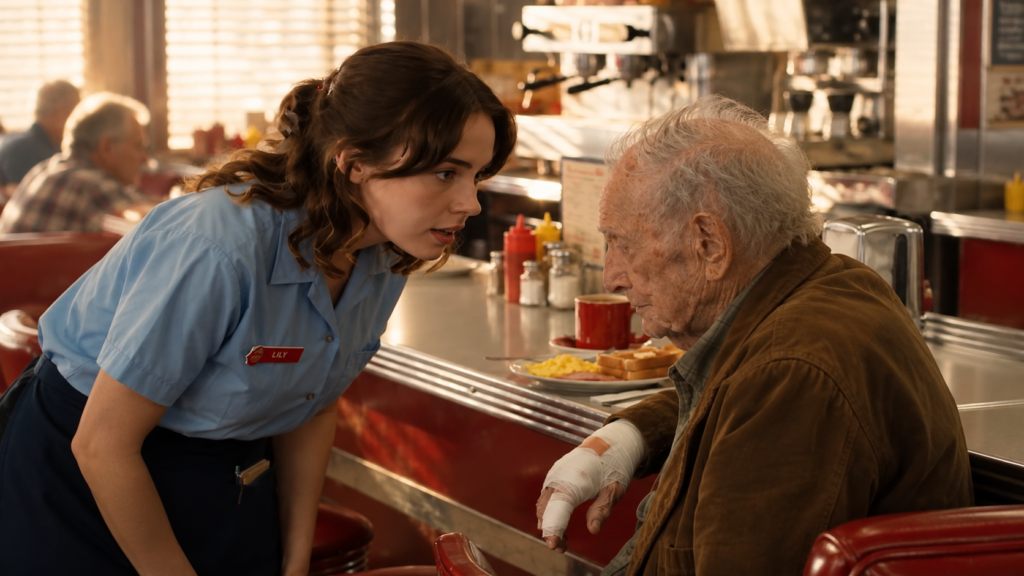
The first thing Lily Hart noticed about the old man was not the bandage. It was the way he stood outside the diner and watched the door as though entering required a decision he had been rehearsing for years.
The second thing was the bandage, white gauze wrapped around his left hand, with a thumb poking out at an uncomfortable angle. He came in during the lull between breakfast rushes, when the Maple Turn Diner smelled of burned toast and fresh coffee and every table had at least one sticky patch the cleaning cloth had missed.
Lily was twenty-five, with a rent increase folded into her apron pocket and a pair of shoes she had repaired twice with glue. She was collecting dishes when he chose the booth closest to the window.
“Morning,” she said. “Coffee?”
“Please. And eggs, over easy. Toast. The potatoes, if they’re good.”
“They’re good when Mateo makes them. He’s cooking today.”
He smiled at that, though it was an expression that seemed to cost him something. His name, she learned from the ticket, was Walter. He did not offer a surname.
When Lily returned with breakfast, Walter looked down at the plate and stayed perfectly still. Five minutes later the toast remained untouched. His coffee had cooled. He had moved the fork from one side of the plate to the other, but had not managed a bite.
“Are you feeling sick?” Lily asked quietly.
He shook his head. “I can’t hold the fork steady.”
He tried to demonstrate, perhaps to make the problem seem smaller than it was. The fork tilted, struck the plate, and bounced onto the table. Walter looked away toward the traffic outside.
Lily had spent enough time watching people pretend they were fine to recognize that particular silence. She did not pick up the fork for him. She asked, “Would it help if I made this easier to manage?”
He considered the question, then nodded once.
She carried the plate to the counter, cut the eggs and toast into manageable pieces, and moved the potatoes into a shallow bowl. She exchanged the heavy ceramic mug for a light paper cup with a sleeve. Then she brought everything back without announcing to the room what she had done.
“Try that,” she said.
Walter picked up a spoon with his good hand. The first bite was awkward. The second was easier. He gave her a grateful, almost surprised look.
From the service station, manager Colin Pruitt frowned. “Lily, tables six and nine need clearing. You’re wasting time.”
“I’ll get them,” she answered.
She did, then returned when Walter needed another napkin. She remained close enough to help without hovering. He finished almost all the potatoes, drank the coffee, and asked her name twice. The second time he said it slowly, as if committing it to memory.
“Lily Hart.”
“Hart,” he repeated. “That’s a name I haven’t heard in a long time.”
She assumed he was making conversation. When he left, he folded his receipt into four squares and tucked it carefully into his coat.
Colin watched him go. “You can’t adopt every customer who walks in here.”
“I helped him eat breakfast.”
“You know what I mean.”
“I really don’t.”
Colin turned back to his register. Lily finished wiping the booth. Under the edge of the plate lay a nickel, not a tip exactly, but an old coin worn smooth at the rim. She slipped it into the lost-property jar rather than her pocket.
By closing time she had forgotten the exchange, except for the old man’s effort to say her surname. She walked home past a closed florist and an empty movie theater, bought discount bread, and checked her phone for a message from her mother. There was none.
The following morning, a stranger arrived carrying a photograph and an envelope.
2. THE LAST SENTENCE
The stranger was in his late forties, with Walter’s gray eyes and the expression of someone who had driven all night without deciding whether the journey was sensible.
“I’m looking for Lily Hart. My father ate here yesterday.”
Lily put down the stack of menus. “Is he all right?”
“He’s fine. Stubborn, embarrassed, and determined. That’s the usual combination. I’m his son, Daniel Mercer.”
He set a faded photograph on the counter. In it Walter stood decades younger beside a tall woman with dark hair, both wearing paint-spattered overalls. Behind them rose an enormous painted moon and a curved structure that looked like the side of a ship.
“Do you recognize her?” Daniel asked.
“No. Should I?”
“Her name is June Vale. My father said she has been waiting for somebody named Hart. He insisted I bring you this.”
The envelope held a handwritten note, a small brass key, and an address in Bellweather, Ohio. The note was short enough that Lily read it twice before she understood how strange it was.
Dear Lily Hart,
If you are the Hart who remembers the sound of the blue room, please come before Saturday. Bring no promises. The key opens the cabinet, not the door. Ask June why the walls were made to move.
— Walter Mercer
Below, in a different hand, someone had written: June Vale has been waiting years for someone with your last name. Do not let them empty the building before she can show you.
Lily looked at Daniel. “What’s the blue room?”
“I was hoping you knew.”
“And who’s emptying what building?”
Daniel rubbed his forehead. “My father was a scenic carpenter. June designed sets. They worked at a theater that closed a long time ago. He’s been trying to reach her for months. Yesterday he went into your diner because he saw your name on the staff board.”
“He could have asked me.”
“He wanted to be certain. Then he hurt his hand and lost his nerve.”
Lily turned the key in her palm. It was stamped with a tiny number fourteen.
“I’m not the person you’re looking for,” she said. “My family is from Pennsylvania. My mother has never mentioned a theater in Ohio.”
“I don’t know whether you are. My father said not to pressure you.”
Daniel reached for the photograph, but Lily stopped him. The woman in the picture had one hand raised to shade her eyes. Her smile was crooked and broad. Something about the painted moon behind her stirred a memory that Lily could not place: a dark ceiling scattered with pinpricks of light, and a low humming sound like distant machinery.
“Can I take a picture of this?” she asked.
“Keep the original. June wanted you to see the back.”
Lily turned it over. Written in fading blue ink were three words: THE WALL LISTENS.
Colin appeared from the office. “Are you ordering, sir?”
Daniel said he was not. Colin told Lily she had two minutes before her shift began. The envelope went into her bag. Daniel left a phone number, but before he walked out he added something that made her uneasy.
“June won’t talk to my father anymore. She says he owes her the truth about one particular night. He says she’s right.”
“What night?”
“The night the theater went dark.”
3. A NAME IN A DRAWER
Lily called her mother during her lunch break. Marianne Hart worked at a dry-cleaning counter in Erie and answered with the clipped patience she used for customers demanding impossible stain removal.
“Bellweather?” Marianne said. “Why are you asking?”
“Have we ever been there?”
A pause. Then, “You were little.”
“How little?”
“Four, maybe five. Your father took us to see a show.”
Lily sat on an overturned milk crate behind the diner. “You told me he never liked theaters.”
“He didn’t, afterward.”
“After what?”
Marianne exhaled. “There was an accident. Nobody in our family was hurt. We came home. That’s all.”
Lily had been eleven when her father died after a sudden illness. She remembered his heavy boots beside the kitchen door, his habit of humming while fixing a hinge, and his insistence that every bedroom have a working flashlight. She did not remember him talking about Bellweather.
“Do you know a woman named June Vale?”
The silence on the line became long enough that Lily checked whether the call had disconnected.
“Where did you hear that name?” Marianne asked.
Lily explained the photograph and the key. Her mother told her not to travel to Ohio. When Lily asked why, Marianne said she had to return to work and ended the call.
After her shift Lily searched the closet in her apartment for the cardboard box of her father’s things. Beneath old tax forms and a cracked tape measure lay a little tin of ticket stubs. Most were for baseball games. One, folded inside a bus schedule, read THE MARINER’S DREAM — FINAL WEEK, BLUE LANTERN PLAYHOUSE, BELLWEATHER.
On its reverse, in her father’s block lettering, were the words: Lily liked the stars. Don’t forget.
She called Daniel. “I found a ticket.”
“Then you should speak to June.”
“Why won’t she speak to your father?”











