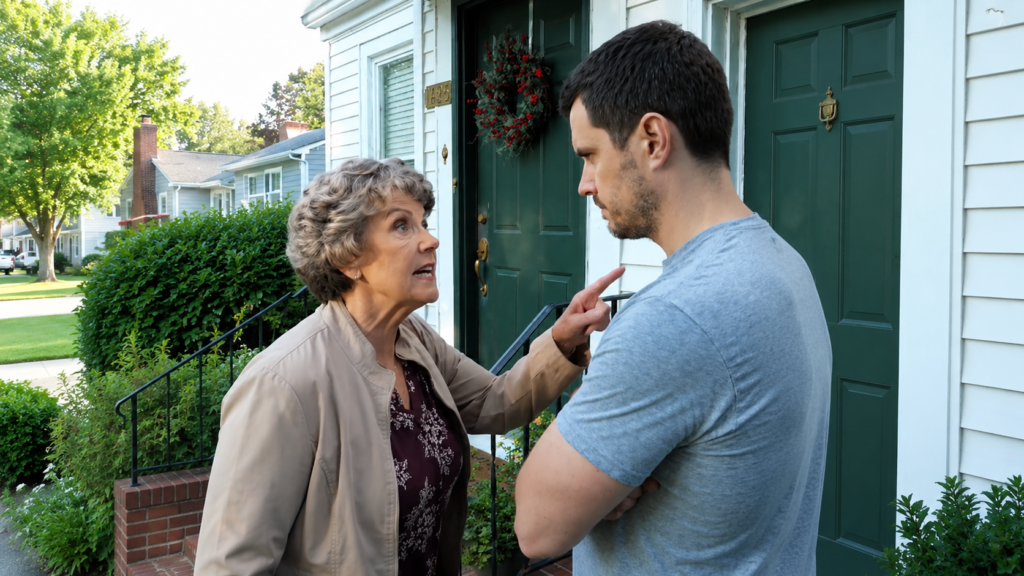
Daniel Reed was locking his front door when Carol Mercer hurried across the lawn as though a fire had started inside his house.
Her gray cardigan hung open, and the soles of her gardening shoes slapped against the concrete path.
“I need to get inside your house,” she said.
Daniel kept one hand on the key.
“No.”
“You don’t understand. I left something in there.”
“You’ve never been inside my house.”
Carol’s eyes moved past his shoulder toward the living room window.
“Then let me check.”
He stepped between her and the porch.
“Go home, Carol.”
She raised her phone as though it were a warrant.
“I’m calling the police.”
Twenty minutes later, two officers stood beside Daniel’s driveway while Carol described a possible emergency that changed with every question.
First she claimed she had seen someone collapse behind the curtains.
Then she said a dangerous object might have been left beside the sofa.
When Officer Lena Ortiz asked how Carol knew about the object, Carol insisted she had only meant that something looked wrong.
Daniel pointed to the undisturbed window and asked them to look from the sidewalk.
They saw a clean living room, an empty armchair, and a stack of folded winter coats waiting to be delivered to Maple Court Apartments.
No one was lying on the floor.
No smoke came from the house.
Daniel declined to admit Carol, and Ortiz explained that a neighbor’s suspicion did not give her permission to enter a private residence.
Carol’s shoulders rose with fury.
“If something happens, this will be on you.”
She walked home without looking back.
Daniel waited until the patrol car left before going inside.
The argument would have been ordinary by Carol’s standards if not for her repeated glances at the window.
She had complained about everything from his compost bin to the boots his nephews left on his steps.
She had never demanded access to the living room.
Daniel put his keys on the kitchen counter and reached for his phone.
The garage camera faced the side gate and captured the narrow strip of yard beneath the living room window.
At 2:17 that afternoon, Carol appeared on the recording carrying a folded grocery bag.
She checked the sidewalk, crouched beside the window, and pushed something through the loose corner of the insect screen.
She used both hands to force the object past the frame.
Then she hurried away without retrieving the bag.
A knock came at the door.
Officer Ortiz stood on the porch, holding a notebook rather than her radio.
“We need to ask you something,” she said.
Daniel turned the phone toward her.
Ortiz watched the footage, and the color drained from her face.
“Don’t touch whatever she put inside.”
“Why?”
“Because she wasn’t trying to get inside your home to find something.”
Ortiz looked across the street at Carol’s closed curtains.
“She was trying to get back inside before you found what she had already left there.”
The second officer, Malik Warren, arrived behind her with a paper evidence envelope and a pair of disposable gloves.
They did not rush inside.
Ortiz asked whether Daniel kept pets, whether anyone had spent the afternoon in the living room, and whether he had opened any packages near the window.
“Only coats,” Daniel said.
He nodded toward the pile visible through the glass.
“Those are for Maple Court’s winter donation drive.”
Ortiz stopped writing.
“Maple Court on Dunbar Street?”
“Yes.”
Warren exchanged a look with her.
The officers stepped into the living room with Daniel’s permission and told him to remain by the doorway.
Below the window, half hidden beneath the fringe of a floor rug, lay a clear plastic specimen cup.
Someone had drilled tiny holes in its lid.
A yellow label wrapped around the side, and a dark shape moved inside when Warren shone his flashlight toward it.
Daniel instinctively took a step forward.
Ortiz held out her arm.
“Stay there.”
Warren photographed the cup in place and eased it into a rigid container without opening it.
Daniel saw several reddish brown insects move against the plastic.
“What are those?”
“They may be bedbugs,” Ortiz said.
Her voice was careful rather than dramatic.
“We’ll need somebody qualified to identify them.”
Daniel stared at the rug where the cup had been.
“She brought live insects into my house?”
“We don’t know yet why she did it,” Ortiz answered.
Outside, Carol’s front curtain shifted.
Daniel suddenly remembered the loose insect screen he had intended to repair last spring.
CHAPTER TWO – A CUP WITH A NUMBER
The officers moved Daniel’s chairs away from the window but did not allow anyone to shake out the coats.
Ortiz explained that a professional inspection would determine whether any insects had escaped.
The lid appeared intact, which was fortunate, but the cup had been thrown hard enough to crack the edge.
Daniel asked whether he could sleep in his own house that night.
She said he could, subject to whatever the pest inspector recommended, and warned him not to begin spraying chemicals on his own.
The distinction mattered because Daniel had already imagined throwing everything he owned onto the curb.
Warren photographed the cracked screen and traced the cup’s label through the clear outer container.
A handwritten number appeared below the manufacturer’s mark.
It read C-19.
There was no address, no signature, and no explanation.
“Is she under arrest?” Daniel asked.
“We have questions to ask her,” Ortiz replied.
“I watched her do it.”
“We watched her push an object through the screen.
”
Ortiz met his eyes.
“We still have to establish what that object was, who put it together, and why.”
Two officers approached Carol’s porch while Daniel waited behind his own door.
Carol answered with her chain attached.
He could not hear their questions, but he saw her shake her head and point at his house.
Eventually she shut the door and left them standing on the steps.
Warren returned looking annoyed rather than surprised.
“She says she was returning something you dropped in her yard.”
Daniel almost laughed.
“She told you she had never been inside.”
“She also says she doesn’t remember what she returned.
”
Ortiz looked at the coat donation bags.
“Tell me about Maple Court.”
Daniel had begun volunteering there eight months earlier after a local repair group asked for help replacing damaged closet hinges.
He worked in building maintenance during the day and spent some Saturdays fixing loose doors, sticking windows, and broken furniture for residents who could not afford private repairs.
Maple Court housed older tenants and several families with children.
A woman named Mrs. Alvarez coordinated their small community room and the winter donation program.
For three weeks, the residents had been collecting warm clothing and bedding from churches and neighbors.
Daniel’s house was only a temporary sorting point because the community room was being repainted.
“Why would Carol know about it?” Ortiz asked.
“Everyone on our street knows,” Daniel said.
“I put up flyers.”
He noticed that both officers were studying the pile with new interest.
“What’s happening at Maple Court?”
Ortiz hesitated.
“We’ve had several complaints involving pest treatment notices and sudden demands that residents discard belongings.”
“Who made the complaints?”
“We can’t discuss other people’s reports.”
Daniel thought of a repair visit ten days earlier.
An elderly tenant called Ada Finch had stood in her doorway holding a stitched quilt made by her sisters.
She told him that a contractor had declared half her bedroom furniture contaminated without examining it.
The contractor offered to haul away everything before the weekend.
Ada had cried because he refused to explain where her belongings would go.
Daniel had assumed it was a misunderstanding between building management and an exterminator.
Now he remembered the contractor’s name on the notice taped above Ada’s mailbox.
ClearHaven Restoration.
“Carol knows somebody at that company,” he said.
Ortiz’s pen stopped.
“How do you know?”
“I saw her talking with a man who wore their jacket at the grocery store parking lot.”
“When?”
“Last Thursday.”
He described the man as tall, heavyset, and younger than Carol, with a noticeable scar along his jaw.
The officers wrote everything down.
Before leaving, Ortiz gave Daniel a case number and advised him to save the original video file.
She also told him not to contact Carol directly.
“A technician is coming to inspect your living room,” she said.
“Until then, don’t move the fabric donations.”
“Daniel, honey, are you coming on Saturday?”
“That’s the plan.”
“Ada, did the restoration people come back?”
She lowered her voice.
“They’ve marked the chairs in our common room.”
“Marked them for what?”
“Removal.”
“When?”
Ada paused.
“Tomorrow morning.”
CHAPTER THREE – THE ROOM WITH YELLOW TAGS
Daniel reached Maple Court twenty minutes later without bringing any donated clothing.
He had called Ortiz first, and she asked him to observe without interfering while housing staff checked the reports.
The building smelled of boiled cabbage and furniture polish, familiar odors that usually meant someone had prepared lunch downstairs.
Today another smell dominated the lobby.
Fresh adhesive from bright yellow warning stickers covered the arms of nearly every chair.
A sign above the elevator declared the east lounge temporarily restricted because of suspected infestation.
Daniel searched for an inspection notice with the name of a licensed pest professional.
He found only a photocopied sheet stamped CLEARHAVEN RESPONSE TEAM.
Ada stood outside her apartment with a paper grocery sack clutched against her chest.
“They said the quilt was in danger,” she told him.
“Did somebody find insects on it?”
“They wouldn’t let me watch the inspection.”
A maintenance worker named Tomas Ibarra came around the corner carrying a screwdriver and looking exhausted.
He had served the building for seventeen years.
“Daniel, come look at this.”
He led him into the vacant community room.
The yellow stickers continued across the wall, onto the donated bookshelves, and even onto a metal folding table.
“They tagged everything yesterday,” Tomas said.
“Three men walked through with clipboards, but I never saw an actual exterminator.”
“Did the building manager approve it?”
“Our new regional office did.”
Tomas unfolded a work order issued by a temporary management company called North Quay Residential.
It instructed maintenance staff to make the loading entrance available at seven the following morning.
A disposal contractor would collect all marked items.
Daniel counted twenty-three tags from the doorway alone.
“What happens to the furniture?”
“They told me it gets destroyed.”
Tomas pointed to the date.
“But the county pest office told me they haven’t received a buildingwide treatment request.”
He looked embarrassed.
“I’m a maintenance man, not an investigator.”
“You’re the person who knows this building,” Daniel said.
“What else changed?”
Tomas showed him a newly fitted brass lock on the basement laundry room.
The key had been taken from the usual ring and given to an outside supervisor.
The same supervisor had demanded access to storage cages where residents kept seasonal belongings.
Tomas refused because the storage cages required individual tenant permission.
Since then, someone had accused him of obstructing pest control.
“It’s like they want everything moved out,” he said.
Daniel walked back to the lobby and found a woman photographing the tagged chairs with her phone.
Her name was Nina Bell, and she lived with her eleven-year-old son on the second floor.
“They’re selling some of these pieces,” Nina said before he introduced himself.
“How do you know?”
She pointed toward a carved oak table near the window.
“That’s my grandmother’s table.”
“Did you agree to give it away?”
“Absolutely not.”
She explained that her grandmother had moved into assisted living and given her the table years earlier.
Nina had lent it to the community room for chess afternoons.
That morning, she had seen a photograph of an identical table in a resale shop’s online preview for an upcoming warehouse sale.
The preview listed the piece as part of an estate clearance.
Daniel studied her phone.
There was a scratch shaped like a crooked V near the table’s left leg.
The same scratch appeared on the table standing in front of them.
“Take pictures of both,” Daniel said.
Nina held up her phone.
“I’ve already done that.”
A man in a dark polo walked through the lobby carrying a bundle of yellow tags.
He glanced at Daniel, then at Nina’s screen.
“Photography isn’t permitted in restricted zones,” he announced.
“Who are you?” Nina asked.
“Grant Vale, ClearHaven operations.”
The man wore the same scar Daniel remembered seeing at the grocery store.
Daniel kept his hands at his sides.
“Are you the licensed inspector?”
Vale’s expression tightened.
“This isn’t a public tour.”
“Those are residents’ belongings,” Nina replied.
“My crew is following management instructions.”
Vale moved toward the oak table and pressed a second yellow tag over the old one.
Nina stepped closer.
“You’re not taking it.”
“Then talk to the property office.”
He turned to Daniel.
“You should be careful about bringing outside items into a building with an active contamination concern.”
Daniel thought of the specimen cup in his living room.
“Is that advice or a threat?”
Vale smiled without warmth.
“It’s good hygiene.”











