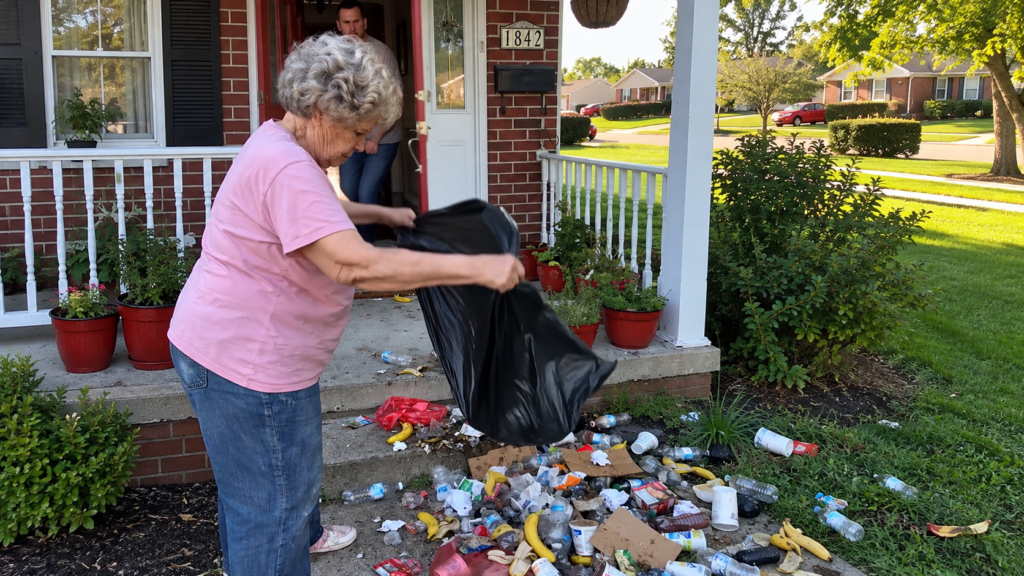
The first can struck Daniel Reed’s front door at eleven seventeen on Saturday morning.
Daniel heard the metallic rattle from his kitchen and assumed the wind had knocked something off the porch.
Then a glass jar shattered, and somebody shouted his name.
He opened the door to find Carol Mercer standing on his welcome mat with an empty black garbage bag in her fist.
At sixty-seven, Carol had the stubborn posture of a woman who had spent her life getting answers from people who preferred to walk away.
She was also standing in the middle of enough household rubbish to fill a wheelbarrow.
Coffee grounds stained his steps, wet newspaper stuck to the railing, and several empty cans rolled toward the flowerbeds.
Daniel stared at the mess.
“What are you doing?”
Carol folded her arms.
“You know exactly why I’m here.”
“This is my house, Carol, and you need to pick that up.”
“Perhaps you should think about what you threw away first.”
Her gaze darted toward a torn grocery bag near his left shoe.
Daniel followed it and saw a shipping label bearing his name.
He recognized the box immediately.
The label had arrived on Wednesday, attached to the replacement parts for a battered mechanical compass he had found in the storage shed at the recreation center.
He had discarded the box and its broken contents on Thursday night.
The locked trash bin stood behind a six-foot gate at the back of his house.
Carol could not have recovered the package without entering the property.
Daniel pulled the soggy cardboard from the pile.
Inside lay a small brass compass case, its glass face cracked and its needle missing.
“You went through my garbage.”
Carol stopped pretending not to be frightened.
“Did you open it before you threw it away?”
“I saw a broken compass.”
“And the paper ring?”
“What paper ring?”
She pushed past a spilled carton and knelt beside the box.
Daniel noticed that her hands were trembling.
“Tell me where you found this,” she demanded.
“In a storage crate at the old recreation center.”
“You weren’t supposed to take anything from that crate.”
“I was hired to clear it before the renovation.”
“Then you should have listened when I told you to keep out of that room.”
Daniel remembered three weeks of complaints about his truck, his visitors, and a ladder leaning against his shed.
He had considered Carol merely unpleasant.
Now he realized she had been trying to keep him away from something specific.
He stepped between her and the open door.
“Get off my porch.”
Carol rose carefully.
“A boy is going to walk into the north maze at three o’clock, and that compass is the only thing that tells us which exit isn’t real.”
Daniel blinked.
The annual Lantern Maze opened that afternoon at Briarfield Park.
Its temporary corridors were built from wooden panels and painted canvas, and teams raced to solve puzzles before sundown.
Daniel had volunteered to repair its mechanical puzzle stations after an organizer complained about broken equipment.
“It’s a game,” he said.
“That’s what they want you to think.”
“Who?”
Carol glanced toward the street, where a white delivery van had slowed beside the curb.
The driver watched them through a dark windshield.
“Get the box inside,” she said.
Daniel did not move.
“Tell me what is happening.”
The van rolled onward.
Carol lowered her voice.
“If you hand that compass to the wrong person, nobody gets to explain afterward.”
“You destroyed my porch to deliver a warning?”
“I destroyed your porch because you wouldn’t open the door when I knocked.”
“You never knocked.”
“I did yesterday, twice.”
Daniel remembered the headphones he had worn while repairing a wooden maze gate.
It was possible she had tried.
It did not excuse the mess.
“You’re going to help clean every bit of this,
” he said.
Carol’s expression hardened again.
“After we find the missing needle.”
He held up the broken compass.
“Why does a missing needle matter?”
“Because this was never a compass,” Carol said.
“It was a key.”
CHAPTER TWO: THE MAZE THAT MOVED
Daniel carried the wet box into the kitchen without inviting Carol inside.
She stayed on the porch while he washed his hands and examined the brass case beneath a desk lamp.
The outer ring was engraved with ordinary directions, but the lid contained four shallow grooves instead of the usual hinge markings.
One groove ended in a tiny star.
The others ended in shapes resembling a lantern, a ladder, and a door.
A thin disc of colored paper clung to the inside of the case.
Daniel eased it free with tweezers.
The disc looked like part of a child’s spinning wheel.
Its faded blue marks divided the circumference into uneven sections.
There was no needle.
There was no spring.
A conventional compass would have been useless without either.
He went back outside with the case in his palm.
“Who made this?”
Carol stood beside a mound of cans she had reluctantly begun collecting.
“A carpenter named Victor Saye.”
“Is he one of the festival volunteers?”
“He was the man who built the maze before the committee made it into a race.
”
Daniel knew Victor by reputation.
The retired scenic carpenter had designed elaborate community puzzles for nearly thirty years, and photographs of his work lined the recreation center foyer.
He had died the previous winter.
“What does the case unlock?”
Carol pointed at the blue disc.
“It doesn’t unlock anything directly.”
“Then what is it?”
“It tells the maze where people are supposed to go.”
Daniel stared at her.
“Wooden walls don’t move by themselves.”
“These ones do.”
She described the original Lantern Maze as an interactive walking puzzle, not a competitive obstacle course.
Its central chamber contained four doors arranged around a rotating stage.
A volunteer could turn the platform to change which door faced each corridor.
Children solved clues to discover the safe route, and every route eventually led outside.
Victor had built a mechanical selector to keep track of the door positions.
The compass case was one part of that selector.
A blue paper disc identified the rotation pattern used for the northern route.
Daniel had repaired two of the maze doors on Thursday.
One had been relocated without explanation.
He recalled fresh bolt holes on the back of a painted wall and a stack of spare panels behind an equipment trailer.
“They redesigned the course,” he said.
“That’s normal before a festival.”
“They changed the doors after the safety inspection,” Carol replied.
“That’s less normal.”
Daniel asked why she had not simply told the organizers.
Carol’s answer was immediate.
“I did.”
“And?”
“They said I was confusing the old maze with the new one.”
“Maybe you are.”
“Maybe you should see what I saw before you decide that.”
Carol placed the first can in his recycling bag, then reached for another.
Daniel looked toward the street.
Two children in bright festival shirts were carrying paper lanterns past his driveway.
He had promised to help install the finish-line bell at noon.
If Carol was wrong, investigating her story would cost him a volunteer shift and several apologies.
If she was right, somebody had changed a maze that hundreds of people were about to enter.
“You have ten minutes,” he said.
Carol picked up the torn grocery bag.
“Then drive.”
“You’re cleaning the porch first.”
“Daniel, this can wait.”
“No, it can’t.”
He handed her a broom.
“If you want me to trust you, you can start by admitting when you’ve crossed a line.”
For a moment, Carol looked ready to throw the broom at him.
Instead she began sweeping coffee grounds toward the dustpan.
“I entered your backyard Thursday,” she said.
“I took the bag from the bin and cut the lock off its hasp.”
“You cut the lock?”
“Yes.”
“You’ll replace it.”
“Yes.”
“And you’ll tell me everything you know.”
She swept another patch of concrete.
“That’s exactly what I’ve been trying to do.”
CHAPTER THREE: THE FOURTH DOOR
Briarfield Park smelled of fresh paint, pine boards, and cinnamon pastries.
Volunteers moved between tents while a local brass band rehearsed beside the fountain.
Beyond the sports field stood the Lantern Maze, a cluster of high canvas walls painted to resemble an enchanted city.
From outside, its structure looked playful and harmless.
Inside, Daniel knew, twelve corridors converged on a dark central chamber.
Carol refused to enter through the public gate.
She led him along the service fence to an opening behind the tool shed.
A yellow sign warned that the construction area was closed until three.
Carol pointed through the gap.
“Look at the northern door.”
Daniel saw a plain wall painted with silver clouds.
A brass handle protruded near its center.
“That wasn’t there last week,” he said.
“No.”
“Who installed it?”
“The sponsor’s contractors.”
At the far end of the enclosure, a young woman in a fluorescent vest was testing a wall-mounted lantern.
Daniel recognized her as Iris Bell, the festival’s safety coordinator.
He waved and she approached with a coil of rope over one shoulder.
“You’re early,” Iris said.
“And you’re standing in a construction zone.”
Daniel held up the broken brass case.
“Carol says Victor used this to track the doors.”
Iris’s face changed.
“Where did you get that?”
“I found it in the recreation center’s old equipment.”
“It was missing from the inventory.”
“It was in a crate marked scrap.”
“Someone changed the label,” Carol said.
Iris looked over her shoulder before speaking again.
“Come into the tool tent.”
They crossed the service yard while a forklift carried panels toward the maze entrance.
Inside the tent, Iris laid out a printed course diagram with colored paths.
The public route showed a single loop through the central chamber.
Three side corridors served as emergency exits.
A green arrow pointed toward the north door.
Carol pressed a finger against it.
“That corridor used to lead outside.”
Iris did not disagree.
“It still does on the approved plan.”
“But not on the ground,” Daniel said.
Iris reached for a ruler.
“The fourth door was originally decorative.”
“Victor designed it as a false choice,” Carol said.
“It opened onto a shallow alcove with a painted view of the street.”
“And now?”
“Now the alcove has become a corridor,” Iris replied.
“The production contractor says it leads to the new sponsor experience.”
Daniel frowned.
“A sponsor experience inside the emergency route?”
“I rejected the modification,” Iris said.
“It was installed anyway.”
Her supervisor had told her the change was temporary and would be removed before the public opened.
She had not been given a new diagram.
Daniel could see why Carol was afraid, but he still did not understand the missing needle.
Iris explained that Victor’s selector once fit into a brass plate at the maze’s control station.
It aligned the movable central platform with the correct exits.
The needle was shaped like a flat steel strip, not a magnet.
Its unique notch prevented the selector from turning unless the correct disc was inserted.
Carol had searched Victor’s workroom, the festival inventory, and the abandoned recreation center.
She had believed the strip was hidden inside the compass case.
“Then why throw the case away?” Iris asked Daniel.
“Because I thought it was broken junk.”
Carol stared at the map.
“The strip could still be in that crate.”
“The crate went to recycling Friday,” Daniel said.
Iris checked her phone.
“The municipal sorting depot is open for another hour.”
Daniel looked at the gray clouds gathering over the park.
The public gates opened in less than three hours.
“Before we search for a piece of steel,” he said, “I want to see where that new corridor really goes.”











