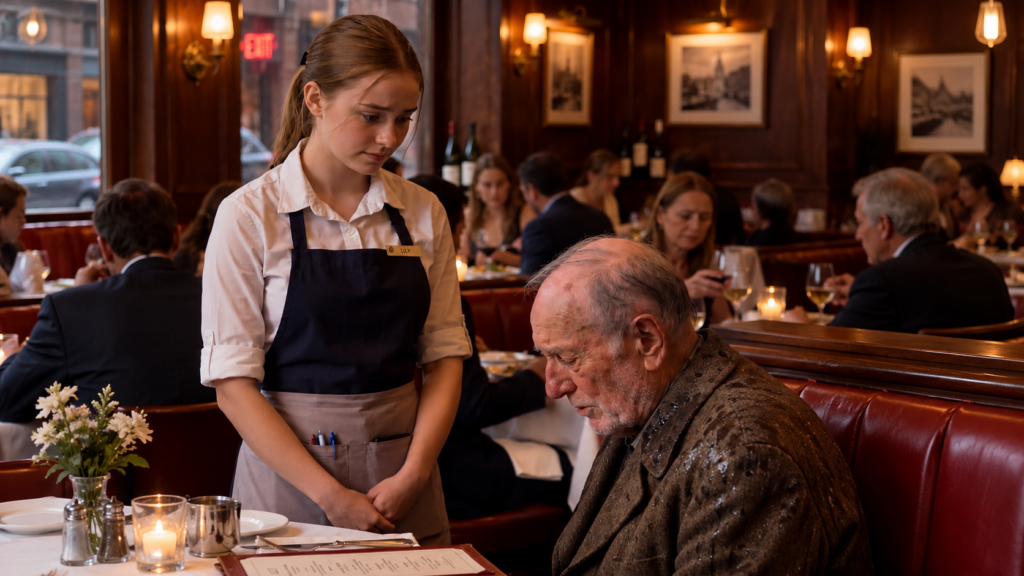
The first thing Lily Morgan noticed about the old man was that he kept his wet coat buttoned inside the dining room.
The second was that he looked toward the kitchen whenever somebody carried out a plate of hot food.
Rain blurred the tall windows of the Bellwether Steakhouse, turning Boston traffic into streaks of red and white.
The restaurant was busy enough that the host had stopped accepting walk-ins an hour earlier.
Nevertheless, somebody had allowed the man to sit near the entrance, perhaps assuming he was waiting for a relative with a reservation.
Lily had passed his table twice before she saw him fold the menu and slide it to the opposite side of the table.
She approached with her order pad tucked into her apron.
“Can I bring you something warm?” she asked.
He glanced at the prices without touching the menu again.
“I’m sorry, miss, but I don’t have enough for anything here.”
His voice was clear, and there was no performance in his embarrassment.
Lily knew that expression because she had worn it herself in a grocery store during the previous winter.
“The kitchen has soup, and I can cover the rest,” she said.
“You don’t have to spend your money on me.”
“I know.”
She returned to the service station, checked the cash tucked behind her name badge,
and asked the cashier to ring up a meal.
The cashier, Priya Shah, tilted her head toward the manager’s office.
“Grant’s been hunting reasons to cut hours all week.”
“I’m buying dinner, not starting a rebellion,” Lily answered.
“Sometimes he can’t tell the difference.”
Lily paid with cash, signed the slip, and carried soup, warm bread, and roast chicken back to the entrance.
The old man sat up when she placed the dishes before him.
“You remembered that I asked for something warm.”
“I remembered you were hungry.”
He tasted the soup, closed his eyes for a moment, and smiled.
“That’s good stock.”
“Our chef would be delighted to hear it.”
“What’s his name?”
“Her name is Simone Alvarez, and she deserves a much better manager.”
Lily regretted the last half of her sentence immediately.
The old man appeared not to notice.
He tasted the bread, then reached for his chicken.
Grant Holloway emerged from the dining room carrying a tablet against his chest like a shield.
“Who approved this table?” he demanded.
The sudden volume made three nearby guests turn toward the entrance.
Lily kept her voice level.
“I paid for the meal myself.”
Grant looked from the old man’s worn coat to the empty chair opposite him.
“This is not a charity kitchen.”
“He wasn’t asking for charity.”
“I don’t care what he asked for.”
“I followed the cashier procedure and paid the entire ticket.”
“You have interfered with the standards of this establishment.”
Lily stared at him because the words did not even seem to fit the situation.
“By purchasing food?”
Grant pointed toward the employee hallway.
“Turn in your badge. You’re done.”
The old man put down his fork.
“You fired her for helping me?”
“She violated policy,” Grant replied without looking at him.
“Which policy?” the old man asked.
“You are welcome to complain tomorrow.
”
Lily loosened her apron strings with hands that would not remain steady.
She had spent four years working restaurant floors and knew the difference between a warning and a dismissal.
Grant was enjoying the silence that followed his order.
She placed her badge beside the unopened dessert menus on the host stand.
“My food’s already been paid for,” the old man said.
“Your food isn’t the problem,” Grant replied.
“Then you have a problem you haven’t explained.”
The old man reached into his coat and brought out a battered flip phone.
Grant watched him dial with a thin smile.
“You can tell anyone you like.
”
“It’s Walter,” the man said into the receiver.
“I’m in the dining room. Come downstairs.”
He ended the call and put the phone on the table beside the soup.
Lily expected nothing to happen except another humiliation.
Instead, less than two minutes later, the private elevator at the back of the dining room opened.
A gray-haired man in an expensive charcoal suit hurried toward them.
Executive chef Simone Alvarez followed him, along with two senior managers Lily had met only at staff meetings.
Grant stopped smiling.
“Mr. Bennett,” the suited man said, “why didn’t anyone tell me you were here?”
The old man stood carefully and extended his hand.
“Because the person who noticed me was too busy being fired.”
The owner, Thomas Voss, looked at Lily’s folded apron.
“Walter, do you want me to handle this?”
“Not yet,” Walter answered.
He indicated the empty chair at his table.
“First, I want Lily to hear why I came here dressed like this tonight.”
Chapter Two: The Reason for the Coat
Lily remained standing because sitting seemed like agreeing that she was part of somebody else’s meeting.
Thomas noticed her hesitation.
“Please sit if you want to,” he said.
“If you prefer to leave, I won’t stop you.”
“I want an explanation,
” Lily replied.
She sat opposite Walter while Thomas pulled another chair from a nearby table.
Simone stood behind him with her arms folded.
Grant hovered beside the host stand, uncertain whether he was still in charge.
Walter touched the wet sleeve of his coat.
“I was out on the northern trail at six this morning.”
“A hiking trail?” Lily asked.
“A woodland survey site near the Merrimack.”
He opened his coat enough to show the edge of a canvas field vest marked with faded stains.
“I inspect wild mushrooms for restaurants and food markets when they have a reason to question what they’ve bought.
”
Lily looked toward Simone.
“We don’t serve wild mushrooms, do we?”
Simone’s expression changed.
“We’re serving them tomorrow night.”
Thomas rubbed the back of his neck.
“The Harvest Table dinner is tomorrow.”
“I know what night it is,” Walter said.
“I received a sample from your supplier yesterday.”
He pulled a small sealed sample box from an interior pocket, but he did not open it near the food.
“It wasn’t what the label said it was.”
Grant stepped forward.
“This has nothing to do with the server.”
Walter turned toward him.
“Neither did your decision to fire her.”
The sentence quieted him.
Walter explained that a distributor called North Quay Provisions had promised a rare wild mushroom assortment for an invitation-only dinner.
Thomas had advertised the meal for weeks, and more than ninety guests had paid deposits.
The dinner included a visiting chef, specialty wines, and a menu printed on thick paper with drawings of woodland plants.
Walter had been hired to review the shipment because Simone had questioned its unusually uniform appearance.
He had arrived without an appointment because the replacement lot was reportedly due that evening.
His bicycle had suffered a puncture near the waterfront, and he had reached the steakhouse after walking through the rain.
He had left his wallet in a locked field case at the survey office, believing he would be met at the kitchen door.
“I tried that door,” Walter said.
“A man there told me guests were not allowed through the staff entrance.”
“Who?” Simone asked.
“He was wearing a black kitchen coat with a red pen in his pocket.”
Simone exhaled sharply.
“Felix.”
Grant lifted his chin.
“Felix follows the access list.”
“There shouldn’t be a problem with Walter’s access,” Thomas replied.
“We invited him.”
“I had no information about that,” Grant said.
Simone looked at Thomas.
“I sent Grant Walter’s name yesterday.
”
Thomas reached for his phone but Walter shook his head.
“That disagreement can wait.”
“What can’t wait?” Lily asked.
“The shipment,” Walter replied.
“A mislabeled mushroom can be an expensive disappointment, or it can be a medical emergency.”
He made no claim about the exact species in the boxes they had yet to inspect.
Instead, he described the limits of determining wild mushrooms from dried fragments and photographs.
“The first lot is uncertain enough that nobody should serve it.”
“I told North Quay to hold the second lot,” Simone said.
Thomas looked at her.
“I was told the supplier had corrected the labels.”
“I asked for documented identification, not fresh labels,” Simone replied.
Grant cleared his throat.
“The supplier’s driver has already left.”
“Left where?” Thomas asked.
“The harbor depot.”
“And where is the truck now?”
Grant looked at his tablet.
“That’s an operations matter.”
Simone stepped toward him.
“The driver has a loading window at seven.”
Lily glanced at the clock.
It was six forty-three.
A line cook crossed the far doorway carrying a crate with a bright orange North Quay sticker.
Walter noticed it at the same moment.
“That’s not tomorrow’s delivery,” he said.
“It’s already here.”
Chapter Three: The Orange Sticker
Simone moved first, crossing the dining room without asking permission.
Thomas followed her, then Walter, then Lily.
Grant called after them that customers were watching.
Nobody turned around.
At the kitchen entrance, a young dishwasher named Ben Ortiz was stacking empty crates beside a trolley.
“Where did that one come from?” Simone asked.
Ben pointed toward the service corridor.
“Felix told us to unpack the orange ones before the count.”
The chef looked at the crate in his hands.
“Stop moving them.”
Lily stayed behind the kitchen threshold because her badge lay on the host stand.
Walter spotted her and said, “She saw the package arrive.”
Simone waved her inside.
“Then she’s a witness, not a server.”
That was not a legal distinction, but Lily appreciated the intention.
In the corridor, ten orange-labeled crates occupied a stainless-steel cart.
Three more stood behind the walk-in refrigerator.
Each bore the words HERITAGE FOREST COLLECTION in oversized green letters.
The smaller labels listed multiple common mushroom names without a visible harvest location.
Simone read the tags carefully and refused to let anybody open the containers.
“We quarantine the entire lot until a qualified identification process is complete,” she said.
Felix arrived carrying a roll of packing tape.
His red pen protruded from his coat pocket.
“Why is everyone blocking the corridor?”
“Where did the mushrooms come from?” Simone asked.
“North Quay,” he answered.
“That is a distributor, not an answer.”
Felix looked toward Grant, who had finally caught up.
“I was told these crates were cleared.”
Grant took one step into the corridor.
“They were scheduled for intake.”
“Who cleared them?” Thomas asked.
“The purchase order did,” Grant said.
Walter stared at him.
“A purchase order doesn’t identify wild food.”
Lily noticed that one crate had a second orange sticker partially covering an older one.
A corner had lifted because the adhesive was damp.
She pointed it out without touching the package.
Simone bent to look.
Beneath the upper sticker were two letters in blue ink and an entirely different item count.
“That’s odd,” Simone said.
Grant’s voice sharpened.
“Stop treating every packaging mistake like a crime.”
“Nobody called it a crime,” Walter replied.
“We’re trying to determine what’s safe.”
Thomas ordered the containers moved into a secured refrigerated holding area.
Simone instructed the kitchen crew not to use any of the ingredients pending verified assessment.
Ben brought clean trays to separate the cartons from the shelves holding ordinary produce.
The staff worked quickly and quietly.
Lily helped count the crates as they moved them.
Three were smaller than the others, and one bore a delivery tag addressed not to the Bellwether but to a restaurant across the river.
“This one’s for Crane Wharf,” she said.
Thomas frowned.
“We don’t receive their supplies.”
“Maybe the driver mixed a pallet,” Felix suggested.
Walter examined the outer shipping tag.
“Then somebody needs to tell Crane Wharf before they cook with whatever arrived in the corresponding crate.”
Thomas took out his phone.
Grant interrupted.
“They are competitors.”
Simone turned on him.
“Their guests are still people.”
Thomas called Crane Wharf’s executive chef while Lily copied the visible package counts onto an unused service order sheet.
A man answered after several rings.
He said Crane Wharf had received a similar delivery and that his team had already prepared a mushroom filling for the next day’s private lunch.
Thomas relayed Walter’s concern and recommended holding the ingredient until independently checked.
The chef fell silent, then agreed to stop using the shipment and alert the staff.
Walter asked him to preserve unopened packaging and follow qualified local food-safety advice.
He did not suggest a home test or a shortcut for identifying species.
When the call ended, Grant leaned against the freezer door.
“You’ve just told another business we’re dealing in dangerous food.”
Thomas looked down at him.
“I told them we didn’t know what we had.”
“You could wreck the dinner.”
“A dinner can be rescheduled,” Simone said.
“A guest’s health isn’t something we gamble with.”
Lily glanced at Walter, who seemed less interested in the argument than in the quiet dishwasher at the end of the corridor.
Ben had stopped moving.
He was staring at a damp envelope taped under the handle of the last crate.











