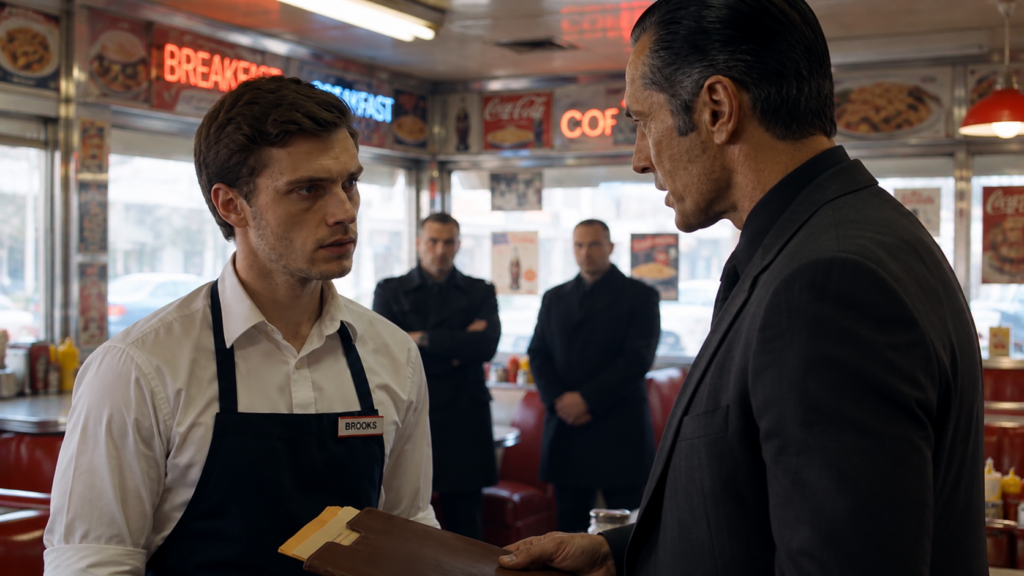
The old man arrived at the Briar Street Diner at 5:17 on a Thursday morning, when the windows were still black and the cook was arguing with a broken toaster.
Daniel Brooks noticed the bandage first. It covered the stranger’s left hand from the knuckles to the wrist, but the fingers were exposed and badly swollen. The man wore a wool coat too heavy for the weather and carried himself with the careful dignity of someone determined not to ask for help.
“Counter or booth?” Daniel asked.
“Somewhere I can see the door.”
Daniel pointed to the second booth. The man ordered eggs, toast, and coffee, then sat looking at the untouched silverware. When Daniel brought the plate, the stranger attempted to lift his fork. His fingers trembled. He set it down before anyone could notice.
Daniel noticed anyway.
“Need some help?”
The man looked at the floor. “I can’t hold the fork steady.”
Daniel fetched a clean knife, cut the eggs and toast, opened the syrup, and replaced the heavy mug with a lighter cup. He did it without an audience and without the cheerful pity that could make assistance feel like a performance.
From the register, his manager, Kent Voss, called, “You’re not paid to babysit customers.”
Daniel didn’t turn. “I’ll take care of table six next.”
“You’ll take care of it now.”
“Then you can fire me after breakfast.”
The old man watched this exchange with an expression Daniel could not read. After eating, he studied Daniel’s name tag.
“Brooks,” he murmured. “I knew that name once.”
“There are a lot of us.”
“Not as many as there should have been.”
He left enough cash for the meal and a modest tip, then paused outside as though deciding whether to come back. A gray delivery truck rolled past. The old man flinched at the sound of its loose tailgate.
Daniel thought about that strange reaction until the morning rush erased it.
Chapter Two: The Dossier
At 6:03 the next morning, a black sedan stopped across two parking spaces. A tall man in a charcoal suit emerged, followed by two men who stood by the entrance rather than entering. He carried a leather dossier beneath one arm.
The diner grew quiet when he asked, “Which one of you is Daniel Brooks?”
Daniel raised his hand. Kent appeared beside the coffee machine, suddenly eager to be useful.
“I’m Adrian Vale,” the visitor said. “You helped someone yesterday.”
He placed the dossier on the counter. Inside were photographs of storefronts, clipped articles about a waterfront strike, addresses in three states, and pages on which BROOKS appeared in different handwriting. At the center lay a photograph of the injured old man, decades younger, beside a row of freight containers.
The caption read: MARCEL ORSINI, 1998.
Daniel’s father had spoken that name only once, during the last evening of his life, when fever and medication had stripped away his usual caution. Daniel remembered leaning close to the hospital bed and hearing: “If Orsini comes, don’t let him choose for you.”
“What do you want?” Daniel asked.
“To correct a mistake that has lasted twenty-six years.”
“Then start by explaining why you brought bodyguards to a diner.”
Vale glanced toward the window. “They’re not here to threaten you. They’re here because the man you fed yesterday is in danger.”
Kent reached for the dossier. Vale shut it before his fingers touched the leather.
“Private conversation,” Vale said.
“This is my restaurant,” Kent protested.
“Then you can decide whether your customers should hear it.”
Daniel led Vale into the narrow hallway by the storeroom, leaving the door open. He had learned early that secrecy often benefited the person who demanded it.
Vale explained that Marcel Orsini had once run a criminal organization along the eastern docks. Daniel’s father, Nathan Brooks, had been a commercial refrigeration mechanic. Twenty-six years earlier, a warehouse blaze killed six workers. Orsini was blamed for ordering the fire; Nathan was blamed for disabling a safety alarm. Both accusations had survived because nobody trusted either man’s account.
“My father wasn’t a criminal,” Daniel said.
“I didn’t say he was.”
“You put his name in a mafia file.”
“I put it in a file about people who were harmed by the mafia. There’s a difference.”
Vale opened the folder to a page of portraits. Daniel recognized his father in a photograph taken before his hair turned gray. Nathan stood with a wrench in one hand, smiling at someone outside the frame. Behind him was a painted sign: HARBOR NIGHT SHIFT COOPERATIVE.
“Your father built something,” Vale said. “Orsini helped destroy it. Now someone is rebuilding the same arrangement, and the people who know how it worked are disappearing from the conversation.”
Daniel looked at the folder again. “Is Marcel alive?”
“Yes. But he won’t be safe for long if he stays where he is.”
Chapter Three: A Different Kind of Debt
Daniel refused Vale’s offer of a ride. He finished his shift, called his younger sister, June, and met her at their father’s old garage. June repaired bicycles for a living and had no patience for dramatic strangers with expensive cars.
“A mafia figure comes into your diner with Dad’s name in a folder,” she said, “and your first instinct is to investigate?”
“My first instinct was to ask him to leave.”
“That’s reassuring. What was your second?”
“To find out why Dad said Orsini’s name in the hospital.”
June put down a wheel rim. “Dad also told you to fix the porch step. That took four years.”
They had grown up hearing that Nathan Brooks had been fired after an accident at the docks. He spent the rest of his life repairing appliances for neighbors who could rarely pay. He never spoke about the warehouse fire, not even when a documentary crew arrived asking for interviews.
In a cabinet June found a stack of instruction manuals, each marked with Nathan’s meticulous pencil notes. One contained a photograph tucked between the pages: twelve workers at a long table, sharing food in an empty warehouse. A handwritten caption said, THE FIRST NIGHT WE ATE TOGETHER.
On the back, Nathan had written, “Nobody clocks out hungry.”
June studied it. “He never showed us this.”
“Maybe he thought it was gone.”
A knock sounded on the garage door. Daniel lifted the shutter and found the injured man from the diner standing alone.
“I hoped you’d be here,” Marcel Orsini said.
June picked up a heavy adjustable wrench. “You have ten seconds to explain yourself.”
Marcel did not move closer. “Your father once saved my life. He also spent twenty-six years wishing he hadn’t.”
Chapter Four: The Man at the Table
Marcel sat on an overturned crate while June remained near the open door. He spoke without theatrical pauses, like someone who had rehearsed a confession too many times and no longer trusted his own voice.
The Harbor Night Shift Cooperative had begun as a shared kitchen for dockworkers who were paid by the load and frequently missed meals. Nathan built refrigeration equipment from discarded parts. Workers from rival crews ate together, exchanged information about dangerous equipment, and refused unsafe shifts as a group.
“That frightened the owners,” Marcel said. “And it frightened men like me. My business depended on crews being isolated. I could pressure one foreman at a time. I couldn’t pressure a hundred workers who knew one another.”
“So you burned it,” June said.
Marcel’s face tightened. “I ordered men to shut the kitchen. I wanted the doors locked, the food spoiled, and the organizers humiliated. I didn’t order anyone to light a fire. But I sent people who thought violence was the easiest language.”
“That’s not much of a defense,” Daniel said.
“It isn’t one.”
He described the night of the blaze. Nathan had been repairing a compressor when two men entered. A fight broke out. A lamp fell near cleaning supplies. Smoke spread through the warehouse. Nathan dragged Marcel out through a loading door even after recognizing him as the man who had ordered the shutdown.
“Why did Dad save you?”
“He said there were enough people dying that night.”
Marcel stared at his bandaged hand. “I told him I would make things right. Instead I let my people convince the city that a faulty alarm had caused the deaths. Nathan lost his job. The cooperative collapsed. I kept my territory.”
June’s voice turned cold. “And now you want forgiveness because someone cut your breakfast?”
“No. I came because your brother treated me like a person without knowing what I’d done. I wanted to remember what that felt like before I did something I should have done years ago.”
He placed a small paper card on the workbench. It listed a time and a location: MONDAY, 9 A.M., NORTH PIER REDEVELOPMENT HEARING.
“The city is about to award a new food-service concession at the rebuilt pier,” Marcel said. “The applicant uses the cooperative’s name. The people behind it intend to hire workers through the same coercive system that destroyed the original kitchen.”











