Chapter Six: The Road Out
Nettie met Samuel that afternoon beside the smokehouse.
The building smelled of cured meat and ash, and its thick walls made ordinary conversation difficult to overhear.
“I heard the name Wren,” she said.
“He has been moving children under a medical arrangement.”
“Where?”
“He claims they go to other households.”
“That’s not an answer.”
“I know.”
Nettie rubbed her hands against her apron.
“My aunt works in Vicksburg near the river warehouses.”
“Can she help?”
“She knows the people who unload wagons.”
“Can she send word back?”
“Only if we find someone she trusts.”
Samuel looked toward the fields.
“Pike watches the road.”
“He watches what he expects to see.”
“He expects me to try to run.”
“Then you do not go.”
Nettie gave him a narrow smile.
“The doctor has been receiving supplies from town, and his driver makes the trip every Thursday.”
“The driver works for Pike.”
“The driver also owes my cousin money.”
Samuel stared at her.
“How do you know?”
“Because my cousin told everybody in the kitchen.”
Samuel almost laughed.
The sound surprised him so much that he stopped it immediately.
Nettie was not proposing an impossible rescue.
She was identifying a person with reasons to listen.
“What should we send?” he asked.
“Names.”
“Names are dangerous.”
“They are already dangerous when Wren uses them.”
She held out a scrap of cloth.
“I can stitch the names into the hem of a coat.”
“Some of the children cannot tell me their full names.”
“Then write what they can tell you.”
Samuel looked at her sharply.
“You know I can read?”
“I know you can make a mark that means something.”
“That knowledge could get us punished.”
“Everything we are doing could get us punished.”
Nettie softened her voice.
“We still need to decide which danger has a purpose.
”
That evening, Samuel returned to the spinning shed with fresh water and a hammer.
He asked Ellis for his mother’s name and where she worked.
He asked Ruth whether her father had a sister in town.
He kept his questions quiet while Pike argued with the wagon driver outside.
Ellis told him that his mother’s name was Clara and that she sang while cutting cotton because silence made her hands shake.
Ruth said her father had once repaired a boat near Vicksburg.
Samuel repeated the details until he could remember them.
The boy watched him with solemn eyes.
“Are you taking us home?” Ellis asked.
Samuel knelt beside him.
“I am trying to get word to people who know you’re here.”
“Will it work?”
“I don’t know.”
“Then why try?”
Samuel looked toward the doorway.
“Because you deserve more than another person telling you to wait.”
He rose before the child could answer.
Outside, Pike was furious with the driver over a missing barrel of lamp oil.
The quarrel gave Samuel enough time to pull the rear bolt free and hide it beneath a floorboard.
He was careful to leave the door looking secure.
He knew a door that opened could save a life only if somebody knew where it led.
Before leaving, he told Ruth how to twist the iron plate if she heard shouting.
She repeated the instruction twice.
Ellis asked whether the passage went to the road.
“It goes to the old orchard,” Samuel said.
“After that, you have to follow the fence until you reach the dry creek bed.”
Ruth watched his face.
“You’re frightened too,” she said.
“Yes.”
“Then I believe you.”
He carried that answer back to the main house like a thing more precious than the cloth in his sleeve.
Chapter Seven: A Missing Driver
The Thursday wagon left before sunrise with Pike riding beside the driver.
Nettie managed to slip the stitched cloth into a bundle of kitchen aprons before the wagon departed.
She expected her cousin to find it when the driver stopped for supplies.
Instead, the wagon returned at noon with Pike alone.
The driver had been dismissed on the road, Pike announced, and would not be coming back.
Nettie felt her knees weaken.
Samuel saw the look on her face and knew immediately that their first attempt had failed.
Pike ordered Samuel to help unload two crates from the wagon.
They were marked as agricultural implements, but one contained baby blankets and the other held little wooden tags.
Samuel counted seventeen tags before Pike slammed the lid shut.
“Eyes down,” the overseer snapped.
Samuel lifted the crate without replying.
At the kitchen door, Nettie pretended to drop a ladle.
“Did he find the cloth?” she whispered as Samuel bent to retrieve it.
“I don’t know.”
“Pike searched the driver’s coat at the gate.”
“Did you see him take anything?”
“No.”
“Then we wait for word.”
“We cannot wait.”
They separated when a chambermaid entered.
By afternoon the household was preparing for a dinner in honor of Dr. Wren.
The physician would leave the following morning with two hired wagons,
and Mr. Harrow had invited neighboring planters to hear about the progress of his new agricultural and domestic program.
Samuel heard the announcement while repairing the nursery cradle.
He lowered his tools and considered the names hidden in the hem of the missing driver’s coat.
The cloth might be on the road to town.
It might be in Pike’s pocket.
It might already have been burned.
There was no way to know.
He needed something more immediate than a message carried by a stranger.
That evening, he found Nell, an older woman who had worked in the laundry longer than anyone could remember.
She was folding bed sheets beneath a fading patch of sunlight.
“How many people have been taken from the quarters this season?” he asked.
Nell looked at him carefully.
“Why do you need the number?”
“Because somebody is telling the county that they were sent to work.”
“And they weren’t?”
“Some of them were children.”
Nell sat down slowly.
“I have the names.”
Samuel stared at her.
“You wrote them down?”
“I remember them.”
“All of them?”
“A person should not have to be written on paper to be remembered.”
She began speaking, and the names came with details no official list could contain.
She remembered who had carried a yellow ribbon, who had lost a tooth, who had promised to return for a sister, and who had cried because a puppy followed the wagon.
Samuel listened until tears made his eyes ache.
“There are twenty-three,” Nell said.
“How long have you been counting?”
“Since before Mrs. Harrow asked for the first basket.”
She folded the last sheet with careful hands.
“I have been waiting for somebody to ask.”
Samuel realized that he had mistaken his own isolation for the absence of other witnesses.
There were people in every part of the plantation who had noticed fragments of the same pattern.
Their greatest difficulty was not remembering.
It was finding a way to make their memories reach one another without giving Pike a name to punish.
That night Samuel asked Nell to speak to three women she trusted.
He asked Nettie to speak to the stable boy, who knew when the wagons moved.
He asked Ruth to remember what she had heard from the driver.
He did not call the work a plan because plans could sound like promises.
He called it learning what had happened.
By midnight, the names began to connect.
Chapter Eight: The Dinner
The main house glowed with candles while rain collected in the ruts of the front drive.
Samuel was ordered to carry coal upstairs and remain near the nursery.
Through the open dining-room doors he heard Dr. Wren describing the efficiency of his household arrangements.
“The great difficulty with domestic placements is uncertainty,” the physician told the guests.
“I provide reliable assessments and supervised transfers.”
A planter asked whether he accepted entire families.
“When the receiving household requires it,” Wren said.
Samuel pressed his hand against the coal bucket.
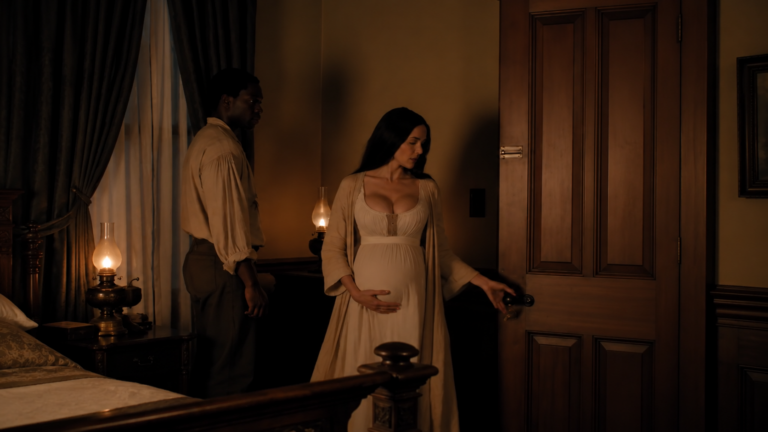
Mrs. Harrow sat at the table in a pale dress that drew every visitor’s attention to her pregnancy.
Her husband raised a glass to the doctor’s excellent judgment.
Wren accepted the praise with a modest incline of his head.
“A healthy household depends on disciplined management,” he said.
Mrs. Harrow pushed her plate away.
Mr. Harrow touched her shoulder.
“You must be tired, my dear.”
“I am not tired,” she answered.
The words were quiet, but Samuel heard the strain beneath them.
Wren watched her across the candles.
“Then perhaps you would like to share the happy news about the nursery.”
She looked at him.
“What news?”
“The final preparations will be complete tomorrow.”
Samuel felt a sudden chill.
Tomorrow was also the day the wagons would leave.
The doctor was presenting the transfers as a celebration of the coming child.
Mr. Harrow laughed.
“My wife keeps every surprise until the last moment.”
Wren raised his glass again.
“Some surprises are best revealed after the necessary arrangements are made.”
Mrs. Harrow stood so abruptly that her chair scraped the floor.
“Excuse me,” she said.
She left the room without waiting for permission.
Samuel followed her upstairs at a distance.
She reached the nursery and leaned against the cradle.
“He intends to take Ellis and Ruth tomorrow,” Samuel said from the doorway.
She turned toward him.
“You cannot know that.”
“The wagons are ready.”
“Wren promised he would delay.”
“He lied to you before.”
Her face tightened.
“What do you expect me to do?”
“Tell your husband what the doctor is taking.”
“He will blame me.”
“People have already been taken.”
“You do not understand what my husband can do when he is angry.”
Samuel looked at the woman who had sent for him each night.
“I understand what he can do better than you do.”
She moved toward him, then stopped.
“If I say anything, Pike will accuse you of inventing the story.”
“Then don’t tell it as my story.”
“What do you mean?”
“Tell him where the wagons are.”
“Wren will deny everything.”
“Then make him open the crates.”
She shook her head.
“You think a man will believe a frightened child over his physician?”
“I think a man who believes he is paying for one thing may ask why he is getting another.”
Mrs. Harrow stared at him.
Samuel hated using her husband’s pride as a weapon, but pride was a language that planter understood.
“You invited Wren into this house,” he said.
“You can make him answer questions here.”
She looked down at the cradle.
“And if he refuses?”
“Then the people who know the children are missing will ask them.”
She raised her eyes.
“You have spoken to others.”
“Yes.”
Fear flickered across her face.
“Pike will find out.”
“He may already know.”
For a moment she seemed ready to call the overseer.
Instead, she sat down heavily.
“You have no idea how badly this can end,” she whispered.
Samuel remembered Ellis asking whether he was going home.
“I know how it has been ending,” he said.