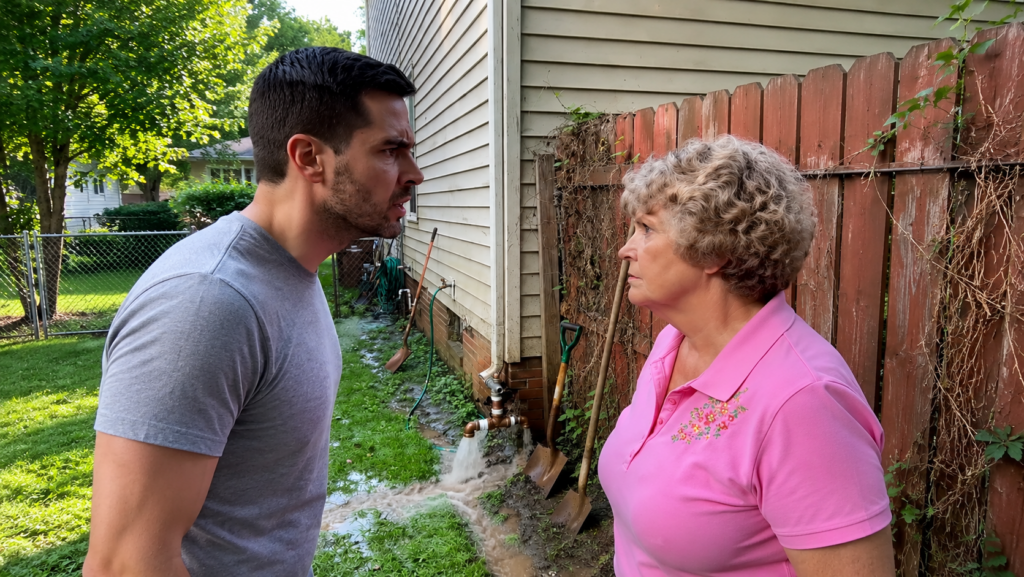
The first blow sounded like somebody striking a church bell with a wrench.
Ethan Cole abandoned the cabinet he was repairing and hurried through his kitchen.
The second blow came before he reached the side door.
Outside, his sixty-five-year-old neighbor, Carol Mercer, stood over a copper water line with a short demolition hammer in her hand.
Water shot across the narrow strip of lawn between their houses.
“What are you doing?” Ethan shouted.
Carol pointed at the spreading puddle as though the damage had appeared by itself.
“That pipe has been leaking onto my property for months.”
Ethan stared at the bright copper exposed where the older pipe had split.
“You didn’t stop a leak. You smashed it.”
Carol’s gloves were wet, but her shoes were dry.
She had positioned herself beyond the spray before bringing down the hammer.
“Then fix it and stay out of my business,” she said.
Ethan reached the isolation valve by the basement steps and shut it off.
The water weakened, dribbled, and stopped.
He was reaching for his phone when a white utility truck rolled to the curb.
A man wearing a city inspection badge stepped out, carrying a canvas tool bag.
Ethan recognized him from a visit two days earlier.
His name was Luis Moreno,
and he worked for the municipal cross-connection inspection office.
“I heard the impact from the corner,” Moreno said.
He looked at the open wound in the pipe, then at Carol’s hammer.
“Who opened this line?”
Carol said nothing.
Moreno knelt and examined a shiny ring inside the copper.
He slipped a narrow gripping tool into the broken section and withdrew a length of transparent plastic tubing.
The tube was small enough to fit through a drinking straw.
A little blue stain marked its end.
“What is that?” Ethan asked.
Moreno looked directly at Carol.
“That’s what I was hoping she would explain.
”
Carol’s hand tightened around the hammer.
“I don’t know anything about it.”
“We found the same hidden tubing connected to three properties on this block,” Moreno said.
“Your property was the fourth address on my inspection list.”
Ethan took a step backward.
He had owned the house for seven years and had never authorized anybody to modify its service line.
Moreno sealed the tubing in a transparent sample pouch.
“Please don’t touch the damaged assembly,” he told Ethan.
“We need to establish whether anything entered the drinking-water side.”
Carol stared at the pouch as though it were a live insect.
“It’s just plastic,” she said.
“Then why did you destroy the copper around it?” Ethan asked.
Carol’s face crumpled for an instant.
She looked toward her own house, where the curtains in the upstairs study had been drawn since dawn.
“You should have minded your own business,” she whispered.
Moreno straightened.
“Mrs. Mercer, has anyone asked you to interfere with this inspection?”
Her answer came so quickly that it sounded rehearsed.
“No.”
From across the street, a van with an enormous painted water droplet turned into the neighborhood.
Its side read ALDER SPRING, PURE FROM THE EARTH.
Carol watched it approach with open alarm.
The driver saw the utility truck and immediately turned into a side street.
Moreno followed the van with his eyes.
“Interesting timing,” he said.
Ethan looked at the blue stain on the tubing.
It matched the turquoise droplet printed on the van.
He wanted to believe that coincidence explained everything.
But Carol had not come outside because a pipe was leaking.
She had come to break a connection before somebody else could examine it.
Chapter Two: Four Houses
By nine o’clock, Ethan’s kitchen taps carried official warning tags.
Moreno had arranged for the affected connection to be isolated pending testing.
A city crew brought temporary drinking water and explained which household fixtures should not be used.
Ethan thanked the crew, then looked at the stack of clean dishes he could no longer wash.
His immediate problem was simple and maddening.
A neighbor had broken his water supply because she was frightened of a small piece of plastic.
His larger problem walked up the driveway wearing bright yellow rain boots.
Nina Patel, who lived two doors down, held a gallon jug in one hand and a tablet computer in the other.
“You got the blue tube too?” she asked.
Ethan showed her Moreno’s contact information.
“Apparently you’re not the only one.”
Nina was a pastry instructor at the community college.
She had bought her house three years earlier and usually avoided neighborhood disputes.
This morning she looked ready to argue with a fire engine.
“The city visited my basement on Thursday,” she said.
“They found an extra connection behind my old laundry sink.”
“Did anyone work there recently?”
“A man named Derek installed a garden misting demonstration last spring.”
Ethan frowned.
“Why would a garden misting demonstration need your laundry room?”
Nina gave him a humorless smile.
“That’s precisely what I asked yesterday.”
She showed him a photograph from her own plumbing inspection.
The tiny tubing was transparent and stained pale blue.
“The man said he represented the community beautification committee,” she continued.
“Carol told me it was harmless and that the neighborhood would receive free landscaping.”
A teenage girl on a bicycle stopped near Ethan’s open gate.
“Are you Ethan Cole?” she asked.
“Yes.”
“I’m Tessa Finch.”
She pointed down the street.
“My grandfather’s home is the third one with the tubes.”
Ethan knew the grandfather, a retired band teacher named Raymond Finch.
Raymond kept his curtains open and played old jazz records loud enough to reach the sidewalk.
“Is he all right?” Ethan asked.
“He’s angry,” Tessa replied.
“Which means he’s probably fine.”
She handed Ethan an unopened brochure.
The front showed a sunlit mountain spring.
The back showed Raymond smiling beside a branded bottle.
“Grandpa never agreed to be in that advertisement,” Tessa said.
Ethan read the headline.
Alder Spring: The Water Our Elders Remember.
“Where did this come from?”
“It’s being handed out for Saturday’s launch at the old theater.”
Nina examined the brochure.
“Why is the address for the supposed spring a mailbox store?”
Tessa shrugged.
“That’s one of the questions Grandpa asked before somebody called him a troublemaker.”
A police cruiser pulled in beside the utility truck.
Officer Jana Brooks emerged, followed by Carol, who had walked over from her own house.
Carol appeared composed again.
Her hair was tied back, and the hammer had disappeared.
“I want to file a nuisance complaint,” she announced.
“His leaking pipe ruined my garden.”
Ethan pointed to the pieces of copper on his porch.
“Your hammer ruined the pipe.”
Brooks asked everyone to speak one at a time.
Moreno joined them and carefully distinguished the damaged plumbing from the mystery connection.
“I cannot yet say what the tube carried,” he told the officer.
“I can say it was placed where no approved household device belongs.
”
Carol crossed her arms.
“Derek said the city approved it.”
Silence followed.
Moreno took out his notebook.
“Which Derek?”
Carol’s expression shifted.
She had named someone she had meant to keep hidden.
“I don’t remember his last name.”
“Then give me the business that employed him,” Moreno said.
“I don’t have to answer questions on my lawn,” Carol snapped.
Brooks looked at the wet ground beneath their feet.
“You’re standing on Mr. Cole’s lawn.”
Tessa made a small choking sound as she suppressed a laugh.
Carol turned away.
“You’ll all regret making this public,” she said.
Ethan watched her cross the sidewalk.
The threat bothered him less than the frightened way she glanced toward the theater district.
Whatever Alder Spring was selling, Carol believed a tiny tube could ruin it.
Chapter Three: The Water Story
Ethan repaired restaurant refrigeration equipment for a living.
His job made him suspicious of any machine that promised too much and explained too little.
It also gave him a useful habit.
He asked what a system actually did before accepting what its owner called it.
By noon, he was standing outside Alder Spring’s newly opened storefront with Nina and Tessa.
The shop occupied a former shoe-repair business near the old Calder Theater.
Its windows displayed handmade-looking stone bottles and photographs of green hills.
A chalkboard offered a tasting flight of three supposedly distinct mineral waters.
Inside, a woman in a white linen jacket poured samples for customers.
Her name tag read LEAH MORROW, WATER CURATOR.
“Welcome to Alder Spring,” she said.
“Have you discovered your body’s natural mineral signature?”
Nina answered before Ethan could speak.
“I’d like to discover where the water comes from.”
Leah smiled.
“Our source is a historic underground formation.”
“Where is it?”
“The location is protected.”
“Who protects it?” Ethan asked.
Leah’s smile weakened.
“Our founder would be happy to explain the philosophy.”
“I asked about plumbing.”
Tessa picked up a small bottle and read the label.
The front called the water RESTORATIVE RESERVE.
A sentence on the back claimed that generations of local families had treasured the source.
Another sentence urged customers to consult medical professionals about their health.
It was careful language arranged beside photographs that implied much more.
A gray-haired woman at the tasting counter lifted a small glass.
“They say it helped a woman walk without her cane,” she told her friend.
Leah did not correct her.
Nina watched that exchange with narrowed eyes.
“How much for the subscription?” she asked.
“The founder’s annual plan is twelve hundred dollars.”
Ethan almost dropped the bottle he was holding.
“For water?”
Leah lowered her voice.
“For a curated experience with seasonal deliveries.”
A door behind the counter opened.
A tall man in a navy jacket stepped out carrying a stack of invitations.
He had a bright smile and eyes that assessed the room before settling on a person.
“I hope everyone’s enjoying the tasting,” he said.
Leah looked relieved.
“Mr. Bell, these visitors have questions about the source.”
The man’s smile widened.
“Questions are the beginning of discovery.”
He offered Ethan his hand.
“Adrian Bell.”
Ethan did not take it.
“Ethan Cole.”
Bell paused for half a second.
“I know your street.”
“You know my water line too?”
Nina showed him the photograph of the blue-stained tubing.
Bell glanced at it, then returned his eyes to Ethan.
“We’ve never installed anything in your home.”
“I didn’t say you had.”
“Then perhaps we should avoid accusations in front of customers.”
The gray-haired woman set down her tasting glass.
Tessa stepped forward.
“Why is my grandfather on your brochure?”
Bell looked at her carefully.
“The Finch family was generous enough to share some neighborhood history.”
“He told you not to use his picture.”
“I’m certain we can address that.”
“He already addressed it,” Tessa replied.
“You ignored him.”
Leah began stacking glasses with unnecessary energy.
Bell handed Ethan a business card.
“Come to our Saturday launch,” he said.
“We invite the whole city to hear our story.”
“We’ll be there,” Ethan said.
Outside, Nina let out a long breath.
“That man answers every question with a new question.”
“He knew my street before I mentioned it,” Ethan said.
Tessa unfolded the brochure again.
At the bottom, beneath the photograph of her grandfather, was a small drawing of four houses beside a blue line.
The drawing was labeled THE ORIGINAL ALDER CORRIDOR.
Ethan recognized the rooflines.
One of them was his.











