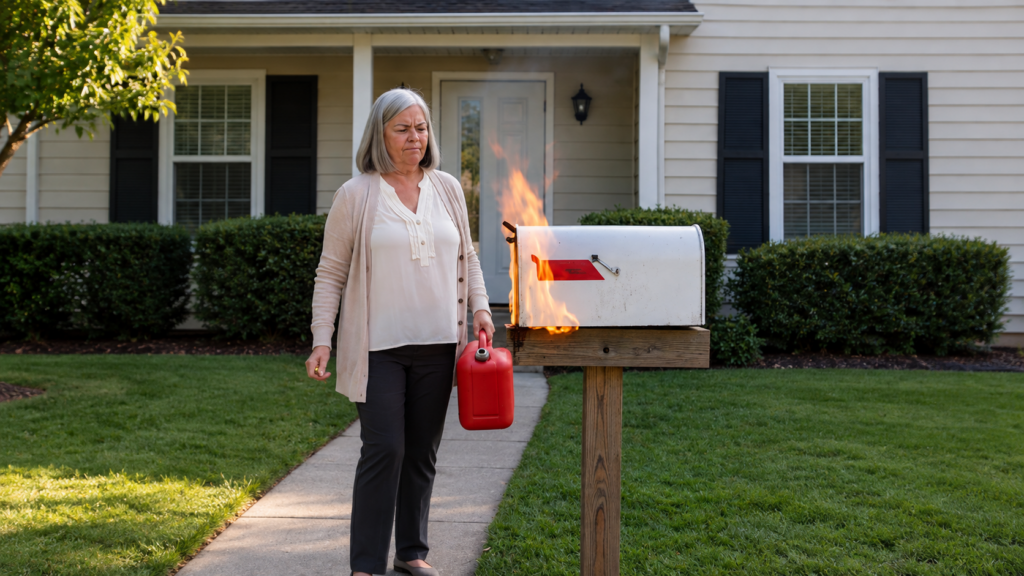
The first thing Elena Ward noticed was the smell of melting paint.
She had been folding towels beside the kitchen window when a quick orange light flashed across the wet pavement outside.
At first she thought a car had turned into the driveway with its hazard lights on.
Then she saw flames rising from the blue mailbox at the curb.
Elena dropped the towel and ran for the front door.
Her husband Noah looked up from the table where their four-year-old son Finn was arranging plastic dinosaurs.
“Stay with him,” Elena said.
She grabbed the fire extinguisher from the pantry and sprinted across the porch.
The mailbox door hung open like a blackened jaw.
Burning envelopes fluttered against the post while smoke rolled toward the neighbor’s hedge.
Elena sprayed the flames until the metal box stopped glowing.
Across the street, a porch light clicked on.
A woman in a quilted green jacket stood halfway between the Ward driveway and the adjoining yard.
Marlene Voss held an empty metal watering can by its handle.
For a second neither woman moved.
“Did you see who did this?” Elena called.
Marlene stared at the damp ashes beneath the box.
“I heard something break,” she said.
“That wasn’t what I asked.
”
Marlene stepped backward into the shadow of her garage.
“You should call the fire department.”
Elena glanced at the watering can, then at the narrow trail of liquid shining on Marlene’s sleeve.
The wind shifted and carried a sharp smell beneath the smoke.
It smelled nothing like rainwater.
“Marlene, what is in that can?”
“Water,” Marlene answered too quickly.
Noah appeared on the porch with Finn behind his legs.
“Mom, is somebody hurt?” Finn shouted.
Elena kept the extinguisher pointed down.
“Nobody is hurt, sweetheart.”
Marlene moved toward her own back gate.
“You need to worry about your family instead of staring at me.
”
Then she disappeared behind the fence.
Elena remained beside the ruined mailbox while the first distant siren sounded.
She had lived next door to Marlene for six years.
The woman brought cookies at Christmas, coordinated neighborhood donation drives, and remembered every child’s birthday.
She had also been unusually interested in Elena’s mail for the past week.
That morning she had asked whether the postal carrier still came before noon.
Yesterday she had asked whether Elena expected anything important from Washington.
Elena had laughed at the strange question.
Now she looked at the smoking envelopes and did not feel like laughing.
CHAPTER TWO — THE LETTER THAT SHOULD HAVE ARRIVED
Firefighter Denise Ortega photographed the wreckage under the white beam of a flashlight.
A police officer stood beside her while Noah carried Finn indoors.
“We found fragments of a commercial ignition fluid container,” Denise told Elena.
“We cannot determine who placed it here without further investigation.”
“Our neighbor was beside the mailbox,” Elena said.
Officer Kevin Ross wrote the statement without promising an arrest.
“Did you see her light the fire?”
“No.”
“Then tell me exactly what you observed.”
Elena described the watering can, the smell, the timing, and Marlene’s evasive answers.
Ross asked for any camera footage from nearby houses.
Elena shook her head.
“Our doorbell camera was down for maintenance.”
“We can look at other evidence,” Ross said.
His answer was less satisfying than Elena wanted, but she understood why he gave it.
By one in the morning, a temporary barrier surrounded the mailbox post.
Elena had placed the damp mail remnants in a cardboard box at the firefighter’s direction.
Among them she found a corner of an envelope bearing the words UNITED STATES.
The remaining print had burned away.
Noah joined her in the kitchen, where Finn had finally fallen asleep on the couch.
“Maybe it’s a tax notice,” Noah said.
“Marlene asked whether Washington was sending us a letter.”
Noah stopped rubbing his eyes.
“Why would she ask that?”
Elena opened the kitchen drawer and removed the receipt for Finn’s newest booster seat.
It was actually the second restraint he had used in less than a year.
The first had been a bright yellow seat provided through Marlene’s neighborhood charity, SafeStart Saturdays.
The second had come from a regular retailer after Finn outgrew the earlier model.
“Do you remember the forms Marlene had me sign when we picked up that first seat?” Elena asked.
“I remember you saying the paperwork was strange.”
“She wanted our address twice and Finn’s height down to the quarter inch.”
“I thought that was normal for a safety program.”
“So did I.”
Elena looked at the partly burned government envelope.
Her younger sister Gabby was seven months pregnant.
Gabby had volunteered at SafeStart events, helping parents carry boxes from Marlene’s warehouse to their cars.
Last Thursday, Marlene had offered to reserve a new infant seat for Gabby’s baby.
When Elena mentioned buying an independent seat instead, Marlene had become offended.
“Those families depend on us,” she had said.
“You shouldn’t discourage a good thing because you like expensive stores.
”
Elena had apologized even though she had not accused anybody of anything.
Standing in the kitchen at two in the morning, she regretted that apology.
“Call Gabby in the morning,” Noah said.
“I don’t want her collecting anything from Marlene until we understand this.”
Elena agreed.
She did not yet realize how many other families were already depending on the next delivery.
CHAPTER THREE — AN UNWELCOME VISITOR
The postal carrier arrived at nine with a supervisor instead of the usual route bag.
A woman named Rita Barnes examined the damaged post without touching it.
“We have recorded the loss of the mailbox and the mail inside,
” Rita said.
“A postal inspector may contact you because someone deliberately burned incoming correspondence.”
Elena showed her the blackened federal envelope fragment.
Rita held it beneath a magnifying glass.
“I cannot identify the sender from this.”
“Can you tell what was supposed to arrive yesterday?”
“Not from what I have here.”
Rita handed Elena a form for requesting replacement mail and a temporary pickup arrangement.
“You may also contact a sender directly if you suspect something urgent.”
“I don’t know who the sender is.”
“Then we’ll begin with the information we can verify.”
An engine sounded behind them.
Marlene’s white minivan pulled slowly into her driveway.
She climbed out carrying two grocery bags.
“What a terrible thing,” she said, looking at the charred post.
Elena watched her face.
“You were standing next to it when I came outside.”
Marlene’s smile tightened.
“I already told you I heard a noise.”
“Then why did you ask about a letter from Washington?”
Rita glanced between them.
Marlene shifted the bags against her hip.
“I ask everyone about mail when the postal service runs late.”
“You asked about Washington specifically.”
“You must have misunderstood.”
Elena stepped toward her.
“Did you burn my mailbox?”
“You cannot accuse me of arson because you are upset.
”
Marlene went inside before Elena could answer.
Rita made a brief note on her clipboard.
“Please tell the inspector exactly what happened, including that conversation.”
Elena nodded, then noticed that Marlene had left her minivan’s rear doors partly open.
Several cardboard cartons sat inside.
A printed logo showed a smiling child beside the words SAFESTART SATURDAYS.
One carton bore a handwritten red X over the shipping label.
Elena did not approach the vehicle.
Instead she copied the visible batch number from where she stood.
That small decision would matter more than anything she said to Marlene that morning.
CHAPTER FOUR — THE FIRST PHONE CALL
Gabby answered from a prenatal appointment waiting room.
“Please tell me this isn’t about Mom’s birthday party,” she said.
“I haven’t bought the cake yet.”
“It’s about Marlene.”
Elena described the fire and the damaged letter.
Gabby fell silent.
“She called me yesterday,” Gabby said finally.
“She asked whether I’d given you my seat reservation form.”
“Why would she care?”
“She said there might be a new safety review and wanted every family’s records in one place.”
Elena sat down.
“Did you collect the seat?”
“Not yet.”
“Don’t.”
“Elena, those seats are how half the neighborhood gets babies home from the hospital.”
“I know.”
“I’m not saying Marlene is perfect, but she’s helped people who couldn’t afford groceries.”
“I’m not accusing the families.”
“Then what are you accusing her of?”
Elena looked at the envelope fragment lying beside the sink.
“I don’t know yet.”
After the call, she opened the official website for the federal product-safety agency responsible for vehicle restraints.
She searched for the manufacturer printed on Finn’s old seat instruction booklet.
The search returned several consumer notices but no exact match for the batch number she had seen in Marlene’s van.
Elena called the manufacturer’s public support line.
A man named Victor Chen answered and requested the full label information.
“I have a label from a seat distributed locally,” she explained.
“I want to know whether the model number matches the product.”
“I can tell you what our company actually made,” he said.
She read the number from the booklet.
Victor paused.
“That format was discontinued two years before the manufacture date you just gave me.”
Elena repeated the date.
“I heard you correctly,” Victor said.
“Can you send a photograph of the label?”
“I no longer have the seat at home.”
“Then I cannot make a definitive identification.”
“What should I do?”
“I can give you the federal reporting contact and open a product inquiry.”
Elena wrote both numbers down.
She had expected a simple reassurance or a simple warning.
Instead she had found a question with no safe shortcut.











