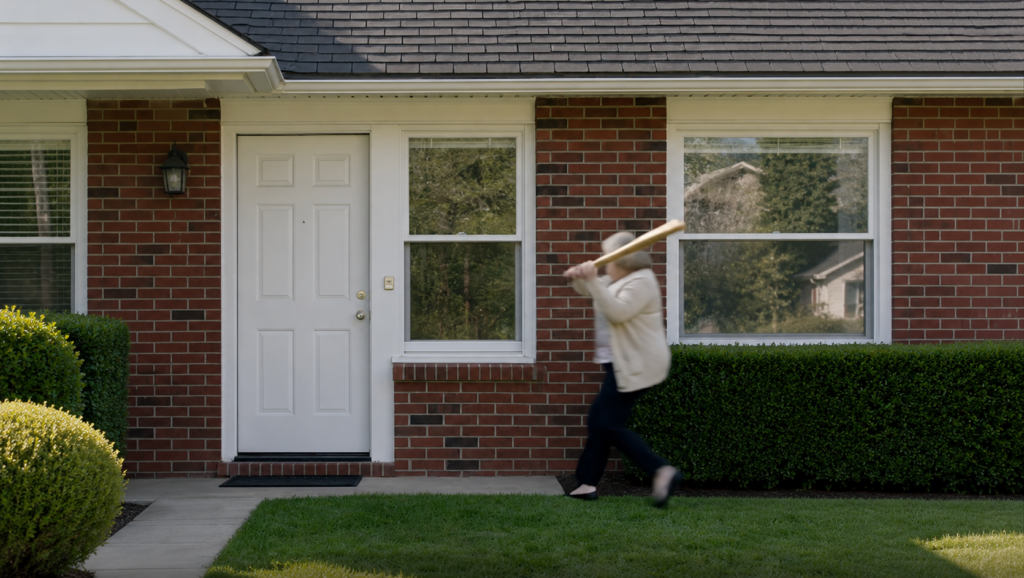
Chapter 1: The Wrong Welcome
The first stone struck the kitchen window at six seventeen on a Tuesday evening.
Elena Ward had been in the house for nine hours, and most of her belongings were still inside cardboard boxes.
She stood at the sink with a mug of cold coffee when the glass fractured above her shoulder.
A second stone hit the porch railing before she could move.
Elena dropped below the counter and heard a woman shouting from the front yard.
“You cannot just move in and pretend this is yours!”
Elena reached for her phone, but the woman outside kicked something hard enough to make the front door shake.
A moment later, the porch light shattered.
Elena crawled toward the hallway and called emergency services.
She gave the dispatcher the address and described the voice outside.
The woman continued shouting while Elena stayed on the floor.
“I told the last owner what would happen if somebody tried this!”
Elena heard a car door slam, followed by the grinding sound of tires on gravel.
She remained still until the dispatcher told her officers were approaching.
When Elena finally stood, the kitchen floor glittered with broken glass.
The house smelled of old paint, packing paper, and rain blowing through the damaged window.
A blue ceramic planter lay in pieces beside the front steps.
The small lavender plant inside it had been crushed beneath a tire.
Elena had bought that plant on the drive into town because her mother had always kept lavender by the door.
She stared at the flattened stems longer than she looked at the broken window.
Then she took a photograph of the damage and waited for the police.
Chapter 2: The Woman Across the Street
Officer Priya Shah arrived with a younger patrol officer named Cole.
They examined the stones, the broken light, and the marks on the porch door.
Elena described a gray sedan and a woman’s voice.
Officer Shah asked whether Elena had met anyone in the neighborhood.
“I’ve been here since breakfast,” Elena answered.
“The moving company left an hour ago.”
A curtain shifted in the house directly across the street.
Officer Cole noticed the movement and crossed the road.
The woman who opened that door wore a cream cardigan and held a dish towel in one hand.
Her name was Lorraine Pike.
She was sixty-three, with carefully arranged silver hair and a smile that seemed practiced in a mirror.
“I saw a strange vehicle,” Lorraine told Cole.
“People come through here looking for empty houses.”
Elena stepped onto her damaged porch and heard the answer.
“Was it a gray sedan?” Elena asked.
Lorraine looked toward her without moving her feet.
“I wouldn’t know.”
“I heard the driver shouting about the last owner.”
“Then perhaps you should ask the last owner,” Lorraine said.
Officer Shah walked toward the curb.
“Mrs. Pike, we need to know whether you saw anyone approach the property.”
Lorraine’s expression tightened.
“I watch this street because nobody else does.”
Elena took a breath and stepped down from the porch.
The sleeve of her work shirt caught on a splintered railing.
She pulled it free, exposing a tattoo along the inside of her left forearm.
The design showed three narrow black lines crossing a small open circle.
Lorraine stopped speaking.
Her dish towel fell onto the front step.
She stared at the tattoo with such intensity that Elena instinctively covered it.
“Where did you get that?” Lorraine asked.
Elena did not answer immediately.
“Why?”
Lorraine moved backward into her doorway.
“That mark doesn’t belong to you.”
Officer Shah asked what she meant.
Lorraine shut the door without another word.
Chapter 3: A Design Without a Name
The tattoo was not a family crest,
a military emblem, or a symbol from an old organization.
Elena had drawn it herself eleven years earlier on a paper napkin.
At the time, she worked as a stage technician for a traveling children’s theater.
The three lines represented the three exits from a theater that had once caught fire during a rehearsal.
The open circle represented the stage, where a young actor named Milo had stood waiting for someone to tell him which way to run.
Elena had guided the children out through a loading door before smoke reached the audience seats.
Nobody died, but the incident ended the theater’s tour and changed the direction of Elena’s life.
She had become a specialist in designing clear, accessible emergency exits for small performance venues.
The tattoo reminded her to look for the people who could not find the door.
She had never explained it to Lorraine Pike.
She had never even visited this Ohio town before buying the house.
Yet Lorraine had recognized the design before Elena could introduce herself.
That evening, Elena covered the kitchen window with a sheet of plywood delivered by a local handyman.
The handyman, a broad-shouldered man named Felix Moreno, inspected the broken porch light.
“You just moved into the Hartwell place?” he asked.
Elena nodded.
Felix glanced across the street.
“That woman has been telling people this house should stay empty.”
“Why?”
“She gives a different answer depending on who’s listening.”
Felix tightened the last screw in the plywood.
“Sometimes she says the foundation is unsafe.”
“Sometimes she says the neighborhood promised to preserve it.”
“Last month she told my cousin that the house attracts trouble.”
Elena looked at the gouges in her front door.
“She might be right about that last part.”
Felix did not smile.
“Trouble doesn’t usually arrive before the furniture is unpacked.”
Chapter 4: The House That Was Supposed to Stay Dark
Elena had bought the property from an estate agent after the previous owner died in a nursing home.
The house was small, with a wide front porch and a detached workshop behind a row of maple trees.
Its greatest attraction was the workshop, which Elena intended to convert into a studio for building portable theater sets.
She had paid for a structural inspection and reviewed the repair estimates carefully.
Nothing about the sale had been mysterious.
The house had simply sat empty for almost three years.
That night, Elena spread her purchase paperwork across the dining table.
She checked the inspection report,
the workshop measurements, and the photograph from the listing.
In the listing photograph, the workshop door was painted red.
Now it was white.
Elena remembered noticing the difference when she first toured the property.
The agent had said the estate caretaker repainted it before the sale.
She had accepted that explanation.
Now she wondered why Lorraine cared so much about a house that did not belong to her.
A vehicle slowed outside shortly before ten.
Elena switched off the dining-room lamp and watched from behind the curtain.
The gray sedan stopped beside the curb.
Lorraine sat in the driver’s seat.
She looked toward the workshop rather than the house.
After a full minute, she drove away.
Elena did not follow her.
She locked the doors, set a chair beneath the damaged kitchen window, and called the estate agent the next morning.
Chapter 5: A Question at the Workshop
The agent, Thomas Bell, sounded tired when Elena mentioned Lorraine.
“She objected to the sale,” he said.
“She objected to the listing, the open house, and the inspection appointments.”
“Did she ever explain why?”
“She said the workshop was dangerous.”
“Did anyone verify that?”
“Your inspector did.”
Elena glanced through the back window toward the detached building.
“Did Lorraine know the previous owner?”
Thomas paused.
“They had a falling-out years ago.”
“Over what?”
“I don’t know the details, and I won’t invent them.”
Elena appreciated the answer more than a confident guess.
Thomas gave her the name of the caretaker who had maintained the property.
His name was Arthur Bellamy, and he worked at a garden supply shop twenty minutes away.
Elena drove there after breakfast.
Arthur was an elderly man with stained work gloves and a quiet manner.
He remembered the house immediately.
“Mrs. Hartwell used that workshop for costumes,” he said.
“She repaired clothes for school productions.”
Elena mentioned the red door.
Arthur’s hands stopped moving over a tray of seedlings.
“I never painted it white.”
“The agent said the caretaker did.”
“Then somebody told him wrong.”
Arthur removed his gloves.
“I stopped going there after Mrs. Pike accused me of stealing supplies.”
“Did she have proof?”
“She had a loud voice.”
Elena asked when he last saw the red door.
“Last winter,” Arthur said.
“There was a blue chalk mark beside the handle.”
He hesitated before continuing.
“Three lines through a circle.”
Elena felt the blood drain from her face.
She rolled up her left sleeve.
Arthur stared at the tattoo, then sat heavily on a stool.
“Where did you see that mark?” he whispered.
“I drew it,” Elena said.
“Years ago.”
Arthur shook his head.
“Somebody was drawing it on that workshop long before you bought the place.”
Chapter 6: The Missing Door
Arthur refused to speculate about who had made the chalk mark.
He did, however, offer to show Elena where it had been.
They returned to the property together that afternoon.
The workshop stood behind the house beneath the maple trees.
Its white door looked ordinary from the path.
Arthur approached it slowly and pointed to the lower hinge.
“That hinge was on the other side,” he said.
Elena inspected the frame.
The screw holes had been filled, and the door had been rehung to swing outward.
“Why would someone change the swing?” she asked.
Arthur looked toward the house across the street.
“Mrs. Hartwell used to say a door should open toward whoever needed it.”
Elena tested the latch.
The door opened freely, but the threshold scraped against a raised strip of wood.
She knelt and found a narrow gap beneath the sill.
Fresh sawdust clung to the edge.
“Someone worked on this recently,” she said.
Arthur pointed at the repaired frame.
“And whoever did it wasn’t trying to make it look pretty.”
Elena stepped inside.
The workshop smelled of dry timber and old fabric.
Worktables lined one wall, and shelves stood empty beneath a high window.
She noticed a row of shallow marks on the floor.
The marks curved toward a section of wall where a large cabinet had once stood.
Arthur said Mrs. Hartwell had kept a rolling costume rack there.
Elena followed the marks with her eyes.
They ended at a square patch of newer flooring.
She reached for a loose board, but Arthur caught her wrist.
“Don’t pull that up yet,” he said.
“Why not?”
“Because somebody has been coming here when the house was empty.”
Elena heard a sharp sound outside.
A car door had closed beyond the maple trees.
Arthur stepped between Elena and the workshop entrance.
“We should leave the floor alone until we know who else has a key.”











