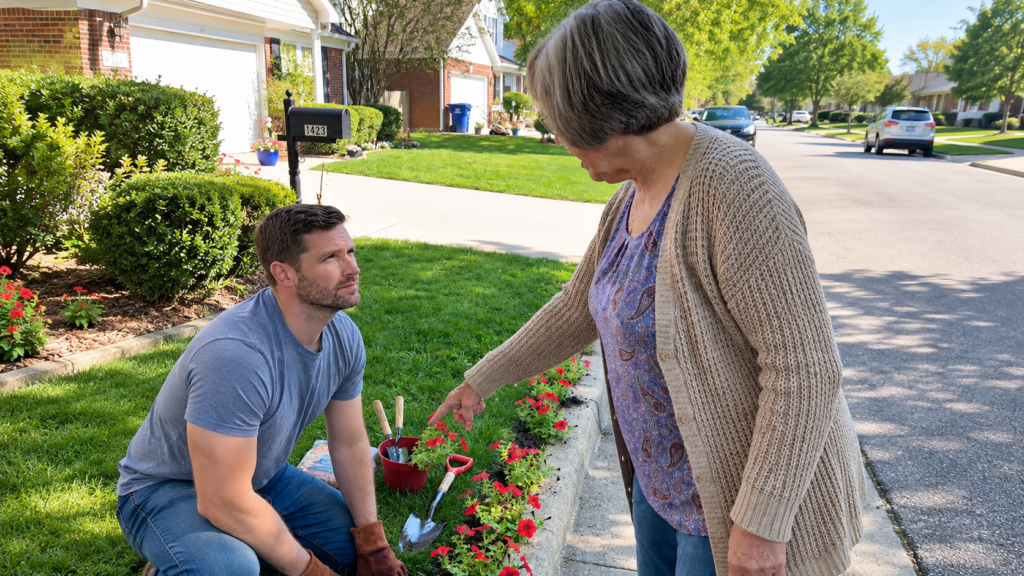
Mark Ellis had planted exactly eleven red salvias when Diane Mercer came charging across the sidewalk.
He was kneeling in the grass with a hand trowel and a paper sack of compost beside him.
The twelfth plant waited in a nursery pot near his shoe.
Diane stopped so abruptly that her garden clogs skidded on the concrete.
“You cannot plant there,” she said.
Mark looked at the shovel in his hand and then at his neighbor.
“Good morning to you, too.”
“That strip is not yours.”
“I bought this house six months ago, Diane.”
“That doesn’t make you an expert.
”
Her voice carried to the house next door, where a curtain moved behind the kitchen window.
Mark had learned that Diane never lowered her voice when an audience might be listening.
“I’m planting flowers, not building a parking garage,” he said.
She stepped over the first row of salvias and pointed to a slender band of earth between his walkway and the sidewalk.
“Take them out now.”
Mark rose carefully, wiping his hands on the knees of his jeans.
He was forty-one and had spent enough years supervising a grocery warehouse to recognize a person who mistook volume for authority.
He was not interested in winning a shouting contest.
“The survey stakes are right there,” he said.
“Those stakes are wrong.”
“They came with the closing paperwork.”
“Then the paperwork is wrong.”
Mark glanced toward his open garage.
Inside, a cardboard box labeled GARDEN held bulbs, spare gloves, and a folder his seller had insisted he keep together.
The folder contained six old property deeds from nearby houses.
He had never understood why a seller would give him other people’s deeds, but he had kept them because throwing documents away felt foolish.
Diane held up her phone.
“I’m calling the police if you keep digging.
”
“You’re calling the police about flowers?”
She tapped the screen instead of answering.
Mark returned to the flower bed and gently loosened the roots of his twelfth salvia.
He heard Diane tell the dispatcher that a man was trespassing and altering another owner’s property.
Her statement changed from questionable to astonishing when she claimed that Mark had threatened her with a digging tool.
Mark placed the trowel on the ground.
He raised both empty hands so that the woman in the next window could see them.
“I haven’t threatened anyone,” he said loudly.
Diane turned away as though his words were part of the problem.
Twenty minutes later, two patrol officers arrived.
Officer Ramirez stepped out of the first car while her partner, Officer Kline, remained near the sidewalk.
Diane rushed to meet them before Mark could speak.
“He has been warned repeatedly,” she said.
“Warned by whom?” Ramirez asked.
“By me.”
Ramirez watched Mark gesture toward the row of small red flowers.
“Sir, can you explain what’s happening?”
Mark repeated the conversation without decoration.
Diane interrupted him five times.
The sixth time, Ramirez held up one hand.
“We can listen to both of you if you speak one at a time.”
Mark mentioned the deeds.
Diane’s expression shifted so quickly that he almost missed it.
She had been angry until he said the word.
Now she looked as if someone had pulled a chair away beneath her.
“What deeds?” she asked.
“The ones the previous owner left in my garage.”
“Those aren’t yours to use.”
“They’re copies, Diane.”
“You don’t know what they mean.”
Mark went inside and carried out a blue folder with six yellowed sheets protected by clear sleeves.
Kline crouched beside the sidewalk to compare the parcel descriptions.
Ramirez called the county mapping office to ask for a current reference.
Neither officer treated the old papers as a magical verdict.
They compared the information against the current boundary map, which showed a narrow shared planting reservation along the fronts of six adjoining lots.
Each deed named a different parcel, but the same narrow reservation ran through them like a thread.
“This strip isn’t Diane’s private yard,” Ramirez said.
Diane pressed her lips together.
Mark turned to the oldest sheet.
He had seen the transfer dates before, but he had never noticed a small handwritten name beside a reference to a demonstration garden.
The signature belonged to a woman named June Bellweather.
On the sixth sheet, a later owner had accepted stewardship of something called the Bellweather Scarlet Collection.
That owner’s surname was Mercer.
“Your family was supposed to look after a collection of plants?” Mark asked.
Diane stared at the page instead of answering.
Ramirez explained that the police would not settle a complicated land-use disagreement on the sidewalk.
She warned both neighbors against damaging anyone’s property and made a note of Diane’s inaccurate statement about the trowel.
Mark agreed to leave the disputed strip untouched until he could ask the county for clarification.
The officers drove away as the morning traffic passed without slowing.
Diane lingered beside the red flowers, her hands clenched against her sides.
“You need to dig those plants up before Friday,
” she said.
“Why Friday?”
She looked toward a white delivery van parked halfway down the block.
Its side displayed a green logo shaped like a leaf inside a crown.
“Because you have no idea who will come looking for what’s under them.”
Diane walked away before Mark could ask another question.
Chapter 2: The Man in the Green Van
The van remained on the block after noon.
Mark saw it through his office window while he searched for Bellweather Scarlet Collection on his laptop.
He found ordinary gardening articles and several unrelated flower companies, but nothing that explained Diane’s reaction.
His phone rang as he was studying a faded advertisement for a county flower festival.
“This is Nolan Pike from Crownleaf Horticulture,” the caller said.
“How did you get my number?”
“Public contact information associated with the property.”
Mark knew enough about salespeople to recognize an answer that had been polished until it revealed nothing.
“What can I do for you?”
“I understand you’re improving the front garden.”
“Who told you that?”
“We’re in the neighborhood conducting a special plant evaluation.”
Mark glanced at the van.
“You mean you’re sitting across from my house.”
A pause followed.
“I was hoping we could meet.
”
“Send me your company’s website.”
“We can talk much more effectively in person.”
“Then I’m afraid we’ll remain ineffective.”
Mark ended the call.
He went outside and photographed the van’s company name and business number from his own driveway.
The driver pulled away immediately.
That reaction unsettled him more than Diane’s temper had.
He walked to the next house, where a woman named Priya Shah was carrying groceries out of her trunk.
Priya taught botany at a community college and had introduced herself when Mark first moved in.
She liked to tell neighbors that she studied plants because plants never pretended to understand instructions they had not read.
“Have you ever heard of Bellweather Scarlet?” Mark asked.
Priya set a carton of milk on the porch rail.
“Where did you hear that name?”
“From a deed.”
She put the milk back into the bag.
“Come inside.”
Her kitchen smelled of basil and toasted bread.
She cleared space on the table beside a microscope and a stack of student assignments.
Mark described the morning’s dispute and placed the oldest deed in front of her.
Priya read slowly.
“June Bellweather wasn’t just a gardener,” she said.
“She was a plant breeder who worked out of her home.”
“Was she famous?”
“Not outside a small circle.
”
Priya pulled a notebook from a shelf.
She showed Mark a photograph of a deep-red flowering plant with slender stems and unusually long flowering spikes.
“June spent years crossing varieties of salvia to develop plants that tolerated dry summer soil without losing their color.”
“That’s useful.”
“It was useful enough for a commercial grower to offer her money.”
“Did she sell?”
“She refused an exclusive arrangement, according to an article my students found.”
Priya turned the page to a photocopy of an old community newsletter.
The caption identified six households who had offered garden space to preserve June’s experimental lines.
Each family raised part of the collection.
They exchanged cuttings during an annual neighborhood planting day.
“The project depended on neighbors keeping different lines alive,” Priya explained.
“A flood, disease, or careless gardener couldn’t wipe out everything at once.”
Mark considered the six deeds again.
“So the strip by my sidewalk was part of a living collection.”
“At least when these documents were written.”
“What happened to it?”
Priya turned the page and found a photograph of June Bellweather holding a ceramic pot with a red ribbon tied around it.
“The newsletter ends here.”
Mark pointed at the date.
It was twenty-eight years old.
“Diane must know something.”
“Diane knows more about this block than the entire county website,” Priya said.
“She also treats information like a family silver service that nobody else is allowed to touch.”
A knock interrupted them.
Diane stood on Priya’s porch holding a folded newspaper.
She looked at Mark first.
“I told you to stop digging.”
“I did stop.”
“Then why is that man still asking questions?”
Mark glanced toward the empty space where the Crownleaf van had been.
“Who is Nolan Pike?”
Diane’s face tightened.
“Someone you should not invite onto this street.”
Priya stepped between them without touching either person.
“Diane, June’s plants may still be growing here.”
“You don’t know what’s growing here.”
“Then tell us.”
Diane studied the red flowers in Mark’s front yard through the screen door.
“Those store-bought things aren’t the problem,” she said.
“The problem is what Mark’s shovel almost reached.”
She unfolded the newspaper and revealed an advertisement for Crownleaf’s upcoming Scarlet Star launch.
The photograph showed a red flowering plant remarkably similar to June’s old experiment.
The bottom line announced a private preview on Friday evening.
Diane folded the paper again.
“Pike is not here to look at your garden,” she said.
“He is here to make sure nobody remembers where that flower came from.”











