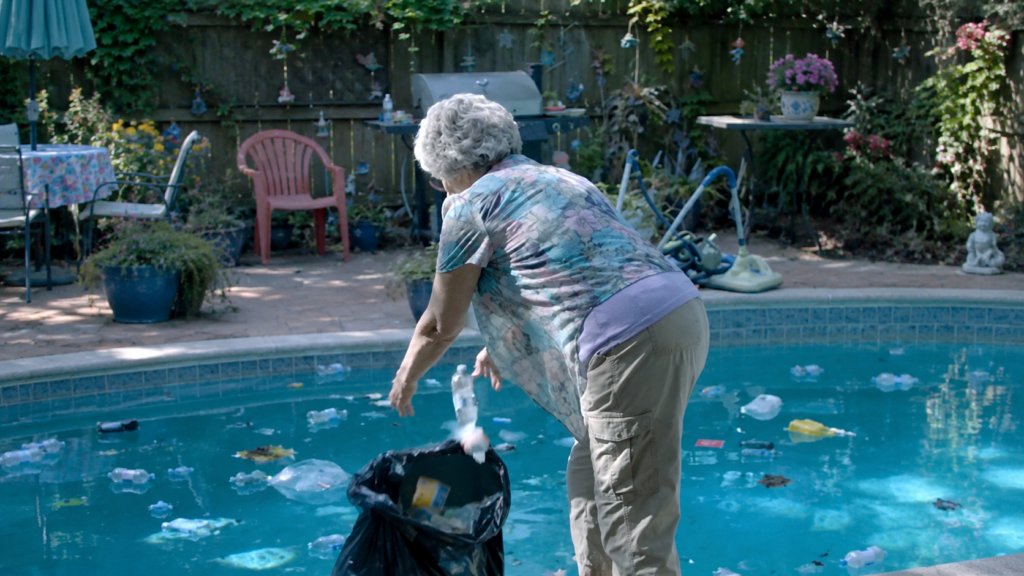
At eleven seventeen on a bright Thursday morning, a black garbage bag split open over the deep end of Elena Price’s swimming pool.
Plastic tubs struck the surface first. Then came flattened cardboard, aluminum cans, greasy paper, and a nest of translucent wrapping that spread across the water like an oil slick. The woman holding the bag shook it hard, once, twice, until the last empty bottle fell out. She was seventy-three, short, and dressed for a trip to the grocery store: soft blue cardigan, comfortable sneakers, a silver watch loose around her wrist.
She did not look ashamed.
She looked toward the sliding glass door as though she had come for an appointment.
Elena stood on the other side, one hand resting on the lock. At thirty-eight, she had spent the morning repairing a miniature wooden staircase for a museum exhibit. The glue on her fingers had not dried when her security alert interrupted her. She had expected a delivery driver. Instead she had watched Nora Fenwick, the woman from the yellow house three doors down, open the side gate and march toward her pool carrying a bag full of rubbish.
Nora raised her phone. She spoke into it, her eyes never leaving Elena’s face.
Elena could read two words through the glass. “She’s here.”
She slid the door open six inches.
“Are you out of your mind?” Elena demanded.
“Come all the way outside,” Nora replied.
“Get away from my pool.”
“I need you to look at me when I say this.”
A paper cup bobbed between them. Something that looked like a restaurant receipt drifted against the pool ladder. Elena felt anger climb up her throat. Her father had painted that pool’s tile border by hand the summer before he died; she had kept the house largely because the courtyard still held the shape of his patient work.
“I’m calling the police.”
Nora’s face tightened. “Then I won’t have much time.”
She turned away from the door, addressed the phone again, and said, “I did it. I did exactly what you told me.”
Elena stopped reaching for her own phone. Nora sounded frightened now, not defiant. A man’s distant reply came through the speaker, too faint to understand. Nora listened, then pressed her lips together.
“No,” she said. “You don’t get to change it now.”
Before Elena could ask what that meant, Nora ended the call. Her hands were shaking.
“Who was that?” Elena asked.
“If I tell you, you’ll assume I’m lying.” Nora glanced at the neighboring fences. “I’ve been told that twice already.”
Elena thought of the hidden camera under the eave above her potting table. It was not part of her ordinary security setup. She had installed it two weeks earlier after finding footprints in the vegetable bed and the wooden side gate unlatched on three separate mornings. Its angle showed the narrow service walkway between the fence and the house, a spot the obvious patio camera could not see. She had not told the neighbors about it.
“Then tell me the truth and see what happens,” Elena said.
Nora stepped backward from the pool. “I want someone to hear me without telling me which words I’m allowed to use.”
A vehicle door slammed on the street. Nora flinched so violently she almost lost her footing.
Elena looked beyond her shoulder. A white utility van was parked outside the gate. A man in a polo shirt stood on the sidewalk holding a tablet. He was smiling, as if arriving to complete a routine appointment.
“Mrs. Fenwick,” he called, “the observation period is over.”
Nora stared at him. “I haven’t finished speaking.”
“You certainly have.”
He opened the gate without knocking. Elena stepped fully onto the patio, furious all over again.
“This is private property,” she said.
The man paused and gave a careful, professional nod. “Good morning. I’m Simon Pell, community assessment coordinator. I believe we can clear up this unfortunate misunderstanding.”
“What assessment?”
Simon looked at Nora, then the floating trash, then back at Elena. “Mrs. Fenwick is participating in a neighborhood response exercise. We sincerely regret the inconvenience.”
Nora made a small, choking sound. “You told me she’d been informed.”
Simon ignored her. “Our organization will cover cleaning costs. If you could avoid contacting third parties until we’ve completed the report, we’d greatly appreciate it.”
“I didn’t agree to any exercise.”
“There’s been a communication error.”
He reached into his pocket for a business card, but Nora moved between them.
“Don’t give her that one,” she said sharply. “Give her the other one. The one with your real office.”
For the first time Simon’s smile disappeared.
Elena looked from his polished shoes to the bag lying crumpled at Nora’s feet. The material wasn’t the thin kind sold in supermarkets. It was industrial grade, with an orange drawstring and a small green square printed near the bottom. She had seen bags just like it somewhere recently, but could not place them.
“Both of you leave,” she said. “Now. And I’m keeping the footage.”
Simon lifted his hands. “Of course. Please don’t make this more distressing than necessary.”
Nora’s eyes met Elena’s. In them was a warning so unmistakable that Elena felt a fresh coldness settle behind her ribs.
“Look at what happened before I brought the bag,” Nora whispered.
Then Simon took her by the elbow and guided her toward the gate. Elena remained by the ruined pool until the van pulled away, its tires whispering over the hot pavement. Only then did she retrieve her phone and open the camera application.
The visible camera showed a woman making a mess. The hidden one showed something else altogether.
At ten fifty-two, Simon had entered through the side gate alone. He had checked the latch, unfolded a small stool, and positioned a flat black case beneath Elena’s garden bench. He had returned twenty minutes later with Nora, speaking close to her ear. When she stepped away from him, he had raised his tablet, pointed toward the house, and apparently issued an instruction.
Then, immediately before Nora poured out the bag, Simon had removed a small device from the black case and pressed it against the wood beneath the bench. The device was still there.
Elena stood up. She did not go near it. She called a friend who worked in commercial building security, described what she had seen, and waited for him to tell her what to do.
“Don’t touch it,” said Malik Owens. “And don’t let anyone back into the yard. I’m coming over.”
For a moment she watched the trash move in lazy circles across the water.
Nora had stayed because she wanted Elena outside. Simon had wanted exactly the opposite: Elena distracted, angry, and willing to dismiss her as a nuisance. The difference mattered. It was the first difference Elena had noticed all morning, and it changed everything.
CHAPTER TWO — THE GREEN SQUARE
Malik arrived carrying a battered equipment case and the expression he wore whenever a customer described an impossible technical problem. He had known Elena since they were teenagers, when he lent her comic books and she returned them full of notes about their perspective drawings. He worked for a firm that assessed physical security at public buildings, but he drew a strict line between professional curiosity and trespassing into someone else’s affairs.
“First,” he said, looking at the pool, “that is a lot of garbage.”
“I noticed.”
“Second, I assume you’ve preserved the recordings?”
Elena nodded. He examined the small object beneath the bench without touching it. A black button no larger than a coin was attached with removable adhesive. Its tiny indicator blinked white every twelve seconds.
“Could be a proximity sensor,” he said. “Could be something that logs movement. I won’t guess until someone qualified examines it.”
“The man said it was a neighborhood response exercise.”
“Exercises don’t ordinarily involve planting devices in someone’s yard without permission.”
They photographed it from several angles, placed a chair across the walkway to keep anyone from brushing against it, and called the nonemergency police number. While they waited, Elena found Simon’s company on the internet. The page for Civic Harmony Metrics showed cheerful families planting trees, neighbors sharing lemonade, and an elderly couple waving beside a newly painted fence. A banner proclaimed, BETTER RESPONSES BEGIN WITH BETTER INFORMATION.
There was no physical office address, only an appointment portal and a phone number. The site’s public material spoke about neighborhood resilience, emotional de-escalation, and voluntary observation. It said nothing about garbage dumped into swimming pools.
Malik inspected the bag without handling the scattered contents. “That green square. Have you seen it before?”
Elena remembered. Three weeks earlier, someone had left an identical bag in the communal recycling enclosure at the end of Birch Avenue. She had picked it up because it was blocking the latch and had seen the same green mark. Several bags were filled with clean packaging scraps, as though someone had emptied a prop department rather than a kitchen.











