By the time Harper Lane pushed open her sliding glass door, a green soda bottle was spinning slowly in the deep end of her swimming pool.
A flattened cereal carton had caught against the ladder. Two disposable coffee cups floated beside a toy sailboat her nephew had forgotten on Sunday. Across the turquoise surface stretched a widening island of wrappers, crushed containers, paper napkins, and a remarkable number of orange plastic ribbons.
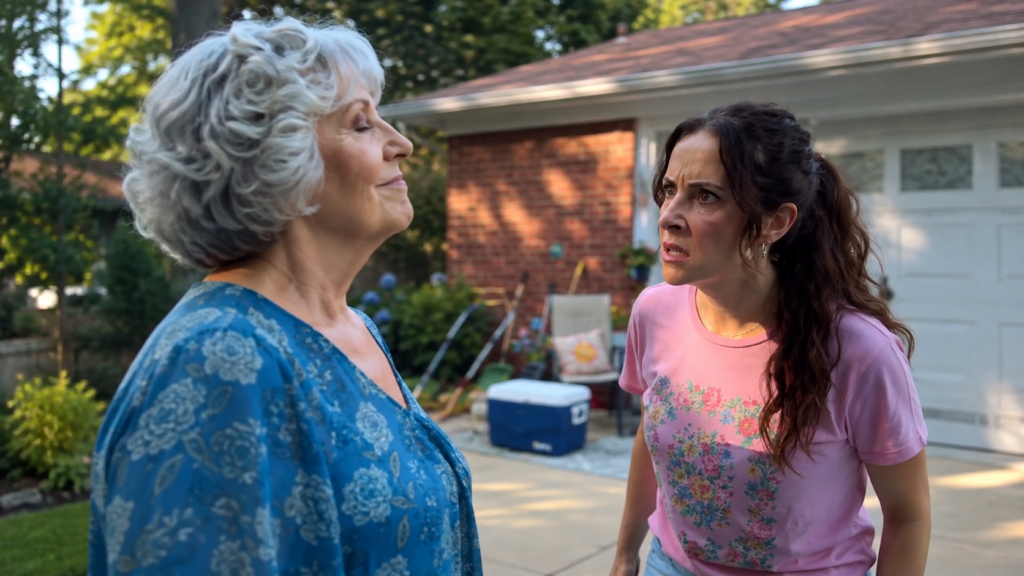
At the center of the mess stood seventy-three-year-old Odessa Pike, still clutching the empty black garbage bag.
Harper stopped on the patio. She was thirty-four, barefoot, wearing paint-stained jeans and the gray sweatshirt she used when she worked from home. She had been calculating the price of repairing the roof over her small theater workshop. She had not expected to discover an elderly neighbor emptying refuse into the pool.
‘What are you doing?’ Harper demanded.
Odessa turned. The woman wore a yellow cardigan despite the warm morning, and her silver hair had been fastened with two mismatched clips. She did not appear surprised to see Harper. That, somehow, made the sight worse.
‘You finally came out,’ Odessa said.
‘You put garbage in my pool.’
‘Yes.’
‘Why?’
‘I needed you to look at what was left.’
Harper stared at her. ‘Then knock on my door like a normal person.’
‘I did. Yesterday. And Monday. You told me through the doorbell that you couldn’t speak to me.’
‘Because you were shouting about a children’s show I don’t run anymore.’
Odessa tightened her grip on the bag. ‘You promised those children they would get their stage.’
Harper walked past a broken umbrella stand and stopped three steps from the older woman. ‘That does not give you the right to do this.’
‘I know.’
‘You know?’
‘I know it is wrong.’ Odessa’s voice shook, but she did not lower her gaze. ‘I came here wanting you angry enough to listen. You could have called the police. I expected that. I also expected you to ask why I brought precisely this bag.’
Harper looked toward the pool again. The ribbons were not random. Tiny paper stars had been glued to them. Between floating bottles she spotted a cardboard sun with a smiling face, its yellow rays bent backward. There was a painted whale with one eye missing. Several objects were pieces of scenery.
‘Where did you get these?’
‘From the bins behind Bellweather Hall.’
A painful pressure gathered beneath Harper’s ribs. Bellweather Hall had been the town’s neglected rehearsal building until Harper leased it for an after-school shadow-theater project called Open Door. For fourteen months, children aged nine to sixteen had built paper cities, enormous puppets, and moving backdrops under her supervision. Three weeks earlier, Harper had closed the program.
‘Those weren’t supposed to be thrown out,’ Harper said.
‘Neither were the people who made them.’
Harper looked back at Odessa. ‘Careful.’
‘No. You be careful. My granddaughter waited outside that building for two hours yesterday with a paper bird she made herself. Someone had taken down the sign with all their names. Do you know what it feels like when a child sees her own work in a dumpster?’
Harper remembered a different child crying in the same hallway, and the memory struck like a slap. She turned away.
‘I’m calling someone to clean this,’ she said. ‘You are going to pay for it.’
‘I will.’
‘And after that, stay off my property.’
Odessa nodded once, but she did not leave. ‘The performance is Saturday.’
‘There is no performance.’
‘There is a performance. Just not theirs.’
Harper faced her. ‘What does that mean?’
‘Go to the old icehouse at four. Ask what they are rehearsing. I won’t tell you what to believe. Look at the children who aren’t there.’
A gust of wind pushed the little cardboard sun toward the filter intake. Harper stepped around Odessa, collected the floating object with the pool net, and lifted it dripping from the water. The smiling face had been painted by Milo Santos, a quiet boy who insisted that all suns should have freckles.
On its reverse, someone had written in black marker: PROPERTY OF THE PRODUCTION.
Harper recognized neither the handwriting nor the claim. She turned the sun over again.
‘Who wrote this?’
Odessa watched her. ‘That’s the question I’ve been trying to get you to ask.’
At last the old woman folded the garbage bag and laid it beside her shoes. She stood still while Harper photographed the mess for the cleaning company. Then she picked up the bag and walked to the gate without trying to excuse herself.
‘Odessa,’ Harper called.
The woman paused.
‘I haven’t forgiven you for what you did.’
‘I didn’t come for forgiveness.’
‘What did you come for?’
‘I came because you are the only adult those children ever believed when you told them a stage could belong to them.’
She passed through the gate. Harper remained beside the pool, holding the ruined cardboard sun, until the little paper stars stopped spinning.
CHAPTER TWO: THE BUILDING WITH TWO DOORS
Bellweather Hall had once been a packing shed for apples. Its floorboards dipped toward the center, its radiators clicked in winter, and its windows rattled whenever a delivery truck passed. Harper loved it because nothing about it asked children to behave like miniature professionals.
The first afternoon she opened its doors, twelve children had arrived carrying notebooks and grocery sacks of scraps. Milo had brought cardboard from his mother’s restaurant. Odessa’s granddaughter, Nell, had brought colored tissue paper and a shoe box containing six wooden clothespins. A pair of brothers had assembled a dragon’s jaw from laundry baskets. By the end of the week, Harper had stopped assigning projects. The children were inventing them faster than she could keep up.
Their show, The City That Learned to Listen, began as an argument about the demolition of the town’s old pedestrian square. Nell believed buildings kept people’s voices in their bricks. Milo insisted the buildings were made of cardboard anyway, so the show could include a building that walked away. By spring they had devised a story about a noisy city where every inhabitant spoke at once, until the quietest resident, a tiny bird with a bent wing, persuaded the citizens to hear one another.
Harper had promised them a Saturday-night performance and a second show for their families. Then a fight between parents during rehearsal had convinced the hall’s board to suspend the program pending a new supervision plan. One parent accused another child of stealing an idea. Another demanded a leading role for her daughter. During the argument, an adult had pushed through a cardboard city gate and ruined weeks of work. Harper, exhausted by her own failing workshop business and afraid of losing the lease, told everyone to go home. She meant to settle the dispute in a day. Instead she stopped answering messages.
The hall board later offered the building to a new cultural organization, Brightline Experiences, which promised a polished family attraction. Harper had signed a release allowing the hall’s remaining set materials to be disposed of or repurposed. The form was only one page; she had read it in the parking lot while fighting tears. She had not understood that repurposed could mean used in a show designed by someone else.
Now she stood in her kitchen with the soaked sun drying on a towel, considering what Odessa had said. Her phone vibrated. A message from Gemma Ortiz, the mother of two Open Door children, appeared on the screen.
Are you coming to the icehouse? We heard they’re using our dragon.
Harper wrote back, I don’t know.
A second message arrived immediately.
That’s what you said three weeks ago.
Harper put the phone face down.
She had been good at teaching children how to invent impossible creatures out of ordinary trash. She had been less good at telling parents that their demands were making the project impossible to run. After the fight, every conversation had sounded like a demand for a verdict. She had convinced herself the responsible choice was to withdraw until everyone calmed down.
She had been waiting three weeks.
The pool cleaner arrived at eleven. His name was Caleb, and he made no attempt to hide his surprise when Harper explained what had happened. He lifted trash into a wheelbarrow, examined the skimmer, and told her the water would probably need extra treatment but the equipment had survived.
‘Your neighbor really stood there and waited?’ he asked.
‘Like she was waiting for a bus.’
‘People do strange things when they’re desperate.’
‘People do strange things when they’re cruel.’
‘Both can be true.’ He handed her an invoice. ‘Don’t go swimming today.’
By one, Harper had changed clothes, packed the cardboard sun into a flat box, and driven toward the old icehouse. She told herself she was going only to recover property. There would be no speeches and no promise to restart the program. But she carried in the trunk the canvas tool roll she had used at Bellweather Hall, including a pair of fabric shears, small clamps, and a pencil worn almost to the metal ferrule.











