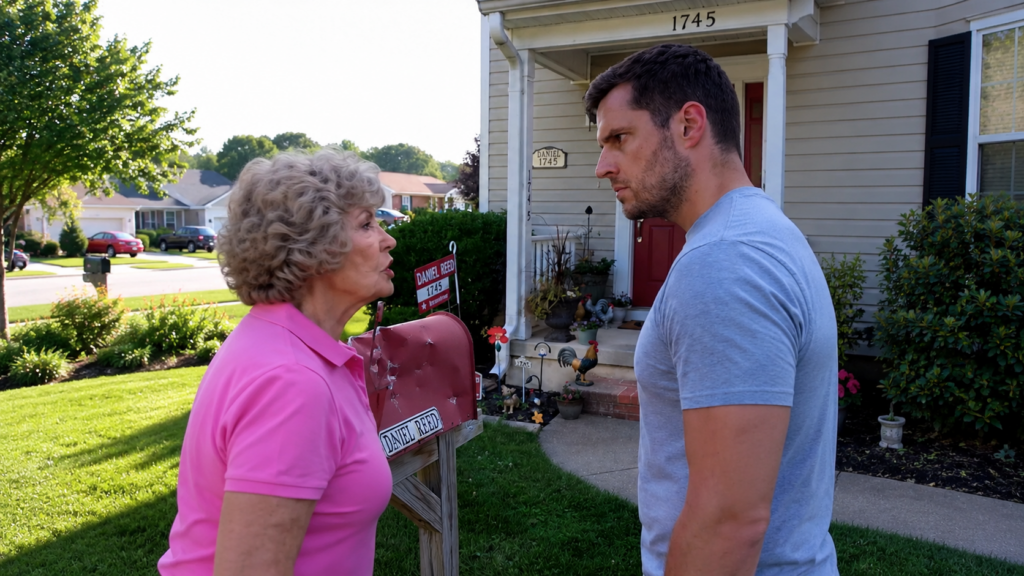
The first blow sounded like somebody slamming a steel door inside Daniel Reed’s kitchen.
Daniel was cutting an orange when the second blow came.
Through the front window, he saw Carol Mercer standing in his yard with a hammer raised above her shoulder.
She was sixty-five, wearing gardening shoes and a blue cardigan despite the heat, and she looked more determined than angry.
Her next strike bent the mailbox door backward until it hung from one hinge.
Daniel took out his phone and started recording before he opened the door.
“What are you doing?” he shouted.
Carol hit the mailbox again,
and its red flag snapped off into the grass.
“You should have left my mail alone,” she shouted back.
“I never touched your mail.”
“Then explain why my envelope was inside your box yesterday.”
Daniel stepped onto the porch and kept his distance from the hammer.
“A carrier brought me one envelope by mistake, and I told her it belonged next door.”
“You kept it.”
“I set it beside my mailbox because I intended to return it when you got home.”
Carol stared at the twisted metal with a peculiar disappointment, as though breaking it had failed to reveal the thing she expected.
She reached toward the opening, but Daniel moved closer.
“Stop right there.”
“You don’t understand what you’ve done.”
“I understand you’ve destroyed my mailbox.”
A white sedan pulled up behind Carol’s parked hatchback.
A man in a charcoal sport coat stepped out carrying an evidence sleeve, and a younger woman followed him with a narrow leather case.
The man introduced himself as Postal Inspector Aaron Bell.
“Mrs. Mercer, put the hammer on the ground, please.”
Carol’s grip tightened.
“Did he call you?”
“We’ve been trying to speak with you since Thursday.”
“About one misdelivered envelope?”
“No, ma’am.”
Bell raised the transparent sleeve.
Inside was a cream-colored envelope with a green paw printed beside the return address.
“We need to know why six residents received mail bearing your return address.”
Carol looked from the sleeve to Daniel’s damaged mailbox.
For an instant Daniel saw her mouth forming an answer, but she said nothing.
The younger investigator identified herself as Lena Ortiz and photographed the hammer lying in the grass after Carol finally released it.
Bell asked whether Daniel had opened the misplaced envelope.
“Absolutely not,” Daniel said.
“Where is it?”
“On the little table inside my porch.”
“Would you show us?”
Daniel brought the envelope out without touching its sealed flap.
It was addressed to Carol Mercer, two doors down, and had no visible return address except a small green paw.
Bell glanced at it.
“This isn’t one of the six we’re investigating.”
“Then why did she come here?” Daniel asked.
Carol spoke quickly.
“Because he was hiding it.”
“The envelope was on my porch in plain sight.”
Bell studied the stamp and the address.
“This is a business reply envelope, Mrs. Mercer.”
Carol’s eyes moved toward her front door.
Daniel noticed because he had watched her scan his mailbox with the same urgency.
She was searching for something, but she still did not know exactly where it was.
Bell asked whether she recognized the company logo.
Carol said it belonged to a pet boarding service where she occasionally volunteered.
“Which service?” Ortiz asked.
“Meadow Haven Animal Retreat.”
Daniel knew the name.
His sister had boarded her terrier there during a winter hospital stay, and a neighbor’s Labrador had disappeared from the service’s records two months earlier.
He remembered the missing-dog posters because Carol had torn one from the communal notice board.
“I thought you hated Meadow Haven,” Daniel said.
Carol turned sharply.
“I don’t need your commentary.”
Bell asked Daniel to leave the envelope on the porch table while the inspectors spoke with Carol.
Daniel stayed outside anyway.
His mailbox was wrecked, his lawn held a broken flag, and a federal investigator had just mentioned six households.
Nobody could reasonably expect him to pretend it was an ordinary Saturday.
CHAPTER TWO: THE SIX ENVELOPES
At the curb, Bell showed Carol photographs of six similar envelopes without exposing the recipients’ personal information.
Each carried Carol’s street number and the same green paw logo.
Each was postmarked within four days of the others.
“Those could have been printed by anyone,” Carol said.
“That’s one possibility,” Bell replied.
“Then go investigate somebody else.”
“We are investigating the mailings.
”
A passing cyclist slowed to look at the ruined mailbox, and Carol snapped at him to keep moving.
Daniel had seen this tactic for years.
Carol treated witnesses as enemies until the witnesses began to doubt whether the trouble was worth their time.
This time the tactic did not work.
Ortiz asked Carol to confirm whether she had maintained an outgoing-mail station for Meadow Haven.
Carol refused to answer without knowing the exact accusation.
“We’re not accusing you of a crime in your driveway,” Bell said.
“We are asking how your home address appeared on correspondence to six former customers.
”
“People borrow addresses all the time.”
“Not usually for letters that claim to settle complaints those customers never agreed to settle.”
Daniel looked up.
He had heard something about a settlement from his neighbor Amy Farrell, whose elderly beagle had returned from Meadow Haven limping and frightened.
Amy had described a formal letter that promised her a refund if she signed an acknowledgment saying the injuries occurred before boarding.
She had refused and called the business herself.
The manager told her no one there had sent such a letter.
Now Daniel understood why Amy had wondered whether somebody was impersonating the company.
“Is Amy one of the six?” he asked.
Bell looked at him without confirming it.
“We can talk privately about anything you know.”
Carol laughed too loudly.
“Everybody complains about something once their dog gets old.”
“Amy’s dog was eight,” Daniel said.
“Old enough.”
“His leg was broken.”
Carol’s smile failed.
Bell invited her to continue the conversation at her house, and she finally agreed.
She retrieved her hammer only after Ortiz said it would need to remain where it was for the local responding officer.
Daniel watched her walk toward the neighboring porch with the small, rigid steps of a person refusing to appear frightened.
His phone vibrated.
Amy had sent a message containing two words.
“Did you see?”
Daniel answered that federal inspectors were outside Carol’s house.
Amy called immediately.
“I knew she was part of it,” she said.
“Part of what?”
“They’ve been telling families their pets were already sick when they arrived.”
“Who has?”
“Meadow Haven.”
She took a moment before explaining.
Her beagle Chester had been boarded for nine days while she cared for her father after surgery.
When she collected him, he could barely put weight on his back leg.
The attendant said Chester must have slipped on her porch before arriving.
Amy knew that was impossible because she had carried him through the reception doors herself.
The next day a letter arrived, carrying Carol’s return address and a prepaid gift-card offer.
It described the injury as a preexisting condition and asked her to sign a waiver before receiving the card.
“I thought Carol was just their neighborhood customer liaison,” Amy said.
“What happened when you asked her?”
“She told me I was upsetting a lot of good people.”
Daniel looked at Carol’s front curtains.
“Why didn’t you tell me?”
“I tried.”
He remembered the afternoon she had stopped him at the driveway and mentioned Chester.
He had been late for work and said he hoped the dog recovered.
At the time he had not understood she was asking for help.
“I’m listening now,” he said.
Amy sounded tired rather than grateful.
“Good, because my letter wasn’t the worst one.”
CHAPTER THREE: A BUSINESS BUILT ON TRUST
Daniel’s first encounter with Meadow Haven had been unexpectedly pleasant.
Its entrance featured flower boxes, a polished sign, and a woman named Paige who offered nervous animals little pieces of dried sweet potato.
The service promoted itself as a quiet retreat for pets whose owners needed a break from city kennels.
It promised small groups, supervised exercise, and individual sleeping rooms.
Daniel had recommended it to his sister because its manager, Nolan Price, sounded reassuring on the telephone.
Now he returned to the website and found photographs of sunlit fields and smiling dogs.
There was no photograph of the interior sleeping rooms.
The reviews were mostly enthusiastic, but several recent customers mentioned unusual delays when collecting their animals.
One claimed a cat had been returned in the wrong carrier.
Another said staff insisted on changing pickup times three separate times.
Daniel was not an investigator, and he knew complaints alone did not establish criminal behavior.
Still, the pattern made him uneasy.
He called his sister, Rachel.
She confirmed that her terrier Poppy had been returned two hours late with a different collar.
“I figured somebody had mixed up their supplies,” she said.
“Did they send you a letter afterward?”
“They offered a complimentary weekend stay.”
“By mail?”
“Yes, with a green paw on the envelope.”
Rachel searched through a kitchen drawer while Daniel waited.
She found a postcard instead of a letter.
Its return address matched Carol’s house.
“That’s odd,” Rachel said.
“I thought the kennel had a mailing office downtown.”
Daniel asked her to keep the card.
He then called Amy and arranged to meet her outside a coffee shop, where she brought Chester in a soft carrier.
The beagle had a brace on his leg and a cautious expression that became hopeful when Daniel offered his hand.
Amy placed her original envelope on the table.
“I didn’t sign anything,” she said.
The letter inside used polished language but made several peculiar mistakes.
It called Chester a mixed-breed terrier instead of a beagle.
It described Amy’s boarding period as three days rather than nine.
It instructed her to send a signed form to Carol’s home address, not to the kennel.
There was also a line saying the form was part of Meadow Haven’s confidential customer-care initiative.
“It sounds like they wanted you to admit something that wasn’t true,” Daniel said.
“Exactly.”
“Did you speak with anyone besides Carol?”
“I called the manager.”
“And?”
“Nolan said the letter might be an outdated template.”
Amy pulled out another envelope.
“Then this arrived.”
The second letter threatened to suspend her future boarding privileges unless she corrected what it called misleading social-media statements.
It was written as if Amy had agreed that Chester arrived injured.
She hadn’t.
Daniel noticed that both envelopes displayed Carol’s address, but the second had a different postmark.
Amy said Bell had already photographed them.
“Why would Carol want this?” Daniel asked.
Amy watched Chester drink water from a travel bowl.
“I used to think she just enjoyed bossing people around.”
“And now?”
“Now I think somebody made bossing people around into a job.”











