CHAPTER EIGHTEEN — THE BEAM EVERYONE HAD SEEN
Morning brought clearer skies and a pale line of sunshine across the ruined gallery.
Arthur summoned Elias Ward back to Brierwood because no other carpenter could reach the property before the roads cleared.
He made the invitation through a hired messenger rather than speaking to the man himself.
Elias arrived carrying a carpenter’s square and a folding rule.
Samuel stood nearby with his injured arm in a sling while Peter helped examine the lower wall.
“I want a plan to rebuild,” Arthur said.
“You need a plan to remove what’s still dangerous,” Elias replied.
“The repair can follow.”
They walked around the broken gallery together.
Elias placed one hand against the old brickwork and showed where the settling roof had separated the lime mortar.
“That wall needs support before anyone works above it,” he said.
Arthur asked how many days the job would take.
“That depends on whether you use sound timber,” Elias answered.
“I will not put my name to another shortcut.”
Voss complained about the expense.
Elias held up the carpenter’s square.
“I was hired to tell you whether a wall would stand, not whether you liked my answer.”
Arthur turned to Samuel.
“You worked on this addition.”
“Yes, sir.”
“Did you understand the beam was unsound?”
Samuel took a breath.
“We found rot when we cut it.”
“Then why did you fasten it?”
“Mr. Voss ordered us to.”
“And you did not tell me?”
“Mr. Ward told you before the work continued,” Samuel replied.
The courtyard went silent.
Arthur’s eyes narrowed.
Evelyn stood beside the kitchen steps and waited.
She had spent the night anticipating anger, but hearing Samuel answer without lowering his head changed something in the air.
Arthur looked toward Elias.
“Did you warn me directly?”
“I did,” the carpenter said.
“On the day you dismissed me.”
Arthur stared at the fractured joint for a long time.
At last he turned toward Voss.
“Stop work on the south side until Ward signs off.”
Voss protested.
“The tobacco shelter needs repair.”
“Then repair the shelter,” Arthur said.
“Not this wall.”
Samuel looked away as though unwilling to show relief.
Evelyn understood that the decision concerned the building, not the people’s rights.
It would not undo the violence of their lives or the power Arthur held over them.
Still, one dangerous wall would not be rebuilt the same way.
That was the first practical change she had been able to force into the open.
CHAPTER NINETEEN — THE ORDER AT THE GATE
Before noon, Voss began gathering workers to clear the southern debris.
He called Samuel by name and ordered him to lift the largest timber from the mud.
Samuel’s shoulder was still bound.
Evelyn heard the exchange from the pantry window and walked into the yard.
“Dr. Bell said he must not do heavy work,” she said.
Voss did not look at her.
“The doctor left instructions, not commands.”
“The injured people are not to lift beams.”
“Your husband put me in charge.”
Arthur stood near the gate speaking with a wagon driver.
Evelyn called him over.
“Mr. Voss is assigning Samuel heavy work against Dr. Bell’s advice.”
Arthur looked exhausted.
“Give the boy another job,” he told the overseer.
Voss hesitated.
“There is little light work today.”
“Then let him rest,” Arthur replied.
The words were delivered impatiently, as though the question had consumed enough of his morning.
Voss turned away, but his eyes settled on Samuel with unmistakable promise.
Evelyn saw it.
She did not believe an order would protect Samuel after she returned indoors.
“I want Samuel assigned to assist Elias with the repair drawings,” she said.
Arthur frowned.
“He is not a carpenter.
”
“He worked on the addition and knows its dimensions.”
Elias looked up from the timber he was marking.
“I could use someone who knows where the old joints are,” he said.
Arthur considered the request.
“Only while the inspection lasts,” he said.
Samuel did not smile.
He moved toward Elias and picked up the measuring cord with his good hand.
Voss walked toward the gate without looking back.
Evelyn understood that the arrangement was temporary and could be reversed before sunset.
But Samuel would spend that day beside a hired carpenter rather than beneath the overseer’s whip.
More important, he would have a witness to the work he was ordered to do.
Elias asked Samuel to show him where the north tie crossed the old wall.
Samuel described the joint precisely, tracing its shape in dirt with the tip of a stick.
Arthur watched, surprised by the young man’s certainty.
Evelyn watched her husband recognize a skill he had benefited from for years without ever asking who possessed it.
CHAPTER TWENTY — THE ROOM WITHOUT A ROOF
Two days after the storm, Elias declared the north wing safe enough for limited use.
The south gallery would remain closed until it was taken apart and rebuilt with independent supports.
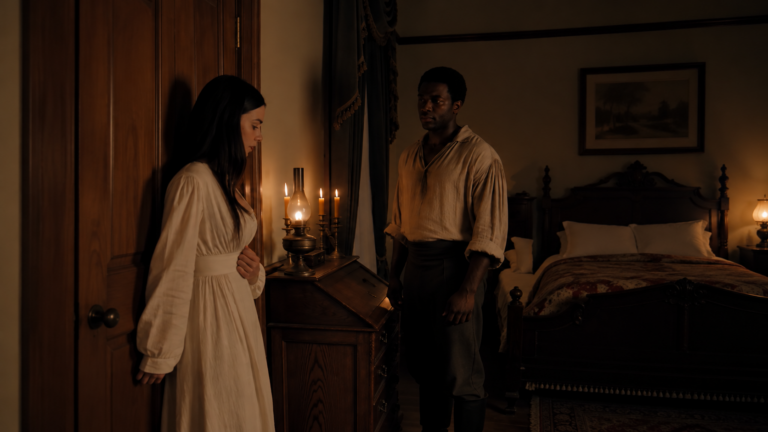
Evelyn returned to her bedroom for the first time since the night Samuel had warned her to move away from the door.
The bed stood beneath a sheet of canvas tied across the broken ceiling.
Rainwater had stained the rug, and broken plaster covered her dressing table.
The fireplace poker lay where Samuel had dropped it after breaking through the door.
She picked it up and ran one finger along the dent in its iron tip.
A single tool had opened a door that fine furniture and expensive locks had made useless.
From the yard came the sound of hammers working on temporary supports.
Samuel’s voice carried through the broken window as he corrected the placement of a brace.
Elias answered with a short laugh and asked him to measure again.
Evelyn went to the doorway.
The upper hinge remained twisted, and the wood around it was split.
She understood now that the room had become dangerous long before the storm arrived.
The danger had begun when a warning was dismissed because of the person delivering it.
It had grown when a cheaper beam was installed despite clear objections.
And it had nearly killed people who had no choice about living and working beneath it.
She put down the poker and left the room without trying to make it look whole again.
Downstairs, Arthur was discussing the repairs with a visiting merchant.
He spoke of lumber costs, damaged tobacco, and the need to restore the house’s appearance before the autumn visitors arrived.
Evelyn stood in the doorway and listened.
When he finished, she asked him to include proper supports for the quarters and service rooms in the repairs.
The merchant looked surprised.
Arthur’s expression hardened.
“We are repairing the main house first,” he replied.
“Then we should not claim the property is repaired,” Evelyn said.
Arthur began to protest, but the merchant had already written the additional inspection into his list.
It was a small, contested step.
Evelyn knew it would not free anyone or make her husband a different man.
Yet it placed the condition of the other buildings where a hired tradesman could see it, rather than leaving every complaint with Voss.
She would have to defend that choice the next day and the next.
EPILOGUE — AFTER THE THUNDER
The repaired roof was not completed before the first cool evenings of autumn.
Elias insisted on sound timber and independent supports, and Arthur complained over every invoice.
Samuel continued assisting with the inspection work while his shoulder healed.
The arrangement remained fragile, and he knew better than to mistake it for freedom.
Dr. Bell returned twice to see Ben, whose ankle improved slowly.
May was able to walk without assistance after several weeks.
The people who had crowded into the smokehouse resumed their work, carrying the memory of that night into ordinary mornings.
Evelyn did not become their rescuer, and the laws that held them enslaved did not bend because a roof had fallen.
She argued with Arthur over assignments and refused to let Voss erase the injuries from the household’s account of the storm.
Sometimes she succeeded, and sometimes she failed.
Samuel learned which decisions she could enforce and which promises remained too dangerous to trust.
One afternoon he passed the restored bedroom door carrying a carpenter’s square and a length of chalk.
Evelyn was standing inside the room, looking at the new ceiling.
“Does it look right?” she asked.
Samuel examined the joint, then the beam above the doorway.
“It does,” he said.
She waited without interrupting while he checked the brace a second time.
“If you see something wrong,” Evelyn said, “I want you to tell me.”
Samuel looked at the repaired wood and then at the open door.
“I told people before,” he said.
“This time,” Evelyn answered, “I will make sure they listen.”
Outside, a light breeze moved through the orchard without disturbing the roof.
Samuel picked up his chalk and went back to work.
The End.