CHAPTER FOUR — THE FIRST TEST
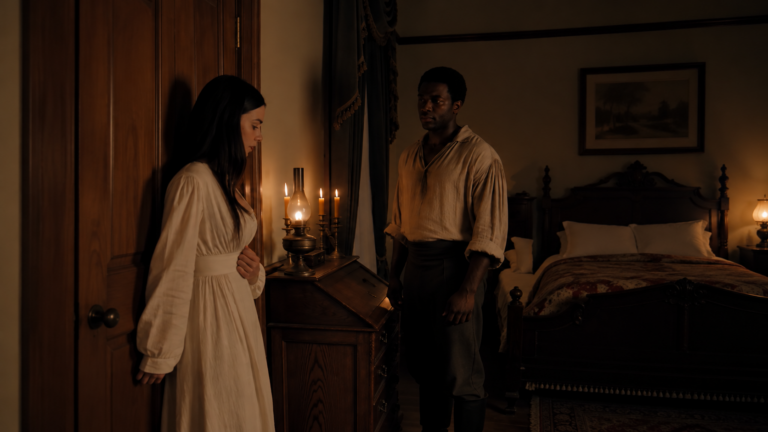
At breakfast, Ambrose announced that Catherine’s purchase would be charged against her personal allowance.
She let him finish, then asked why he had hired wagons for Friday.
His fork stopped beside his plate.
“I have made arrangements for surplus stock.”
“What stock?”
“Old household pottery.”
“I thought the kiln closed years ago.”
“It did.”
“Then why are the wares still here?”
Ambrose smiled at the servant standing near the door.
“Thomas, leave us.”
Thomas left without looking up.
Ambrose leaned toward Catherine.
“This is precisely why I wished you had stayed in Savannah.”
“The old house has obligations that cannot be satisfied by sentiment.”
“Are the bowls safe?”
Ambrose watched her carefully.
“Has that crippled man been filling your head with inventions?”
Catherine felt anger rise at the ease with which he reduced Elijah to an injury.
“He told me nothing about this conversation.”
“Then your questions are even more ridiculous.”
“I would like to inspect the kiln.”
“You would like to put yourself in danger by wandering around a ruined building.”
“It’s my estate.”
He rested his fork on the tablecloth.
“Then perhaps you would like to hear what happens when creditors learn its mistress cannot manage it.”
Catherine understood the threat beneath his polished voice.
He could destroy her reputation among men who already doubted her competence.
He could also order punishments against people who could not refuse him.
She pushed her plate away.
“I will not sign a bill of sale for pottery I have not inspected.”
Ambrose stared at her.
Then he rose and left the room without taking his breakfast.
Outside, Elijah was sweeping the carriage approach under a supervisor’s eye.
Catherine waited until the supervisor went to the stables.
“He knows we entered the east wing,” she told Elijah.
“He knew last night.”
“He’s moving the pottery on Friday.”
“We knew that too.”
“Do you have proof the glaze is dangerous?”
Elijah leaned his broom against the wall.
“Not proof that a man like Ambrose will admit.”
“What would he admit?”
“A customer complaining loudly enough to threaten the price.”
Catherine looked toward the empty carriage house.
“That sounds like another person with money.”
“Sometimes a person with money becomes useful when losing more of it frightens him.”
He explained that a free potter named Gabriel Finch operated a workshop in Milledgeville.
Gabriel had learned his craft beside Odessa’s brother and knew how to distinguish common yellow glazes from the hastily prepared mixture Whitmore had used.
He could compare samples by weight, color, and the way a surface reacted to vinegar and heat.
None of those observations alone would prove every illness, but together they could establish that someone knowingly sold questionable goods.
Elijah shook his head.
“Ambrose opens the outgoing post.”
“I can travel myself.”
“Then he will know where you went.”
“Does he watch everything?”
“He watches whatever might cost him something.”
Catherine considered the timetable.
The nearest market was on Wednesday.
She could travel there to inquire about household provisions without arousing suspicion if she did not bring Elijah openly.
She told him her plan.
He listened and then corrected it.
“Odessa is coming.”
“Ambrose won’t allow her to leave.”
“Odessa is the person who knows what those pots looked like before they were broken.”
“I know.”
“Then if you cannot get her there safely, I will not hand you the shards.”
Catherine stared at him.
She had spent her life watching men tell other people where to go.
Now an enslaved man was setting conditions for her help.
“All right,” she said.
“Odessa will come.”
CHAPTER FIVE — THE WAGON WITH NO MARK
Catherine told Ambrose she needed new sheets and lamp wicks from town.
He approved the trip reluctantly after insisting that a driver accompany her.
The driver he chose was Mercer, a man loyal to the overseer and accustomed to reporting private conversations.
Catherine asked Odessa to come as her seamstress.
Ambrose objected until she suggested that Mercer could accompany them both.
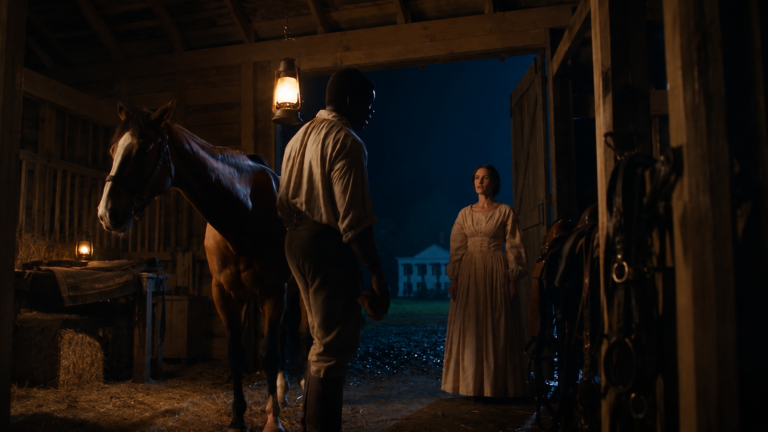
Elijah watched the carriage depart from the stable lane and waited another ten minutes before taking the old mule cart through the southern fields.
He traveled slowly enough that a worker in the cotton rows had time to tell him which road the overseer was using.
Odessa had found a way to hide her shards beneath folded linen.
Catherine had memorized the shop’s address.
A young worker named Esther had arranged to take extra feed to the market so Elijah could return without having to explain where the mule had gone.
When Catherine reached Milledgeville, Mercer insisted on waiting outside the cloth merchant’s shop.
She purchased a spool of thread and told him she wanted to visit a dressmaker on the next street.
Odessa carried the bundle while Catherine walked beside her.
At the corner, they turned away from the dressmaker and hurried toward Gabriel Finch’s pottery shed.
Gabriel stood beside a wheel, shaping a broad jar with hands gray from clay.
He looked at Odessa and stopped the wheel immediately.
“Your brother wrote about you years ago,” he said.
“Then he knew more than I did,” she answered.
Gabriel took the shards from her linen bundle.
He examined the underside of the first one.
“Whitmore’s work.”
“How can you tell?” Catherine asked.
“Most potters cut the base after firing, but the Whitmore kiln trimmed the clay while it was damp.”
He turned the piece in his hand.
“The ridges remain under the glaze.”
Odessa produced another fragment, bright yellow at its center.
Gabriel studied the surface and frowned.
“Where did this come from?”
“From a bowl used when my youngest was sick,”
Odessa replied.
Gabriel set both fragments beside his wheel.
“The color is too strong for a stable household glaze made with the materials that yard normally used.”
“Can you prove it is dangerous?” Catherine asked.
“I can show that the mixture is inconsistent and that it contains material no careful potter should put into a vessel meant for food.”
He opened a cabinet and removed three test tiles.
The first was pale cream, the second dark amber, and the third matched the garish yellow of Odessa’s fragment.
“An old glazer taught me to test mixtures on tiles before selling a single cup,”
he explained.
“Your family’s foreman purchased mineral pigment from a man who sold it for decorative roof ornaments.”
“Roof ornaments?”
“Objects that never held food.”
Catherine stared at the yellow tile.
“So the color is the trouble.”
“The trouble is using a glaze without knowing what leaves it when food or acid touches it.”
He placed a drop of vinegar on the fragment and showed how the glossy finish dulled where the liquid rested.
“This is enough to stop me selling it,” he said.
“It is not enough to tell exactly which sickness came from which bowl.”
Odessa nodded.
“We never asked for an impossible promise.”
From outside came a mule’s bray.
Elijah stepped through the workshop door, followed by Esther.
Catherine started in surprise.
“I thought you were staying home.”
“I did not say that,” Elijah answered.
Gabriel looked from him to Catherine and understood the shape of their arrangement.
“You brought everyone who can speak to this material,” he said.
“Not everyone,” Odessa replied.
“Not yet.”
They spent the next hour comparing shards, stamps, and a notebook Gabriel used to record his own glazes.
Then Esther returned from the street with troubling news.
A wagon bearing no merchant’s mark had passed through town before dawn,
carrying crates from Whitmore’s eastern road.
Its driver had told a stable boy the load was intended for a merchant named Reuben Shaw in Macon.
Catherine frowned.
“Friday was supposed to be the first shipment.”
“Friday may be the public shipment,” Elijah said.
Gabriel put down the fragment.
“If Shaw sells those bowls to innkeepers and families before anyone asks questions, more people will eat from them.”
Esther pointed toward the road.
“The wagon will reach the Macon crossroads by nightfall.”
Catherine calculated the distance.
“We cannot outrun a loaded wagon in this heat.”
Elijah looked at the mule resting beneath a tree.
“We do not need to outrun it.”
“Then what do we need?”
“We need to learn who is waiting at the other end.”
CHAPTER SIX — A BUYER’S TABLE
Gabriel knew Reuben Shaw by reputation.
He was a middleman who bought cheap household goods from struggling estates and resold them wherever customers did not know the makers.
He had a small warehouse in Macon and a habit of sending his clerks into towns ahead of his wagons.
A merchant like Shaw had little loyalty to Ambrose if he believed another buyer could expose him to a costly dispute.
That, Elijah argued, gave them a narrow opening.
They went to a boardinghouse owned by an older woman named Mrs. Ames, who agreed to rent Catherine a room without asking questions about her traveling companions.
Catherine paid for separate rooms and learned that Elijah could not safely register under his own name.
Mrs. Ames accepted a quiet explanation from Gabriel and assigned the back room to Odessa and Esther, while Elijah slept in the shed with the mule.
Catherine objected to the arrangement.
Elijah told her not to make a show of concern that would bring attention to the people she claimed to protect.
She fell silent because the correction was deserved.
The following morning, Gabriel entered Shaw’s warehouse carrying a basket of ordinary clay cups and asked whether the merchant wanted a new supplier.
Shaw, a stout man with red suspenders, inspected his work with bored impatience.
“I’m expecting a large consignment from Whitmore,” he said.
“I can sell you twice as many vessels for half that price.”
Gabriel kept his voice light.
“Does Whitmore still use its yellow glaze?”
Shaw paused.
“That is none of your concern.”
“Then I hope your customers do not complain about the taste.”
Shaw set the cup down.
“Who has been talking?”
“Men in my trade talk whenever a buyer offers dangerous bargains.”
Shaw glanced at his assistant.
The assistant looked away.
“Get out,” Shaw said.
Gabriel did not argue.
He left the warehouse carrying his cups and found Elijah waiting near the grain store.
“Shaw knows there is a problem,” Gabriel whispered.
“How do you know?”
“He asked who had been talking before I said there was anything wrong.”
Catherine had been waiting in a hired carriage around the corner.
She listened, then asked whether a complaint to the magistrate would stop the sale.
Gabriel shook his head.
“A magistrate might care if a buyer refused the goods or if someone could testify to the mixture used.”
“Odessa can testify.”
“Odessa has no safe claim to a hearing under the rules these men follow.”
Odessa, standing beside the carriage, heard him clearly.
“That does not mean I will stay silent,” she said.
“I’m telling you what danger to expect, not what to do,” Gabriel replied.
Elijah studied the warehouse doors.
“If Shaw refuses the first wagon, Ambrose may send it somewhere else.”
“What else can we do?” Catherine asked.
“Find the foreman’s kiln marks on the crates and make Shaw examine them before he signs the receipt.”
Gabriel nodded.
“Once he signs, he owns the burden of the bargain.”
“Then we should be there when the wagon arrives,” Catherine said.
Elijah looked at Odessa.
“She decides whether her own work is shown.”
Odessa touched the scar on her hand.
“I made those bowls because refusing orders would have punished my children.”
“I will not let the foreman say we invented the trouble afterward.”
The wagon reached the warehouse in late afternoon.
Two men rolled open the doors, and a driver in a broad hat backed the team toward the loading platform.
The first crate carried a fresh label identifying the contents as decorative garden vessels.
Gabriel frowned.
“These are table bowls.”
The driver shrugged.
“That is what the label says.”
Catherine stepped forward and identified herself as the owner of Whitmore Plantation.
Shaw emerged from the office, his cheeks reddening.
“Miss Whitmore, I have a contract with your uncle.”
“I have not authorized the sale of household dishes as garden ware.”
Shaw glanced toward the driver.
“Your uncle assured me the property was settled.”
“It is not settled.”
The driver began unloading anyway.
Then Odessa reached into the nearest crate and lifted a bowl whose yellow rim bore a dark flaw.
“This one came from the batch we rejected,” she said.
“Put it down,” the driver ordered.
Odessa held it where Shaw could see.
Gabriel took the bowl and showed him the underside.
“The glaze is unsuitable for food contact, and the label does not describe the vessel’s use.”
Shaw looked toward the open warehouse, where several customers were waiting to inspect merchandise.
He understood what a public argument could cost him.
“Take the wagon around the back,” he snapped.
Catherine said he would not do that until the shipment was counted in front of witnesses.
Shaw stared at her as though she had become a stranger.
“Elijah Carter,” someone said behind them.
The voice belonged to the Whitmore overseer.
He stood beside the loading ramp with two hired men and a whip looped over his wrist.
“Your uncle said you might be here.”
Elijah did not move.
The overseer smiled at Catherine.
“Miss Whitmore, your uncle requests your immediate return.”
Then he looked at Elijah.
“And I have orders to bring this man back in chains.”