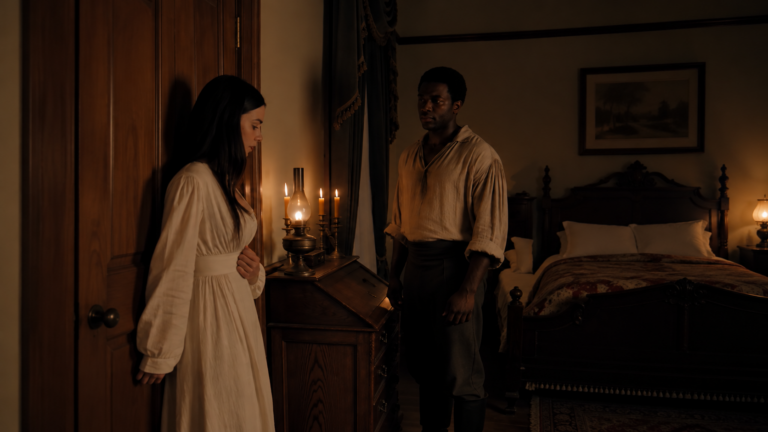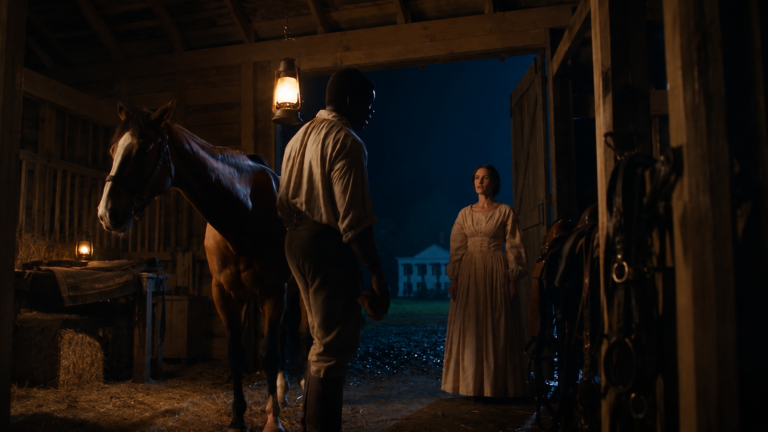
Daniel Carter was repairing a cabinet in the plantation woodshop when Lady Catherine entered after midnight and closed the door behind her.
He knew it was after midnight because the kitchen clock had struck twelve while he fitted the second hinge. The plantation slept in fragments: the great house behind drawn curtains, the cabins along the orchard road, the watchman crossing the mill yard with a lantern. His shop smelled of linseed oil and shaved walnut. A brass pin rolled between his fingertips as Catherine approached the bench.
“You know why I came,” she said.
Daniel set the pin in its tray. She wore a blue dressing gown beneath a black cloak, inappropriate clothing for the cold workshop and, worse, clothing intended to be noticed. She had come three times that month, never with a request he could carry out and leave behind. The first time she had asked about a warped drawer. The second, a lock that had not been broken. The third, she had stood beside him while he worked and spoken about loneliness as if loneliness excused a person for frightening someone who could not safely refuse her.
“I do not belong to you that way,” he said.
For a moment, she looked startled, as though the words were a language she had not expected him to speak.
“You have a fine opinion of yourself.”
“I have work to finish.”
She touched the half-built cabinet. “My husband thinks you are indispensable.”
“Your husband has never asked whether I agree.”
The air changed. Catherine withdrew her hand. Daniel understood that she had expected either gratitude or fear, and his steady voice had supplied neither.
“If you embarrass me,” she whispered, “I can have you sold before breakfast.”
He had been sold once, as a boy, and knew the sound of an auctioneer discovering that a human being had an injured knee. He knew how family names vanished across a yard once somebody with money raised a hand. He felt fear now, sharply, but refused to give it the shape of a plea.
Daniel opened the door and stood aside. “Good night, ma’am.”
Catherine passed him. The hem of her gown brushed a pile of curled shavings. She paused just outside, looking toward the house where two upper windows glowed. For an instant he thought she meant to say something different. Instead she went away through the damp grass.
Daniel secured the cabinet with a clamp and turned down his lamp. He would later remember that he had left the left-hand drawer open by a finger’s width so its finish could dry. He would also remember that the latch of the outer door had never clicked after Catherine crossed the yard. The wind could have nudged it closed. Somebody else could have entered.
At dawn, Overseer Harlan Pike arrived with two armed riders.
Pike did not ordinarily enter the woodshop without knocking. This morning he kicked the door wide and told Daniel to stand against the wall. The riders were local men who sometimes escorted purchases from the county market. Neither met Daniel’s eyes.
“A bracelet is missing from the lady’s dressing room,” Pike announced. “She says you threatened her.”
Daniel remained still while Pike searched the shelves. He pulled out the cabinet’s tools, overturned a box of fittings, and yanked the left drawer completely free. In its back corner lay a silver bracelet shaped like a twisting vine, its clasp bent and bright.
“There,” Pike said.
Daniel had never touched it. He had seen it on Catherine’s wrist at dinner when he carried a repaired chair into the dining room. But the bracelet itself was not the detail that stopped him. Under the drawer was a crescent of pale sawdust, fresh against the darker walnut shavings he had swept there the night before. Beside the bench, in the soft dust by the leg, a boot sole had pressed a distinctive diamond with a missing corner.
Catherine had worn soft slippers. Daniel wore boots with flat repairs on both heels. The third print belonged to neither of them.
Pike grabbed Daniel’s arm. “Now you can explain yourself to the master.”
Daniel looked once at the drawer. Its underside had a new gouge, made by somebody using a blunt chisel rather than the thin awl kept in his tray. Whoever planted the bracelet had been clumsy, hurried, or certain that no one would care about an enslaved carpenter’s observations.
“What time was it found?” Daniel asked.
Pike tightened his grip. “After you stole it.”
“That is not a time.”
One rider coughed to hide a laugh. Pike hit the workbench hard enough to send the brass pins scattering. “You will answer questions, not ask them.”
As they took Daniel outside, he spotted an empty barrow beside the bakehouse and saw the same diamond print stamped in the mud. Someone had walked from the woodshop toward the carriage shed before dawn. He could not examine it with Pike pushing him forward. But he could remember.
The bracelet, he realized, was an accusation. The sawdust was a direction.
2. THE MAKING OF A LIE
Master Alden Wexley received Daniel in a breakfast room where an untouched plate sat beside a newspaper. Alden was not an old man. His hands were soft, his temper uncertain, and his recent enthusiasm for modern machinery had left the plantation indebted to people he preferred not to name. His wife stood at the window, face composed.
“Catherine says you tried to force yourself on her,” Alden said.
Daniel’s stomach dropped. It was a more dangerous accusation than theft, and he understood why the bracelet had been planted. Catherine had moved the story farther than she had threatened to move it. There would be no safe way to repeat what she had actually asked of him in that workshop, not before these people, not under their rules.
“I did not threaten her,” he said. “I did not take her bracelet.”
“Then how was it in your drawer?”
“I do not know who placed it there.”
Pike leaned against the door. “Convenient.”
Alden stared at Catherine. “You are certain?”
She looked at the wallpaper rather than Daniel. “I want him removed.”
Pike’s satisfaction was too quick. “There is a trader at Bell Junction until tomorrow. I can have the man away before dinner.”
Alden pressed two fingers against his temple. The plantation’s new drying house had an enormous wooden ventilation carriage that Daniel had designed. The device opened twenty-four louver panels at once to regulate the heated air around tobacco bundles. The county agricultural committee was coming in two days to inspect it. If the demonstration succeeded, Alden might secure credit from the equipment syndicate. If Daniel disappeared before then, no one else knew how to adjust the carriage safely.
“The demonstration,” Alden murmured.
“I can finish the work,” Pike said.
“You cannot tell a bearing from a barrel hoop.”
Pike’s jaw flexed.
Alden turned to Daniel. “You will remain under guard until the demonstration is complete. Then you will be sold.”
Daniel had learned that a delay could be useful without mistaking it for mercy. Two days were better than one hour. Two days might also be enough time for whoever had planted the bracelet to finish doing something worse.
“Let him work without his ordinary tools?” Catherine asked unexpectedly.
Alden glanced at her. “He will be watched.”
Pike took Daniel out through the servant passage and tied his wrists loosely in front, not for necessity but for display. Outside the kitchen, a young woman named Mercy Bell stood holding a bucket of ashes. She had worked in the great house since childhood and was rarely permitted beyond its rooms. She saw Daniel’s bound hands and lowered her eyes only after meeting his gaze.
“Drying house,” he said, as if speaking to no one in particular. “The little wheel needs its wooden tooth.”
Mercy nodded once. She understood him. A missing tooth in that wheel could jam the machinery; she also understood that he would not mention it while Pike was close unless it mattered.
The overseer marched him to the carriage shed, where the new ventilation frame had been assembled on trestles. The apparatus looked like a long wooden rib cage with jointed arms and a series of sliding weights. Daniel had built it to reduce the furnace attendants’ exposure to the hot house interior. Workers could adjust the louvers from an exterior platform rather than climb amid the bundles. Alden had called it a splendid improvement and immediately demanded that it operate faster than Daniel had intended.
Now Daniel saw a fresh iron bracket bolted to the far end of the frame. The bracket had a polished surface, new screws, and a shallow groove on one side. He had not ordered it. A heavy cable stretched from it to the upper crossbeam, where a counterweight hung in darkness.
“What is that?” he asked.
Pike stepped in front of it. “An improvement.”