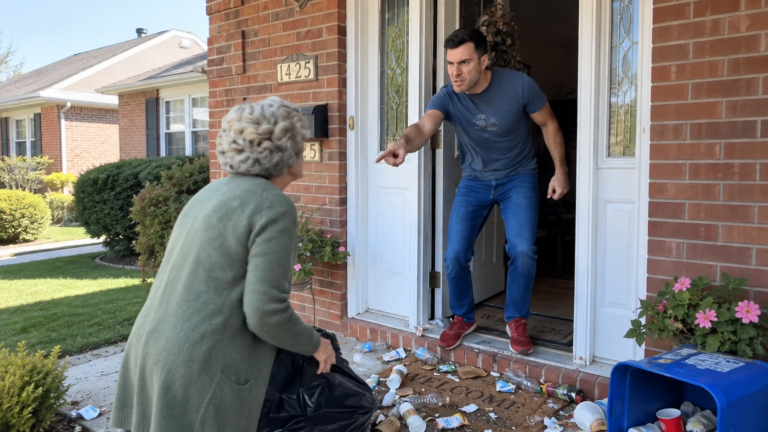
At two, a tow truck stopped outside Edith’s home and a young mechanic retrieved an old delivery van from her driveway. Mara watched from her front porch while Officer Keene approached the house again. Edith appeared at the door in a cardigan, no raincoat, looking smaller than she had that morning. She saw Mara across the street and withdrew inside before the officer could finish speaking.
Nisha arrived at three carrying dog food, medical supplies, and a folded photograph of seven greyhounds standing behind chain-link fencing at a kennel called Rook’s Run. Mara recognized six immediately. Cedar had been standing at the far edge, half hidden by another dog’s shoulder.
“Here’s the problem,” Nisha said. “The kennel’s former transport contractor claims these seven were never released to us.”
“But they were.”
“Yes. We accepted them in person. Now somebody is offering cash for every one of them recovered. I thought it was a paperwork fight. This morning tells me it isn’t.”
Mara looked through the glass at the dogs. The argument had just become much larger than her backyard.
3. The House with the Drawn Curtains
Edith Voss opened her door at sunset, after Mara had rung twice and stepped back beyond the porch. There was a white plastic bag at Edith’s feet containing groceries she had not yet unpacked. The old woman’s eyes were swollen. She stared at Mara’s shoes rather than her face.
“Are the dogs all right?” Edith asked.
Mara hadn’t said anything about dogs.
“Why did you dump garbage in my pool?”
“I’m sorry.”
“That’s not an answer.”
Edith glanced toward a parked vehicle halfway down the street. Mara turned to look. It was a silver sedan with dark windows. The engine wasn’t running, but someone occupied the driver’s seat. When Mara faced Edith again, the older woman had begun closing the door.
“Please,” Edith whispered. “Don’t come here again.”
Mara put her hand against the jamb, not blocking the door but refusing to walk away without another word. “Someone tried to take the dogs while you were making sure I watched you. Did you know that would happen?”
Edith’s hand tightened around the doorknob. “I didn’t think he’d go inside.”
“Who?”
“I can’t.” Edith’s voice had become dry and ragged. “Just keep them away from the gate tonight.”
The door closed. Mara heard the deadbolt slide across. On the walk home, she noticed the silver sedan had disappeared.
Inside, Nisha was speaking on the phone to a woman named Rena Solis, the county’s former racing-track veterinarian. Rena had examined dogs at Rook’s Run years earlier and still volunteered for emergency animal transfers. Nisha put her on speaker.
“Every dog can be identified independently,” Rena said. “The identification tattoos are inside their ears. Some of the kennel’s old records are unreliable, but the dogs aren’t.”
“Somebody offered money for them,” Mara said. “Why these seven?”
Rena paused. “Because they’re trained to do something nobody has explained to you yet. And I’m not certain the people coming after them know what that something is.”
“They’re racing dogs. They run.”
“Not this group. They stopped racing before the kennel closed. They were being moved to a place called the Annex, an old agricultural exhibition center beyond the county line. Rook’s Run called them demonstration animals. I was never allowed to examine them there.”
Nisha interrupted. “Demonstration of what?”
“That’s what I’m trying to find out.”
When the call ended, Mara found Owen sitting on the floor beside Cedar. The dog’s breathing had finally settled. Owen had placed a small wooden block in front of him, a toy from the kitchen’s puzzle drawer. Cedar nudged it to the right, waited, and nudged it again when Owen moved it back.
“He keeps doing that,” Owen said. “He likes the one with a corner missing.”
Mara watched. When Owen placed the block to Cedar’s left, Cedar ignored it. He waited until the boy moved it to the right of his front paws, then tapped twice.
“Maybe his left leg hurts,” she said.
“Maybe. But he does it every time I say ‘ready.'”
Owen demonstrated. “Ready?”
Cedar lifted his narrow head and gave two deliberate taps.
Mara did not know whether the trick meant anything. For the first time all day, though, the dog’s behavior did not look like fear. It looked like a memory somebody had taught him to keep.
That night she slept on the couch beside the sunroom. The pool lights remained off, the side gate was reinforced, and a carpenter’s bar rested against the garage door. At two in the morning, she awoke to the sound of someone dragging a metal object across pavement. She looked outside. At the far end of the street, the silver sedan was back.
It drove away when she switched on the porch light, but not before she saw that the rear plate was covered in mud. Someone had taken care to make the numbers unreadable.
4. The Annex
The next morning, Mara and Nisha drove to the old agricultural exhibition center. Owen stayed with a neighbor named Frances who knew the dogs and had already offered to help with feeding. Mara hated leaving them, but the officer assigned to check on the property had agreed to pass the house twice during the day.
The exhibition center stood beyond a faded billboard advertising a summer livestock fair that had closed years ago. Behind it, a row of corrugated barns sat along a narrow access road. A wire fence enclosed three training yards. Weeds pushed through the concrete around the loading dock. Nothing about the place looked active until Mara noticed fresh wheel marks near the far gate.
A woman in dusty work boots approached from the nearest barn. She introduced herself as Alma Reed, caretaker of the property. When Nisha asked about Rook’s Run, Alma folded her arms.
“You’re the people with the seven dogs,” she said.
“We have legal custody through the surrender,” Nisha answered.
“I’m not interested in your fight. I’m interested in the seven frightened creatures someone turned into a business.”
Mara asked what the business was.
Alma led them into the barn. Inside were a series of low platforms, painted targets, portable ramps, and stacked boxes with small doors cut into their fronts. It resembled an obstacle course, but some obstacles were far too narrow for a greyhound to pass through. There were no trophies, betting machines, or grandstands. Instead a long workbench held canvas pouches, bells with their clappers removed, and bundles of short wooden dowels.
“They trained the dogs to sort objects,” Alma said. “Or that’s what they told me. Different shapes, different sounds, different doors. Visitors paid to watch a demonstration about animal intelligence. At first it was harmless. Then they started asking the dogs to identify objects nobody had shown them before. They called it intuition.”
Nisha picked up a wooden block with a corner missing.
“Like this?”
“Exactly like that.”
Mara thought of Cedar tapping twice beneath the kitchen table.
“The demonstration wasn’t the crime,” Alma continued. “The money was. People were paying for private appointments. They believed these animals could make decisions no machine could make. Some lost more than they could afford.”
“Who ran it?” Mara asked.
“A man named Victor Senn. Never put his name on the signs. He paid a trainer called Beck. Beck used to work with rescue dogs, and he had a way of making an ordinary trick look miraculous.”
The barn door opened behind them. A young man in a canvas jacket stood silhouetted against the sunlight, holding a plastic bucket. He stopped when he saw Mara and Nisha.
“Alma,” he said, “you weren’t supposed to bring anyone here.”
“People are asking questions, Eli. They have a right.”
Eli set the bucket down carefully. “Victor’s buyers are coming Tuesday. If those dogs aren’t here, he says everyone who worked the Annex will be blamed for taking them.”
Mara asked whether the man who entered her garage worked for Victor.
Eli looked away. That was enough of an answer.
Before anyone could speak again, a vehicle rolled past the open barn. A black utility truck, moving slowly, with two men in the front. Alma grabbed Mara’s sleeve and pulled her away from the doorway.
“There’s another exit,” she said. “Don’t let them see which car belongs to you.”
They hurried through a side door into the long grass. Behind them, Eli called after Alma, but the truck had stopped near the loading dock and the sound of boots on gravel made all further argument impossible.
Mara and Nisha reached their car by crossing behind a row of rusted animal pens. As Nisha turned the key, Mara saw one of the men leave the truck and head for the barn. He carried a folded canvas bag of the kind trainers used to store supplies.
“What happens Tuesday?” Mara asked.
Nisha drove through the open exit without answering. Her knuckles had gone white around the steering wheel.
5. A Trick with Two Answers