Near dusk, Frances brought soup and sat with Owen in the kitchen. She was a retired school librarian with a calm voice and an unusual talent for convincing animals not to fear her. When Mara told her about the stage act, Frances set down her spoon.
“My sister went to something like that,” she said. “She was grieving. A dog touched a green box, and a man told her it meant she should stop visiting the home where her husband had died. She sold it. Two months later she regretted the decision.”
“Why didn’t she complain?” Owen asked.
“Because it’s humiliating to admit someone made you feel foolish when you were sad,” Frances answered. “People keep quiet about much worse than an expensive ticket.”
Mara went out to the porch and studied the darkening street. She understood then that recovering the dogs would not be enough. Victor could replace their stage names, modify the cues, and persuade new customers to believe the same false certainty. What he relied upon most was not dog training, but his audience’s embarrassment. People who discovered the trick would be reluctant to tell anyone they had fallen for it.
Inside, Cedar rested his chin on Owen’s knee. Mara watched the dog’s eyes close. Whatever happened Tuesday, Cedar would not have to stand beneath Victor’s lights again.
7. Edith’s Kitchen
Officer Keene called the following morning with a request. Edith had agreed to speak to Mara if Keene could remain present, and only for fifteen minutes. Mara left Owen with Frances and crossed the street carrying a container of homemade soup. She had not made the soup for forgiveness. She simply remembered the untouched groceries and suspected Edith had eaten very little.
Edith’s house smelled of lemon polish and toast. A clock ticked above the refrigerator. On the wall hung pictures of a smiling man beside an enormous red delivery truck, a child holding a fishing pole, and Edith in a bright blue coat standing outside a theater. In the kitchen, an empty chair had been pulled slightly away from the table.
“My brother is alive,” Edith said before Mara could ask. “His name is Raymond. He’s seventy-six and lives in a residence near Grayfield. They called me with a recording of him begging for help.”
Keene sat quietly beside the doorway. Mara placed the soup on the counter.
“What did they say would happen?” she asked.
“They said Raymond had signed up for something. Some program for older people to meet people, go on trips. Then they said he’d broken an agreement and owed them money. I told them he couldn’t have. He doesn’t have money like that. So they played the recording.”
Edith pulled a crumpled tissue from her sleeve. “He was saying, ‘Edie, please.’ He calls me Edie. Nobody else does anymore.”
“Have you spoken to him directly?”
Edith shook her head. “They said he wasn’t allowed calls until I settled what he owed. I paid what I had. Then they wanted me to do one more thing.”
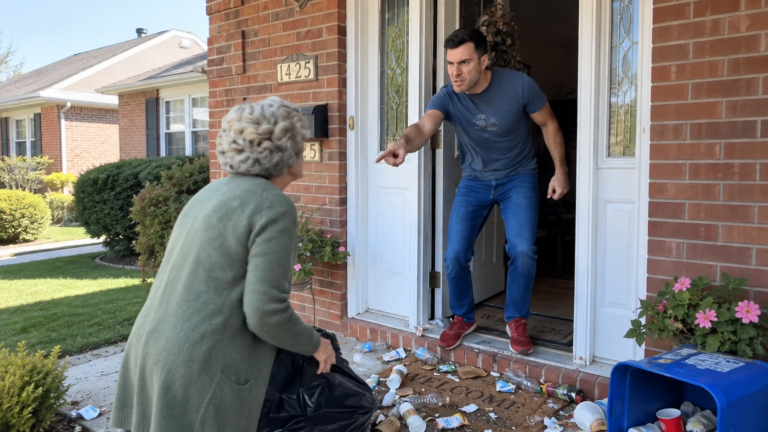
“Dump the garbage,” Mara said.
“Yes. They gave me the bag at six. Told me to walk into your backyard at seven fourteen, stand beneath the camera, and make sure the contents were visible. They said if I did it, Raymond could come home. If I refused, they’d move him somewhere I couldn’t find him.”
Mara tried to imagine crossing a familiar yard carrying that bag, knowing the person who lived there would see the humiliation. The cruelty seemed almost deliberate in its unnecessary details. Someone had required Edith to make herself hated, to become a distraction so conspicuous that Mara would overlook the intruder at the other end of the property.
“Why didn’t you tell me afterward?” Mara asked.
“They said they’d know if I talked. A man parked outside until midnight. He did the same thing on Sunday. I couldn’t think. I kept picturing Raymond on a bus somewhere, frightened and alone.”
Keene explained that officers had contacted the residence. Raymond was physically safe. He had made a distressed phone call after being told his sister was in trouble. The recording had been taken from that call, cut short, and played to Edith without the explanation. He had not been held captive. The deception was real, and so was Edith’s fear.
Edith covered her face. For a long moment Mara heard nothing but the kitchen clock. Then the old woman reached for the napkin Mara had set beside the soup and wiped her eyes.
“He asked me not to send money to anyone,” she whispered. “Last Christmas. I told him he was being silly. And then I did exactly what he warned me about.”
Mara did not tell Edith that everything was all right. The pool required cleaning, the dogs had been frightened, and a stranger had entered the house while a child slept upstairs. An apology could not reverse any of that. But Edith had been used, and her brother’s wellbeing had become part of the danger. Mara found herself angry in a direction she could act upon.
“I’m not going to pretend what happened was harmless,” she said. “But I want you to tell Keene every time that sedan came, every number that called, and every word they made you say. That’s how we make it harder for them to do this again.”
Edith nodded. Then she reached into the pocket of her cardigan and produced a small orange plastic clip. “They attached this to the garbage bag. It had a number on it. The man told me to remove it before I went through the gate. I put it in my pocket instead. I thought somebody might need to know who gave me the bag.”
Keene leaned forward. On the clip, beneath a strip of dried black adhesive, was a hand-lettered inventory code: PAV-12. Mara recognized the first three letters from the advertising for the Mercer Exhibition Pavilion. The thing that had made Edith’s act visible was also the thing the men had wanted her to throw away.
8. The Empty Stage
At the Pavilion that afternoon, work crews were arranging folding chairs beneath banners that read LISTEN TO WHAT MATTERS. The main stage had three painted doors and a large screen for projecting each participant’s question. An overhead rig supported velvet curtains, but there were no dogs, no kennels, and no visible signs that the show had been hastily rearranged. Victor Senn stood at the center aisle directing workers as if nothing outside the building concerned him.
Mara and Nisha entered with two volunteers from Second Mile, both wearing ordinary clothes. They had purchased general admission passes, and Nisha had already informed the rescue’s attorney of their plans. Officer Keene knew they were visiting but had warned them not to provoke a confrontation. Her department was pursuing the trespass and threats; the animal ownership dispute was being handled separately.
Victor spotted Mara halfway down the aisle. He was a handsome man in his late forties, with neatly combed hair and a voice trained to sound calm in a crowded room. He approached with a smile that did not extend to his eyes.
“Ms. Ellison, I believe,” he said. “You’ve had quite an eventful weekend.”
“You sent somebody into my garage.”
“That allegation is being discussed through the proper channels. I don’t conduct disputes in the foyer.”
“Then why did you invite the public here to watch dogs you don’t have?”
His smile thinned. “We have a program planned. People are looking forward to it. I hope you’ll respect that.”
Nisha stepped between them. “The animals are not yours to use, Victor.”
“That remains to be established.”
He turned away before they could reply and signaled a worker to move the painted doors farther apart. Mara noticed a cluster of visitors waiting to speak to him. One elderly man held his hat against his chest. Another woman clutched a photograph so tightly its edges had folded. None looked like a wealthy collector searching for an amusing night out. They looked like people who needed a question answered.
As Victor greeted them, Mara realized his business had grown more predatory than she had imagined. It sold an experience of certainty to people who could least afford disappointment. Even if the dogs performed an innocent sequence of tasks, the surrounding theater offered interpretations that turned spectacle into authority.
Mara approached one visitor, an older teacher named Helen Gage who had come with her adult daughter. Helen explained that she wanted help deciding whether to move to a different city after her husband’s death. The daughter looked exhausted and skeptical. “Mom, I told you an animal can’t decide where you live,” she said.
Helen looked embarrassed. “It isn’t that. I just wanted a little courage.”
“I understand,” Mara said. “But the performer chooses on command. Whatever door opens, it doesn’t know your situation.”
The daughter glanced at Mara, grateful but uncomfortable. Helen drew her coat closed. “You don’t have to make me feel stupid.”