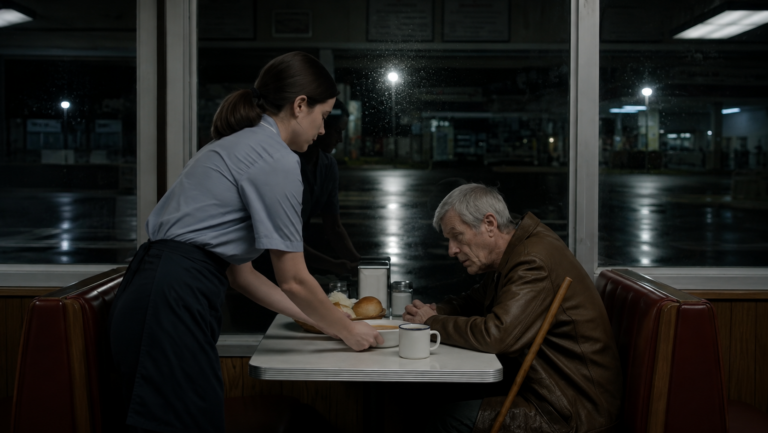
That evening, Northline’s Victor Saye arrived uninvited.
He chose a table near the front and ordered sparkling water.
When Francine came to greet him, he slid a new purchase offer across the table.
“I’ve increased the price,” he said.
She saw a figure considerably higher than Ethan’s early estimate.
“You still won’t protect the staff?” she asked.
“I’ll interview every employee.”
“That’s not the same thing.”
“No sensible buyer guarantees a job forever.”
“Nobody asked for forever.”
Victor smiled.
“Then we’re negotiating definitions.”
He pointed to the signature line.
“This offer expires tomorrow at noon.”
Francine looked beyond him to Lucia carrying a tray of clean plates toward the kitchen.
She imagined the restaurant painted gray, the tables replaced, and the people who knew its rhythms disappearing one by one.
Then she imagined the invoices Nadine had shown her.
A higher sale price would protect her retirement and settle the debts without fear.
She put the paper in her bag.
“I’ll consider it,” she said.
Victor watched her walk away and was satisfied with how uncertain she looked.
CHAPTER EIGHT — A VOTE WITH SOMETHING TO LOSE
Marissa received an offer from the hotel catering company on Sunday morning.
The position paid more than her old job and included health benefits after a probationary period.
It also required her to accept by five.
She held the phone while Elena read the letter over her shoulder.
“That’s real money,” Elena said.
“Yes.”
“You should be pleased.”
“I am.”
“You don’t look pleased.”
Marissa set the phone on the table.
“I want to see whether the restaurant can be something else.”
Elena leaned back.
“Do you want to work there, or do you want to prove that firing you was a mistake?”
The question stung because Marissa had not asked it of herself.
“Both,” she admitted.
“Then choose the first reason before the second one eats it.”
Marissa read the hotel’s offer again.
“I could take this and forget Harper’s Table.”
“You could.”
“And I wouldn’t be letting anybody down.”
“No.”
“Even if the others stay?”
“Their choices belong to them.”
Marissa stared at the signed offer page.
She had spent so long carrying other people’s emergencies that the prospect of simply taking a decent job felt almost selfish.
At Harper’s Table, the staff representatives had scheduled an open meeting after the Sunday brunch service.
Francine invited everyone, including the employees who had rarely spoken in public.
Ethan agreed to attend only for the first section and then leave while staff discussed his proposal.
Priya brought an accessible summary of the finances and made sure each employee received a copy.
Nadine explained cash flow without pretending it was more cheerful than it was.
The restaurant could remain open only if someone provided capital and if spending controls improved quickly.
Northline offered a faster sale and likely closure for remodeling.
Ethan offered a less certain path with more staff influence.
Remaining independent would require Francine to risk much of her remaining savings.
No option came without cost.
The debate grew sharp almost immediately.
Becca had two children and wanted the buyer who could guarantee prompt wages.
“I can’t pay the landlord with influence,” she said.
Lucia agreed about wages but feared that a corporate buyer would replace kitchen staff after training new hires.
Omar wanted written rights for support workers instead of vague promises of equality.
Jules argued that accepting a billionaire’s help without enforceable limits could make the restaurant dependent on his mood.
Simone asked whether anyone could survive another month with Calvin’s system still embedded in the schedules.
Francine admitted that she had not yet determined how many hours were truly necessary for each service.
The room became quiet because they had reached a hard part of the problem.
More predictable staffing meant deciding how to allocate limited hours fairly.
It would not always mean giving everyone the hours they wanted.
Ethan took questions for almost an hour.
He acknowledged that he wanted a return on his investment.
He said he would not buy a restaurant simply to lose money indefinitely.
Some employees appreciated the honesty.
Others disliked hearing the numbers attached to their jobs.
“Would you sell us out if a company offered you twice what you paid?” Niko asked.
Ethan considered before answering.
“I don’t know what I’ll be offered in five years.”
“That’s not comforting,” Niko said.
“I promised I would stop offering comforting answers I can’t defend.”
Lucia leaned forward.
“Then give the workers the first chance to buy your stake if you ever sell.”
Priya made a note.
“We can model that.”
“And voting rights over a buyer who intends to close the kitchen,” Omar added.
Ethan looked at Priya.
She nodded slowly.
“That will affect the valuation, but it’s negotiable.”
“Good,” Jules said.
“We intend to negotiate.”
Marissa arrived after the meeting had begun.
She listened near the back without taking a seat.
Francine noticed and invited her forward.
“I don’t think I should vote,” Marissa said.
“I’m not employed here.”
Jules held up a hand.
“We can vote about whether to invite you back.”
A ripple of laughter loosened the room.
Marissa stepped to the front.
“I have another job offer,” she said.
“I need to decide today.”
Nobody interrupted her.
“I can’t promise I’ll stay if this deal happens, and I don’t want my name used to sell a plan that hasn’t been tested.”
Ethan watched her carefully.
“But I can tell you what I would need if I came back.”
She asked for a written role with specific duties and a salary that would not depend on tips.
She wanted authority to stop service when safety or staffing required it, subject to review by colleagues.
She wanted training time paid for every new employee, including dishwashers and hosts.
She wanted complaints heard by more than the person being complained about.
Most of all, she wanted the employee council to exist whether or not she accepted a position.
“It’s not a monument to my bad day,” she said.
“It has to work on ordinary days too.”
When Ethan left the room, the staff continued debating.
Jules proposed a vote on whether the employee representatives should negotiate with Ethan at all.
The ballot was simple because the question needed to be simple.
Ten voted yes.
Two voted no.
One employee abstained because she expected to leave next month and did not want to shape a workplace she would not occupy.
The group accepted that decision without pressuring her.
Next they agreed that nobody would sign an individual agreement trading future claims for a bonus until Nadine explained its meaning.
It was not an accusation against Ethan.
It was an acknowledgment that even well-meaning offers could produce obligations people did not understand.
Francine phoned Victor that evening.
“I won’t sign by noon tomorrow,” she said.
Victor sounded genuinely surprised.
“My offer is substantially stronger.”
“On price, yes.”
“You owe your staff nothing beyond the law.”
Francine stood in her kitchen holding the telephone more tightly.
“That sentence tells me enough.”
“Don’t make a sentimental mistake.”
“I’ve already made a practical one,” she answered.
“I gave the wrong man control of my restaurant.”
She ended the call.
For the first time in years, she did not immediately call Calvin to ask what to do next.
CHAPTER NINE — THE CUSTOMER WHO CAME BACK
Walter returned to Harper’s Table on Monday morning.
He walked slowly from the bus stop, carrying a small paper bag.
The dining room was closed between breakfast preparation and lunch.
Simone recognized him through the window and unlocked the door.
“You came back,” she said.
“I wanted to finish a conversation.”
“With Marissa?”
“If she’s here.”
“Not yet.”
Walter looked around at the empty tables.
“Then maybe I can speak to whoever is listening.”
Simone led him toward a booth.
She brought tea without asking whether he could afford it.
Walter thanked her and placed the bag on the table.
Inside was a photograph of the restaurant from many years earlier.
The image showed his wife smiling beside Francine’s husband at a community cooking demonstration.
“My wife taught cooking classes,” Walter said.
“She wasn’t famous. She taught young adults who’d never had a chance to learn.”
Simone studied the photograph.
“Did she work here?”
“Not regularly. She helped with a few classes in the old kitchen.”
“That’s wonderful.”
“It was.”
He paused before continuing.
“She died last year. I stopped taking care of myself for a while.”
Simone waited.
“When Marissa fed me, she didn’t ask whether I had a sad story to justify being hungry.”
“She does that with everybody.
”
“That’s why I came back. I don’t want her kindness turned into a show about me.”
Marissa arrived just before ten to discuss the proposed position.
Walter stood when he saw her.
She hurried forward and told him he didn’t need to rise.
“I never got to thank you properly,” he said.
“You don’t owe me thanks.”
“Then perhaps you’ll accept a request.”
She sat across from him.
He explained that reporters had contacted him after identifying him from a photograph posted by a customer.
One wanted a picture of him holding the lunch plate.
Another asked for an interview in which he would describe how desperate he had been.
“I don’t want to be the reason somebody gets a heartwarming advertisement,” he said.
Marissa felt ashamed that she had not considered his privacy sooner.
“I’ll tell Ethan,” she said.
“I already told him.”
“What did he say?”
“He apologized and asked what I wanted.”
Walter opened the paper bag again and withdrew the photograph.
“I want this restaurant to remember how to welcome people without using them as evidence of how good it is.”
Marissa studied the old kitchen in the photograph.
“I think that’s something we can work on,” she said.