CHAPTER 55: THE BOOK OF NAMES
Back home, Josiah began arranging the family documents into a volume that could be read by future generations.
He asked Ruth, Miriam, Abel, and several others to review the sections concerning their lives.
He refused to write as though he had witnessed events that other people alone remembered.
Miriam contributed an account of Esther’s help and the letters she had sent without receiving answers.
Ruth described the decision to protect Mercy and the work of rebuilding their household after release.
Abel supplied an introduction explaining why he had preserved the old lists and where the uncertainties remained.
The church secretary helped Josiah distinguish confirmed dates from family recollections.
Mercy suggested adding a section for stories that could not be reduced to names and years.
She wanted the book to include the blue button, the orchard, and the songs her grandmother remembered.
Josiah agreed and asked her to write the first passage herself.
Mercy spent several evenings describing the reunion from her point of view.
She wrote about the carriage, the wooden house, and how her grandmother had laughed when she said she liked horses more than sewing.
The passage contained details Josiah had forgotten.
He realized that the child’s memory was not a smaller version of the adults’ history.
It was a separate account deserving its own place.
When the volume was complete, Josiah made copies for family members and the church collection.
He included a note explaining that the records were incomplete and should be corrected whenever new evidence appeared.
He did not call the work a history of his triumph.
He called it a book of names because every person within it had lived a life larger than the circumstances of their captivity.
Miriam held her copy for a long time before opening it.
She found her name beside Ruth’s and Josiah’s, with Mercy listed on the next line.
For years she had searched for proof that her children still lived.
Now she could read their names together on a page prepared by their own hands.
She asked Josiah to leave room for people who had not yet been found.
He added several blank pages at the back.
The empty space was not an admission that the work had failed.
It was a promise that another voice could still be heard.
CHAPTER 56: THE MEANING OF PLEASE
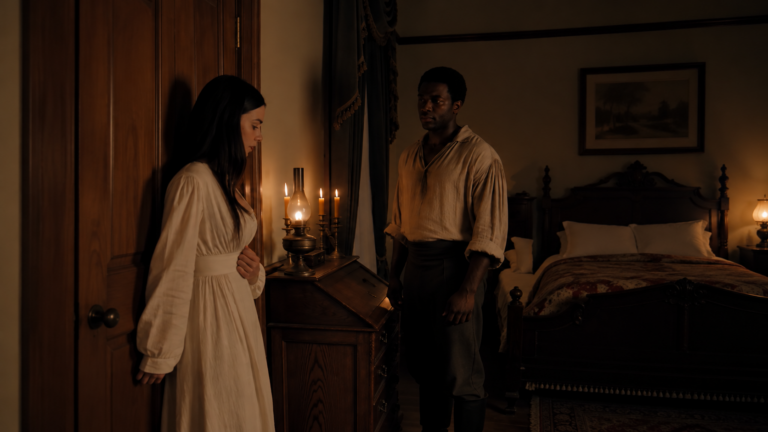
Years later Josiah still remembered Isabella’s voice in the stable.
He remembered how the word please had sounded like a plea while resting on the authority of someone who could command him.
He also remembered that the conversation had forced a dangerous truth into the open.
Isabella had not saved him by asking for his company that night.
She had exposed a wrongdoing that she herself helped authorize.
Josiah, Ruth, Abel, and others had decided how to use that knowledge without surrendering their judgment to her.
The distinction mattered whenever people tried to retell the story as a tale of a lonely mistress and a brave young man who rescued her.
Josiah corrected them.
He said the center of the story was not the sorrow of the woman in the big house.
It was the families whose names had been written into a sale order without their consent.
It was Ruth refusing a bargain that would abandon Mercy.
It was Abel preserving names that the books reduced to prices.
It was Miriam surviving long enough to answer a letter.
Josiah married years afterward and built a modest livelihood working with horses.
He taught younger people to read when he could do so safely and openly.
Ruth expanded her sewing work and helped other families correspond across long distances.
Mercy grew old enough to understand why her mother kept the freedom papers wrapped so carefully.
The family did not preserve the documents because paper had created their worth.
They preserved them because the world had demanded documents before acknowledging a freedom that should never have been withheld.
One evening Mercy asked Josiah whether he had been frightened when Isabella first came to the stable.
He told her that he had been terrified.
She asked what he did with that fear.
Josiah considered the question before answering.
“I listened carefully, and then I chose what belonged to us,” he said.
Mercy looked toward her mother and grandmother sitting by the window.
She seemed satisfied with an answer that honored their choices rather than turning one man into a legend.
Josiah watched the daylight settle over the yard.
The old plantation was far away, but the lives it had tried to control remained present in every remembered name.
Their freedom was not a gift from a master’s wife.
It was a future they had insisted on claiming together.
The End.