Richard Sterling had always preferred rooms where people waited for him to speak.
On Monday evening, the Crestwood Business Association held its annual dinner at a hotel ballroom.
He arrived wearing his dress uniform and took the seat beside Mayor Colin Mercer.
The mayor was a thin man who looked perpetually tired, even while smiling for photographs.
“The federal hearing is drawing attention,” Mercer said quietly.
Sterling buttered a roll.
“Attention from people who have never run a department.”
“Our city attorney is concerned about the towing contract.”
“The contract was approved by council.”
“The question is whether the officers followed it.
”
Sterling placed his knife beside the plate.
“You want me to throw my officers under a bus?”
“I want you to preserve records and stop intimidating witnesses.”
The chief laughed sharply.
“That sounds like a prepared statement.”
Mercer looked toward the podium where the association president was thanking sponsors.
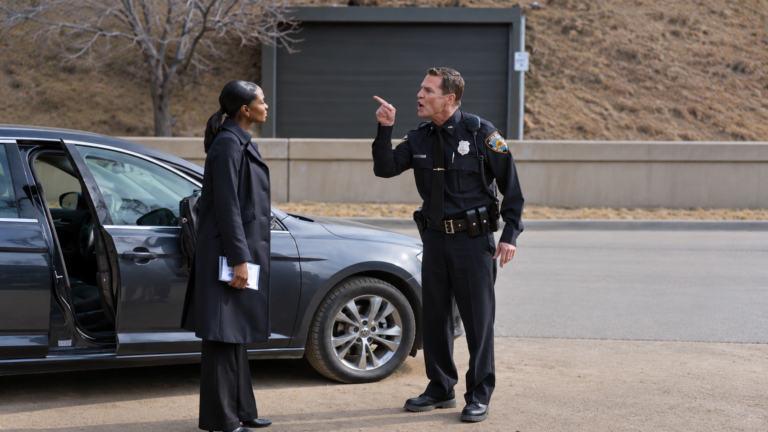
“Someone contacted my office about a woman stopped on Route 9.”
“Another complaint?”
“She says you searched her rental car without a citation.”
“She had an attitude.”
Mercer turned to him.
“An attitude is not a traffic offense.”
Sterling’s smile disappeared.
“You appointed me to keep the roads safe.”
“The council appointed you,
and I supported it.”
“Then support it now.”
The mayor lowered his voice.
“I will not help you hide the footage.”
Before Sterling could answer, the master of ceremonies announced his name for a public safety award.
Applause filled the ballroom.
Sterling rose, straightened his coat, and walked toward the stage with the confident stride people had come to expect.
He spoke about accountability, courage, and community trust.
Near the back of the room, a hotel server named Keisha Bell watched him from a service door.
Her brother had lost a landscaping job when Crestwood Recovery held his truck for nine days.
She had spent her savings getting it released.
When Sterling said the town had never been safer, Keisha lowered her tray and walked out of the ballroom.
She went to the staff locker room and found the number for the legal aid intake line.
By the time Sterling returned to his seat, another witness had made an appointment.
Young Jenkins spent Tuesday reviewing a separate federal training initiative in a conference center two counties away.
She had recused herself from operational decisions about Crestwood, but she could not put the town out of her mind.
During a break, a colleague named Mira Lawson found her by the coffee station.
“You look exhausted,” Mira said.
“That is accurate.”
“I heard about the stop.”
Young set her cup down.
“The complaint process is confidential.”
“David told me only that you needed schedule flexibility.”
“I appreciate that.”
Mira watched her carefully.
“You know there will be people who claim you planned this.”
“I know.”
“They will say the rental car was bait.”
“It wasn’t.”
“Then keep your dates clear and your boundaries clearer.”
Young smiled faintly.
“You sound like our ethics officer.”
“I learned from her.”
That afternoon, a hotel receptionist called Young’s room to report that a visitor was waiting downstairs.
The visitor claimed to be from Crestwood City Hall.
Young had not scheduled any meeting.
She asked for the visitor’s name and received one she did not recognize.
The man introduced himself over the lobby phone as Thomas Pike, a consultant for the city.
“I want to settle any misunderstanding before it gets expensive,” he said.
“You should direct any legal communication through counsel.”
“I was hoping we could speak informally.”
“We cannot.”
“Chief Sterling regrets that you felt disrespected.”
“My report describes his actions, not merely my feelings.”
Pike cleared his throat.
“There may be compensation for damaged clothing.
”
Young looked at the raincoat hanging beside her room door.
“Please contact the assigned attorneys,” she repeated.
She ended the call and immediately documented the attempted contact.
The visitor had not threatened her.
He had also made an unsolicited approach to a material witness in a pending matter.
Investigators, not Young, would determine whether it crossed a legal line.
A few minutes later, she called Denise.
“Someone came to the hotel to offer me dry-cleaning money,” Young said.
Her sister let out a sound between a laugh and a gasp.
“For forty-five minutes in freezing rain?”
“Apparently.”
“Are you all right?”
Young sat on the edge of the bed.
“I am beginning to understand how exhausting it is to be asked to prove an experience over and over.”
Denise softened.
“You knew that before.”
“I knew it professionally.”
She rubbed her tired eyes.
“That is not the same as standing there.”
On Wednesday, Priya obtained a set of documents produced by the city under a federal preservation order.
The pages included contract amendments, internal emails, and hundreds of tow referrals.
One email caught her attention.
Its subject line was corridor compliance reconciliation.
The sender was a finance coordinator named Ellen Moss.
Moss had asked why a vehicle was counted as a safety intervention when its driver had been released without a charge.
The reply came from the chief’s executive assistant.
It instructed Moss to process the entry as approved and stop requesting unnecessary clarifications.
Priya placed the email beside several similar exchanges.
“She kept asking the same question,” Caleb said.
“And she kept getting told not to ask.”
They requested an interview with Moss through her attorney.
She arrived the next morning wearing a wool coat and carrying a small paper bag containing her lunch.
Her lawyer made the introductions.
Priya began with routine questions about invoice processing.
Moss explained that the police department submitted monthly spreadsheets listing traffic interventions and associated expenses.
The finance office did not independently determine whether a stop had been lawful.
It paid approved claims if the supporting numbers appeared in the right fields.
“Who could approve an intervention?” Priya asked.
“The chief, the deputy, or designated shift supervisors.”
“Did you ever reject one?”
“I tried.”
Moss folded her hands.
“The system marked it as overdue, and I received a call asking why I was obstructing public safety.”
“From whom?”
“Chief Sterling.”
Her lawyer nodded for her to continue.
“He said we might lose the program if I kept delaying reimbursement.”
Priya showed her a line from a payment report.
“What does the code C17 mean?”
“That’s a contractor reconciliation code.”
“Which contractor?”
“Corridor Metrics.”
“What service did they perform?”
Moss looked down.
“They said they verified the number of reported vehicle removals.”
“How?”
“I never received a methodology.”
Moss explained that she eventually printed discrepancies and brought them to a meeting with the city manager.
Afterward, she was reassigned to routine vendor renewals.
She had not been fired, but her access to the safety program ended.
“Why are you speaking now?” Priya asked.
Moss touched the paper bag beside her chair.
“Because I got a call from a woman who couldn’t get her van back.
”
“Did you know her?”
“No.”
“How did she find you?”
“My name was at the bottom of a payment form.”
Moss swallowed.
“She asked whether I had children.”
“What did you say?”
“I told her I have two.”
“And then?”
“She asked what I would do if someone kept my car while my children waited for me.”
Priya let the silence settle.
Moss drew a breath.
“I decided I could live with a transfer,” she said.
“I couldn’t live with telling her that my job was to stop asking.”
Sterling learned that Ellen Moss had agreed to an interview on the morning his department received another preservation notice.
The notice demanded records of who had approved changes to the road safety program.
He summoned Deputy Quinn to his office and closed the blinds.
“They’re digging through old accounting decisions,” he complained.
“The city has an obligation to produce the records,” Quinn said.
“You keep using that word.”
“Which word?”
“Obligation.”
She sat without being invited.
“I use it because it applies to both of us.”
Sterling paced behind his desk.
“I built this department when the council barely funded our radios.”
“You also signed the contracts.”
“Contracts that kept officers on the road.”
“Some of the extra shifts were used to tow cars that weren’t dangerous.”
He stopped walking.
“Are you accusing me?”
“I’m telling you what the records suggest.”
“You sound like the federal lawyers.”
Quinn took a slow breath.
“Last winter an officer asked whether a car needed towing when the driver was parked outside a tire shop.”
“I remember.”
“You instructed him to classify it as a corridor hazard.”
“It had a flat tire.”
“It was parked off the road.”
Sterling planted both hands on the desk.
“You weren’t there.”
“I was on the radio.”
For a moment he seemed to consider denying the conversation.
Instead, he changed direction.
“How many officers have been talking?”
“I won’t answer that.”
“I am still your chief.”
“And I am still responsible for accurate records.”
He stared at her with an expression she had never seen before.
Under the anger was something close to fear.
“People remember all the times I helped them,” he said.
“They remember when I found their kids and fixed their problems.”
“Those things don’t erase the other things.”
Quinn rose.
“The evidence custodian has protected the videos and dispatch records.”
“I didn’t authorize that.”
“The preservation order did.”
She left before he could threaten her job.
Outside, a patrol officer was waiting for a signature on a fuel request.
Quinn signed it and asked about his shift as though nothing unusual had happened.
She had spent years believing that loyalty meant keeping internal disputes private.
Now she understood that privacy had allowed ordinary mistakes to become established practice.
She was not proud of how long the change had taken.