The first testimony concerned the city’s obligation to maintain accurate impound records.
Priya described the method her team used to compare patrol reports, tow dispatches, and reimbursement claims.
She did not accuse every officer of wrongdoing.
She explained which records matched, which conflicted, and which remained missing.
Roth introduced a sample of entries showing vehicles classified as roadway hazards although the associated reports documented no dangerous condition.
Kessler questioned whether the sample represented the entire program.
“It does not,” Priya answered.
“It represents the discrepancies we can currently substantiate.”
Judge Whitaker asked for the total number of entries still under review.
Priya provided the count and distinguished confirmed inconsistencies from unresolved questions.
The judge nodded and wrote something down.
Ellen Moss then explained why she had questioned invoices and how Sterling had instructed her to stop delaying them.
Kessler suggested that she misunderstood a routine budget discussion.
Moss did not raise her voice.
“I asked him for supporting documentation,” she said.
“He told me to approve the claim without it.”
“Did he use those exact words?”
“He said the department did not need a clerk deciding which police actions counted.”
“That sounds like a division of responsibilities.”
Moss looked at the judge before answering.
“It would have been, if my job had not required verifying the supporting documents.”
Marisol testified next.
She described the stop, the working license light, the escalating storage charges, and the release form demanding that she waive complaints.
When she mentioned missing her children’s school events, her voice broke.
The judge gave her time to drink water.
“I am not asking this court to make me special,” Marisol said.
“I am asking why paying the bill never seemed to end the bill.”
Her words hung in the room.
Kessler questioned the timing of her husband’s inspection of the license light.
Marisol admitted that the inspection occurred after the stop.
She refused to claim she knew the light’s condition at every moment of the drive.
“What I know is that nobody explained why we had to lose our car for weeks,” she said.
The judge listened without interrupting.
Then Bradley Hayes was called.
Sterling watched him take the oath.
The rookie described Young’s stop and his own failure to intervene.
Roth asked whether Sterling had identified an offense before searching the rental sedan.
“Not in my hearing,” Hayes said.
“Did you observe resistance from the driver?”
“No.”
“Did the chief tell you to leave her luggage in the mud?”
“Yes.
”
Kessler stood.
“Officer Hayes, are you testifying to protect your own position after being reassigned?”
Hayes looked toward the defense table.
“My position got worse after I spoke,” he answered.
“I am here because the facts did not change.”
Sterling looked away.
Young Jenkins took the witness stand after lunch.
She stated her name, position, and current responsibilities.
Roth immediately asked about her recusal from decisions concerning her own complaint.
She explained when she had reported the conflict and what steps had been taken to separate her testimony from the oversight investigation.
“Did you travel to Crestwood expecting Chief Sterling to stop you?” Roth asked.
“No.”
“Did you identify your federal position during the stop?”
“No.”
“Why not?”
Young looked toward the judge.
“I had complied with the request for identification, and my occupation was not relevant to the alleged traffic offense.”
Roth asked her to describe the stop.
Young repeated the chief’s words without imitating his voice.
She described the rain, the search, and the forty-five minutes beside the road.
She explained that no citation was issued and no reason for the search was provided to her.
“Were you frightened?”
“Yes.”
“Did your position prevent that fear?”
“No.”
Kessler approached for cross-examination.
He asked whether she had legal training.
She said she did.
He suggested that her answers at the roadside were designed to irritate the chief.
Young replied that she had answered directly and requested a lawful explanation.
“You knew you could file a complaint afterward,” he said.
“I hoped I would not need to.”
“You were aware that Chief Sterling might lose his position if your complaint succeeded?”
“My complaint does not determine his employment.”
“You have considerable authority as a federal director, don’t you?”
“Within the boundaries of my office, yes.”
“Could you have made one phone call and brought this department to its knees?”
Roth objected to the argumentative characterization.
The judge sustained the objection.
Young waited while Kessler reformulated.
“Have you used your authority to direct this investigation?”
“No.”
“Then what exactly do you want from this court?”
Young paused.
“That question belongs to counsel regarding the relief requested,” she said.
“As a witness, I want the court to understand what happened on Route 9.”
Kessler returned to his table.
Sterling was staring at Young as though her calmness were a personal insult.
The judge asked one question of her own.
“Director Jenkins, would your account of the stop be different if you held no federal position?”
“The facts would be the same,
Your Honor,” Young replied.
“The practical consequences might have been far harder for me to challenge.”
Judge Whitaker thanked her.
Young stepped down and returned to the audience without looking toward Sterling.
Kessler called Sterling to the stand despite the obvious risks.
The chief insisted that his officers faced dangerous conditions on Route 9 and deserved freedom to make quick decisions.
He described late-night crashes and the difficulty of finding funding for traffic patrols.
Several spectators nodded because those dangers were real.
Roth did not dispute them.
He asked Sterling whether the city had authorized officers to tow vehicles merely to improve program statistics.
“Of course not,” Sterling answered.
“Then why did you approve an impound reported from a private parking lot?”
“The officer made a safety judgment.”
“Was the vehicle obstructing traffic?”
“Not according to that summary.”
“Was its owner present?”
“Apparently.”
“Had the owner arranged a replacement tire?”
“That appears to be the case.”
Roth paused.
“What danger required impounding that vehicle?”
Sterling stared at the photograph on the monitor.
“I’d have to review the circumstances.”
“You approved the intervention three times.”
Roth displayed the original report, the amended report, and a reimbursement certification bearing Sterling’s electronic approval.
“Did you review the circumstances when you certified payment?”
The chief shifted in his chair.
“I relied on my staff.”
“And when your finance coordinator asked for those circumstances?”
“I told her to let the police do their jobs.”
Roth took one step back.
“Did you ever investigate why she questioned the charge?”
“No.”
“Did you order anyone to investigate?”
“No.”
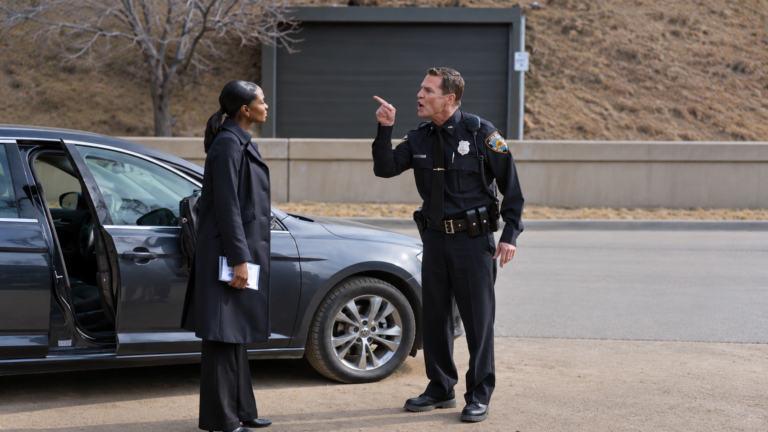
Roth moved to the Route 9 stop.
He asked the chief what traffic offense Young had committed.
Sterling said he believed her rental sedan had drifted near the shoulder.
Roth showed him the contemporaneous dispatch entry.
The entry described a vehicle that seemed out of place.
It said nothing about drifting.
“Why did you leave out the lane violation?” Roth asked.
“I didn’t write every detail into dispatch.”
“Why didn’t you issue a warning?”
“I used discretion.”
“Why did you search her luggage?”
“I was concerned about officer safety.”
“What did the luggage contain that threatened you?”
Sterling looked toward Kessler.
His attorney remained seated.
“I couldn’t know before I checked,” Sterling said.
Roth did not argue with him.
He asked the final question softly.
“Was there anything about that driver, apart from her identity and your dislike of her answers, that justified what you did?”
Sterling gripped the edge of the witness box.
“I acted in good faith.”
The answer did not identify a single fact.
When he stepped down, the courtroom remained quiet.
Judge Whitaker did not decide the entire case that afternoon.
She explained that preliminary hearings were not substitutes for trials and that contested allegations would require fuller examination.
Then she ruled on the immediate requests.
The city was ordered to preserve identified patrol footage, dispatch data, reimbursement records, contractor communications, and relevant personnel materials.
The court imposed temporary safeguards against impounds unsupported by documented legal grounds and required prompt review of vehicles held under disputed police orders.
It also directed the parties to establish a procedure for reporting suspected retaliation against witnesses and employees cooperating with the inquiry.
The judge did not announce that Sterling was guilty of every accusation.
She found sufficient grounds for interim protections and further scrutiny.
She was especially concerned that an administrative program had treated the number of removed vehicles as proof of public safety without adequately checking why they had been removed.
“A statistic is not a justification,” she said.
“An invoice is not a lawful basis to seize a person’s property.”
Sterling sat rigidly as the judge read the remaining provisions.
His lawyer placed a hand on his sleeve to keep him from standing during the ruling.
Outside the courtroom, the press surrounded the attorneys.
Young declined to discuss the merits beyond her testimony.
“The judge has issued an order,” she said.
“The process continues, and the affected residents deserve privacy and a fair hearing.”
A reporter asked whether she felt vindicated.
Young glanced at Marisol, who was waiting with her husband near the corridor doors.
“I am relieved that people who could not get anyone to listen are being heard,” she answered.
She did not call it victory.
A court order could stop certain practices while the litigation continued.
It could not return every lost shift, explain every frightening encounter, or repair every relationship damaged by public humiliation.