Bradley Hayes attended his first interview with federal investigators on a cold Monday morning.
A union attorney sat beside him while Priya and a second investigator asked about the Route 9 stop.
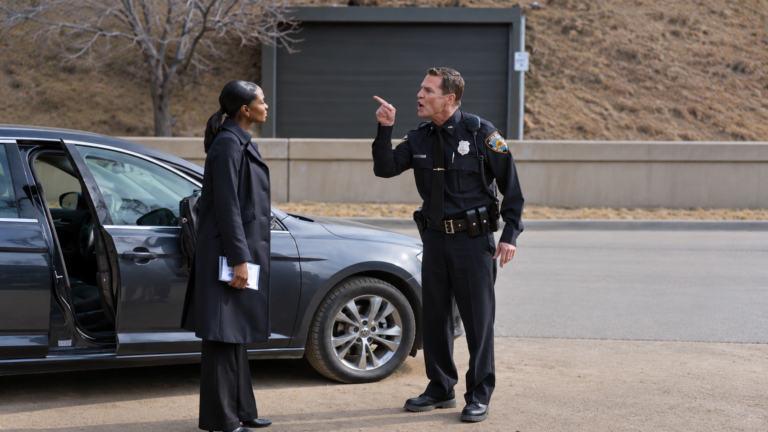
Hayes described the moment Sterling approached Young’s rental sedan.
He confirmed that the driver’s papers were valid and that she had complied with instructions.
“Did you hear Chief Sterling identify a traffic violation?” Priya asked.
“No, ma’am.”
“Did you see any evidence of a weapon or illegal substance?”
“No.”
“What did the chief tell you about the stop before you arrived?”
Hayes rubbed his thumb along the edge of his notebook.
“He said the car looked out of place and that we were going to teach the driver respect.”
His attorney glanced at him but did not interrupt.
“Was there a safety reason to remove the luggage?”
“Not that I observed.”
“Why didn’t you help the driver retrieve it?”
Hayes swallowed.
“The chief ordered me not to.”
“Did you think the order was appropriate?”
“No.”
The answer came out quietly but without a qualification.
Priya paused before asking the next question.
“Did you do anything to stop him?”
“No.”
Hayes looked directly at her.
“I should have.”
He then described two unrelated traffic encounters in which he had been told to complete forms for vehicle removals he considered unnecessary.
His notebook contained dates, patrol numbers, and the names of other officers present.
The investigators warned him that notes alone would need corroboration.
He understood.
He was not asking them to make his testimony the entire case.
When the interview ended, his attorney asked for a break.
Hayes stepped into the hallway and leaned against the wall.
A vending machine hummed near the elevators.
He wanted to call his father and report that he had told the truth.
Instead, he looked at the ceiling and waited until he could breathe normally.
A young custodial worker pushed a cart past him.
She smiled and said good morning.
Hayes answered, then realized how ordinary the hallway appeared.
No music announced what he had done.
No supervisor emerged to congratulate him.
He had answered questions under oath, and now he would have to live with whatever followed.
Caleb Foster found the financial connection two days before the hearing.
Corridor Metrics had been established by a former police department administrator named Jeffrey Sloan.
Sloan had left the city payroll six months before the company received its first contract.
He was married to Wade Larkin’s sister, but that fact alone did not prove misconduct.
The important detail appeared in the payment approvals.
Sloan billed the city for verifying intervention statistics that his office had received directly from Crestwood Recovery.
The supposed verification process involved comparing each tow receipt with a duplicate copy of the same receipt.
The company had charged more than two hundred thousand dollars over several years for the service.
Priya examined a diagram Caleb had prepared.
“What does the city contract require?”
“Independent review of whether the intervention met program rules.”
“Did Sloan’s office review police reports?”
“We have no evidence that it did.”
“Then the service they billed for may not have been delivered.”
Caleb nodded.
Their investigative team had also located a set of messages showing that Sterling asked Sloan to reclassify several removals after a quarterly performance target was missed.
The messages did not show cash being handed to the chief.
They showed pressure to convert questionable actions into successful program events.
“We need to be careful not to call this bribery without proof,” Priya said.
“It’s still a serious procurement problem.”
“And it may explain why the department resisted correcting its numbers.”
Roth reviewed their findings with the assigned prosecutor handling financial allegations.
He decided that the imminent civil hearing should focus on preserving records, preventing retaliation, and addressing ongoing seizures.
Potential criminal charges would be reviewed separately.
“I don’t want a judge thinking we have bundled every accusation into a theatrical reveal,
” he told Priya.
“We can establish the pattern without exaggerating it.”
That afternoon, the court received a motion from Sterling’s lawyer asking to exclude testimony about the Route 9 stop.
The motion argued that Young Jenkins had an institutional conflict and had deliberately provoked an encounter.
Roth read the filing twice.
“They are trying to turn an ordinary driver’s conduct into a conspiracy because of her job,” he said.
Priya handed him the rental booking confirmation.
Young had reserved the car before the regional schedule was finalized.
The traffic stop occurred outside her assigned meetings, and the footage showed no provocation.
Roth knew that the motion could still complicate the hearing.
He drafted a response explaining that Young had been screened from investigatory decisions and would testify as a fact witness about her own experience.
Her title did not entitle her to favorable treatment.
It also did not erase the ordinary rights she possessed before the chief knew her name.
On Wednesday morning, Marisol received a call from Crestwood Recovery.
A clerk said her van could be released if she signed a document resolving all complaints about the tow.
Marisol asked the clerk to repeat that condition.
“It’s just a standard form,
” the clerk said.
“I want my lawyer to see it.”
“That could delay things.”
“Then it will be delayed.”
She hung up with tears of frustration burning behind her eyes.
At legal aid, Nia Palmer read the release and pointed to a paragraph near the bottom.
It would have waived claims arising from the impound in exchange for release of a vehicle the company had no independent right to keep once the police hold was lifted.
“We will challenge this,” Nia said.
“Can they make us pay more?” Marisol asked.
“They may try.”
“Then I can’t win.”
Nia pushed the paper away.
“You have already done more than you should have had to do.”
Luis squeezed his wife’s shoulder.
The following afternoon, after an emergency conference between counsel, the company agreed to release the van without requiring the disputed waiver.
The fee dispute remained unresolved.
Marisol drove to the storage yard with Luis and Nia.
Wade Larkin stood beside a row of cars with keys in his hand.
“Here you go,” he said, as though he were performing a courtesy.
Marisol inspected the van before touching the keys.
The driver’s seat was damp, the fuel level was lower than when it had been taken,
and the red mitten was still beneath the rear wiper.
She photographed the condition and recorded the mileage.
When she started the engine, it coughed and then steadied.
Luis leaned through the window.
“Are you ready?”
“I think so.”
She drove slowly out of the lot and stopped at the first safe place.
For several seconds she sat with her hands on the wheel.
Then she called the school office and confirmed that she would collect her children herself.
The school secretary sounded relieved.
“They’ve been asking every day,” she said.
Marisol looked at the vehicle’s worn dashboard.
“Tell them I’m coming.
”
She knew her case was not finished.
She also knew what the engine under her hands meant.
Sterling spent the final week before the hearing trying to maintain his ordinary schedule.
He attended a neighborhood meeting and thanked residents for their support.
He posed beside a donated bicycle at the police station.
He gave an interview in which he blamed outsiders for manufacturing outrage.
But every public appearance seemed to create another question.
A woman asked whether the department had received a financial benefit from towing her brother’s car.
A mechanic asked why officers ignored his offer to repair a stranded vehicle before ordering a tow.
A retired firefighter wanted to know who had authorized the road safety reimbursement scheme.
Sterling answered with general statements about procedures.
The people asking questions had documents.
At headquarters, Deputy Quinn noticed that officers who once avoided difficult conversations were beginning to compare experiences.
Some defended the chief, saying he had kept order through years of underfunding.
Others remembered stops they had regretted but never reported.
The division was painful.
Quinn arranged a briefing about record retention and witness protections.
She told every officer that they must preserve relevant material and answer authorized requests accurately.
A senior sergeant asked whether the briefing was an admission that the department had done something wrong.
“It’s an admission that we are subject to the law,” Quinn replied.
Hayes stood near the back of the room.
Several colleagues refused to meet his eyes.
One officer quietly patted his shoulder as everyone filed out.
Neither gesture changed his responsibility.
That night, Hayes received notice that he had been removed from field training assignments pending an internal review.
The stated reason was scheduling needs.
His attorney asked the city to preserve the decision process in case it proved retaliatory.
Hayes took his uniform shirt from the closet and folded it for the next day.
He was worried about his career.
He was also relieved that he would not have to ride beside Sterling on Route 9 again.
Three weeks after the traffic stop, Richard Sterling entered the federal courthouse wearing a dark blue suit.
His attorney, Martin Kessler, walked beside him carrying a narrow trial case.
Reporters gathered near the security checkpoint.
Sterling answered only one question.
“I have served this community honorably,” he said.
“The facts will show that.”
Inside the courtroom, he sat at the defense table and watched the other parties assemble.
Marisol Vega sat beside Luis in the first row.
Ellen Moss took a seat near her attorney.
Deputy Quinn stood quietly along the back wall.
Hayes arrived without his uniform and sat several rows away from his former supervisor.
Sterling noticed him and turned back toward the front.
A court officer asked everyone to rise as the judge entered.
Judge Elaine Whitaker reviewed the matters set for argument.
The hearing concerned preservation, preliminary relief, and the scope of evidence regarding an alleged pattern of unlawful stops and impounds.
Then the side doors opened again.
Young Jenkins entered carrying a leather briefcase marked with a gold federal seal.
She wore a charcoal suit and moved with the controlled pace of someone who had spent years inside courtrooms.
David Roth rose to greet her.
Kessler stopped speaking in the middle of a sentence.
Sterling looked from Young to the gold seal and back again.
He recognized the woman who had picked her clothes out of the mud.
He did not recognize the woman whose title appeared on the court’s witness schedule.
The clerk confirmed her identity.
Judge Whitaker addressed her as Director Jenkins when explaining the conditions for her later testimony.
Sterling leaned toward his lawyer.
“Director of what?” he whispered.
Kessler’s jaw tightened.
“Federal oversight,” he answered.
Sterling stared at the back of Young’s chair.
She did not turn to look at him.
The chief seemed to expect a confrontation or a triumphant smile.
Instead, Young opened a notebook and waited for the court to begin.
Kessler requested a brief recess to review the witness schedule.
Judge Whitaker allowed five minutes.
When the lawyers moved toward the side conference room, Sterling followed them in disbelief.
“She was working undercover?” he demanded.
“The government says she was traveling for meetings,” Kessler replied.
“Then why wasn’t I told?”
His attorney looked at him sharply.
“Because she had no obligation to tell you her job before you treated her lawfully.”
Sterling began to speak, then stopped.
For the first time since the hearing began, he could not find an answer that improved his position.