“He may have hoped she’d agree once she arrived,” Megan said. “He knows how to make refusing difficult. A room full of people smiling. Someone lifting a camera. A waiter bringing flowers. He makes decisions look inevitable by arranging the furniture first.”
Lauren recalled Reid asking about her childhood ambition to become a costume designer. He had wanted photographs of her early work, images she assumed he was collecting because he cared. He had asked whether she still owned the blue dress she wore when they first met, whether Owen knew their old song, whether she regretted the quiet life she had chosen. Her answers had been intimate and sometimes unkind. She imagined those words repeated under warm lights to strangers who had bought tickets to admire her bravery.
“What else did you bring?” Owen asked.
Megan took out a notebook. She opened it to a page containing six names, each beside a time and a short description. “These are employees who’ve been told tonight is an ordinary paid event. They aren’t responsible for his stories. I don’t want them caught in a scene they don’t understand.”
Lauren looked at the names. A server, a bartender, a photographer, two kitchen assistants, and a young events coordinator. Under the last name Megan had written: Thinks this is a surprise vow renewal. Lauren’s anger finally found an object. The surprise wasn’t merely the audience. Reid had told different people different stories, so each would perform one small part of a fiction he alone could see.
Owen’s phone buzzed. His lawyer had sent a routine reply to a question he asked that afternoon. He silenced it without reading. The three of them sat with the strange realization that their private confrontation had acquired witnesses before any of them knew it existed.
“What do you want from us?” Owen asked Megan.
“First, I want Lauren to understand what she’s walking into. Second, I want the people who’ve paid to be told what the event actually is. Third, I want to talk to my husband without being made into the unreasonable woman ruining his work.”
“You have reasons to ruin his work,” Lauren muttered.
“I have reasons to stop his lies. That’s not the same thing.”
The distinction embarrassed Lauren because she’d arrived in the hallway planning to call Owen’s objection an attempt to control her. Now Megan was standing in her kitchen carefully separating accountability from revenge. Lauren could not remember when she had last made such an effort herself.
“Will you come?” Megan asked.
Owen looked at Lauren. “That’s her decision.”
“I’m asking both of you,” Megan replied. “He has spent weeks creating a story about all four of us. I don’t think any one of us should let him decide the ending alone.”
Chapter Three: Different Versions of Friday
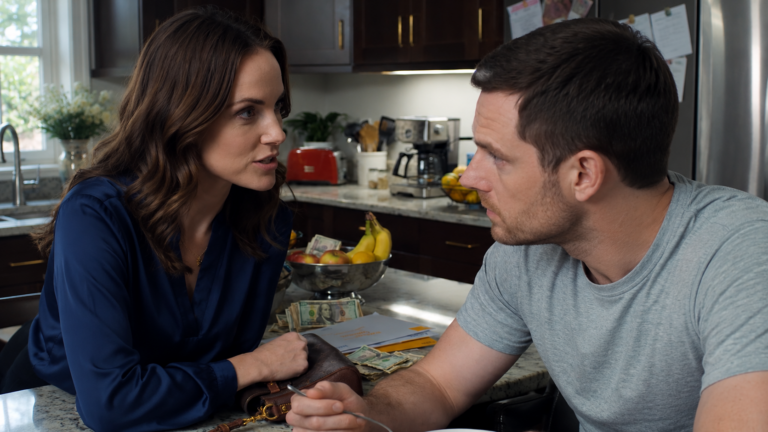
They did not leave immediately. Owen made tea, partly because Megan’s fingers were cold and partly because all three needed an ordinary action that would not become a declaration. Lauren pushed her untouched cup aside and asked how Megan had learned the truth.
“A florist called,” Megan said. “Reid gave her my number because I usually handle the restaurant accounts. She wanted to confirm the spelling of your name on an arrangement. I asked what arrangement. She said the reunion centerpiece for Friday.”
“And you believed her?”
“I believed she was confirming an order. That was a start.”
Megan described spending the next two days visiting the restaurant when Reid was away, speaking to people who thought she knew about the event. The events coordinator showed her a seating chart. A cook asked whether the menu should have dishes from Reid’s first restaurant. A cleaner said the back room had been fitted with a temporary curtain behind which the guest could change clothes. Each conversation was ordinary on its own. Together they revealed a plan that had been concealed from the two women whose lives it was supposed to celebrate.
“Why didn’t you call me first?” Lauren asked.
“I tried. The number he gave me was missing a digit. When I asked him to correct it, he said you were sensitive and didn’t want me involved. Then yesterday he told me you’d agreed to speak about the courage of leaving a loveless marriage. I asked how he knew yours was loveless. He said you told him.”
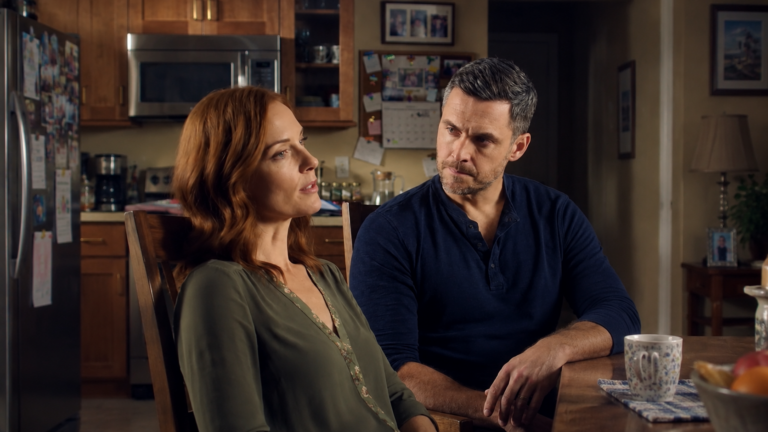
Lauren looked at Owen. He was studying the wooden grain of the table, not offering her an opening to defend herself. That was somehow worse than an argument.
“I said we were distant,” Lauren admitted. “I said I felt unseen. I said we sometimes ate dinner without talking because we were both tired.”
“All of that is true,” Owen said.
“I also told Reid you wouldn’t understand why I wanted to design costumes professionally again.”
Owen lifted his head. “You never told me you wanted to try.”
“You asked me last year whether I could take extra shifts at the clinic.”
“Because we were paying for the roof after the hailstorm. I asked if it was possible, not whether it was your destiny.”
“I heard it as the same thing.”
Megan looked between them and did not interrupt. The room was suddenly full of small, ordinary injuries, none dramatic enough to sell tickets and all substantial enough to affect a marriage.
Owen set his mug down. “I knew you were unhappy. I didn’t know you were treating our marriage like a story you needed somebody else to rescue you from.”
Lauren started to object, then stopped. Reid had repeatedly described himself as the one person who saw her clearly. That idea had flattered her precisely because it spared her from the work of speaking plainly at home. She had allowed herself to believe that being understood by someone who called every evening was more meaningful than making herself understood by someone who lived beside her.
Megan’s own story was less tidy. She and Reid had married nine years earlier when his second restaurant was failing. She had trained as an accountant but spent six years handling schedules, vendors, and payroll while he pursued new concepts. The restaurant survived, and Reid gradually began describing himself as the visionary who had carried it through disaster. She had let that pass because correcting him in public always became a fight at home.
“A year ago,” Megan said, “I told him I wanted to go back to work outside the business. He said of course. Then every time I scheduled an interview, something urgent happened at the restaurant. A refrigerator failed. A delivery didn’t arrive. Someone needed payroll fixed. I kept choosing the immediate problem. That’s my part of it. I should have stopped choosing.”
“Do you want to leave him?” Lauren asked.
“I haven’t decided. But I am not helping him put you on display while he asks an audience to applaud him for having rediscovered romance.”
At seven-fifteen, Reid sent Lauren a photograph of a closed side door decorated with white flowers. Underneath he wrote: Trust me, tonight changes everything.
She showed it to Megan, then Owen. Megan closed her eyes briefly. “Those flowers were ordered for my birthday last month. He told me the florist lost them.”
The table went silent.
Owen looked at his wife. “You can still stay here. He doesn’t need an audience, and you don’t owe him an explanation tonight.”
“I owe him a refusal,” Lauren said.
“You can send it from this room.”
“He can still tell those people whatever he likes. Some of them paid to hear me speak. If I don’t show up, he’ll say I lost my nerve.”
Megan looked at her carefully. “You’re thinking about how he will describe you. That’s how this works. He makes the story seem more important than the choice.”
Lauren took a long breath. “Then we don’t give him a scene he can sell. We tell the staff the truth before the guests arrive. We ask for the microphones to be switched off. And we let people leave.”
“Who says he allows that?” Owen asked.
Megan opened her notebook to the events coordinator’s name. “We begin with the people who have keys.”
They made a plan, but it was not one of those satisfying schemes in which everyone knew exactly what would happen. There were uncertainties. They didn’t know who owned the evening’s recordings, whether the guests had signed releases, or how Reid would react when confronted. Owen told Megan he would not enter the restaurant to intimidate anyone. Lauren told Owen she wasn’t asking him to defend her honor. Megan said she wanted both of them to remember that she, too, would be facing her husband.
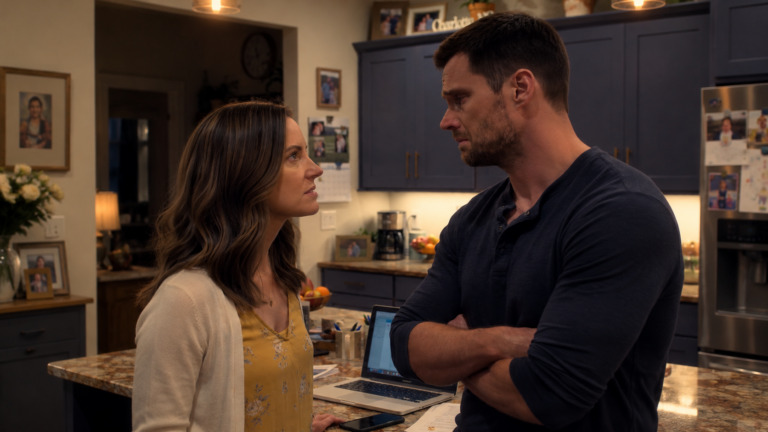
At seven-twenty-five, Lauren took off her coat and changed from high heels into ordinary black boots. When she came downstairs, Owen was waiting by the door. The separation agreement remained unsigned on the table.
“I’m not tearing it up,” he said before she could speak.
“I wasn’t going to ask.”
“Good.” He reached for his car keys. “Then we can deal with tonight without pretending it fixes tomorrow.”